Учебник алгоритмов на Rust
Учебник алгоритмов Algos
Rust — современный системный язык программирования с производительностью, схожей с C/C++, и возможностями низкоуровневой оптимизации, что делает его отличным выбором для написания алгоритмов и решения задач LeetCode.
Учебник Algos охватывает реализации различных распространённых алгоритмов и структур данных, а также решения задач LeetCode. Для соответствующих алгоритмов предоставлена документация и комментарии на русском языке, чтобы помочь вам учиться быстрее и эффективнее.
Об алгоритмах
Алгоритмы — это громкое слово, которое в области компьютерных наук может показаться чем-то запредельным. Но на самом деле в алгоритмах нет ничего таинственного. Когда мы пишем код, мы постоянно взаимодействуем с алгоритмами, просто большинство из них мы не замечаем, поскольку они хорошо упакованы в библиотеки. Мы лишь подаём данные на вход и получаем результат на выходе. Отсюда следует базовое определение:
Компьютерный алгоритм — это пошаговое описание того, как компьютер преобразует входные данные в требуемый результат. Проще говоря, это процесс преобразования входа в выход.
Если для выполнения задачи достаточно вызвать чужую библиотеку, зачем же нам учить алгоритмы? Ответ прост: собеседования. Шучу. Конечно, собеседования важны, но ещё важнее повышать свой уровень. Изучение алгоритмов углубляет понимание кода: вы узнаете, зачем и как оптимизировать код, а когда действительно понадобится написать алгоритм вручную, у вас будет чёткое представление о том, какой алгоритм выбрать, а не только лишь перебор.
Итак, начнём наше путешествие в мир алгоритмов. В этой главе представлены реализации различных распространённых алгоритмов на Rust. К большинству разделов прилагаются статьи с подробными объяснениями.
Изучение Rust
Если вы знакомы с алгоритмами, но недостаточно знаете Rust, обратитесь к Rust Language Bible — это один из лучших открытых учебников по Rust.
Контрибьюторы
Мы осознаём ограниченность наших знаний и приветствуем вклад разработчиков со всего мира, чтобы вместе создать учебник по алгоритмам, который будет лучшим в мире!
Алгоритмы сортировки
Сортировка — это упорядочивание последовательности записей по возрастанию или убыванию на основе одного или нескольких ключей. Алгоритмы сортировки определяют, как именно записи должны быть упорядочены. Им уделяется большое внимание во многих областях, особенно при обработке больших объёмов данных. Хороший алгоритм способен сэкономить значительные ресурсы. С учётом различных ограничений и требований в каждой области, создание эффективного алгоритма требует тщательного анализа и рассуждений.
Сортировка пузырьком
#![allow(unused)]
fn main() {
pub fn bubble_sort<T: PartialOrd>(arr: &mut [T]) {
    if arr.len() <= 1 {
        return;
    }

    let size = arr.len();
    for i in 0..(size - 1) {
        // Флаг: были ли обмены на этой итерации
        let mut swapped = false;

        // Последние i элементов уже отсортированы
        for j in 1..(size - i) {
            if arr[j - 1] > arr[j] {
                arr.swap(j - 1, j);
                swapped = true;
            }
        }

        // Если обменов не было, массив уже отсортирован
        if !swapped {
            break;
        }
    }
}

#[cfg(test)]
mod tests {
    use super::*;

    #[test]
    fn test_empty_vec() {
        let mut empty_vec: Vec<String> = vec![];
        bubble_sort(&mut empty_vec);
        assert_eq!(empty_vec, Vec::<String>::new());
    }

    #[test]
    fn test_number_vec() {
        let mut vec = vec![7, 49, 73, 58, 30, 72, 44, 78, 23, 9];
        bubble_sort(&mut vec);
        assert_eq!(vec, vec![7, 9, 23, 30, 44, 49, 58, 72, 73, 78]);
    }

    #[test]
    fn test_string_vec() {
        let mut vec = vec![
            String::from("Bob"),
            String::from("David"),
            String::from("Carol"),
            String::from("Alice"),
        ];
        bubble_sort(&mut vec);
        assert_eq!(
            vec,
            vec![
                String::from("Alice"),
                String::from("Bob"),
                String::from("Carol"),
                String::from("David"),
            ]
        );
    }
}
}
Сортировка корзинами
#![allow(unused)]
fn main() {
/// Sort a slice using bucket sort algorithm.
///
/// Time complexity is `O(n + k)` on average, where `n` is the number of elements,
/// `k` is the number of buckets used in process.
///
/// Space complexity is `O(n + k)`, as it sorts not in-place.
pub fn bucket_sort(arr: &[usize]) -> Vec<usize> {
    if arr.is_empty() {
        return vec![];
    }

    let max = *arr.iter().max().unwrap();
    let len = arr.len();
    let mut buckets = vec![vec![]; len + 1];

    for x in arr {
        buckets[len * *x / max].push(*x);
    }

    for bucket in buckets.iter_mut() {
        bucket.sort();
    }

    let mut result = vec![];
    for bucket in buckets {
        for x in bucket {
            result.push(x);
        }
    }

    result
}

#[cfg(test)]
mod tests {
    use super::*;

    fn is_sorted(arr: &[usize]) -> bool {
        arr.windows(2).all(|w| w[0] <= w[1])
    }

    #[test]
    fn empty() {
        let arr: [usize; 0] = [];
        let res = bucket_sort(&arr);
        assert!(is_sorted(&res));
    }

    #[test]
    fn one_element() {
        let arr: [usize; 1] = [4];
        let res = bucket_sort(&arr);
        assert!(is_sorted(&res));
    }

    #[test]
    fn already_sorted() {
        let arr: [usize; 3] = [10, 9, 105];
        let res = bucket_sort(&arr);
        assert!(is_sorted(&res));
    }

    #[test]
    fn basic() {
        let arr: [usize; 4] = [35, 53, 1, 0];
        let res = bucket_sort(&arr);
        assert!(is_sorted(&res));
    }

    #[test]
    fn odd_number_of_elements() {
        let arr: Vec<usize> = vec![1, 21, 5, 11, 58];
        let res = bucket_sort(&arr);
        assert!(is_sorted(&res));
    }

    #[test]
    fn repeated_elements() {
        let arr: Vec<usize> = vec![542, 542, 542, 542];
        let res = bucket_sort(&arr);
        assert!(is_sorted(&res));
    }
}
}
Сортировка перемешиванием
#![allow(unused)]
fn main() {
pub fn cocktail_shaker_sort<T: Ord>(arr: &mut [T]) {
    let len = arr.len();

    if len == 0 {
        return;
    }

    loop {
        let mut swapped = false;

        for i in 0..(len - 1).clamp(0, len) {
            if arr[i] > arr[i + 1] {
                arr.swap(i, i + 1);
                swapped = true;
            }
        }

        if !swapped {
            break;
        }

        swapped = false;

        for i in (0..(len - 1).clamp(0, len)).rev() {
            if arr[i] > arr[i + 1] {
                arr.swap(i, i + 1);
                swapped = true;
            }
        }

        if !swapped {
            break;
        }
    }
}

#[cfg(test)]
mod tests {
    use super::*;

    #[test]
    fn basic() {
        let mut arr = vec![5, 2, 1, 3, 4, 6];
        cocktail_shaker_sort(&mut arr);
        assert_eq!(arr, vec![1, 2, 3, 4, 5, 6]);
    }

    #[test]
    fn empty() {
        let mut arr = Vec::<i32>::new();
        cocktail_shaker_sort(&mut arr);
        assert_eq!(arr, vec![]);
    }

    #[test]
    fn one_element() {
        let mut arr = vec![1];
        cocktail_shaker_sort(&mut arr);
        assert_eq!(arr, vec![1]);
    }

    #[test]
    fn pre_sorted() {
        let mut arr = vec![1, 2, 3, 4, 5, 6];
        cocktail_shaker_sort(&mut arr);
        assert_eq!(arr, vec![1, 2, 3, 4, 5, 6]);
    }
}
}
Сортировка расчёской
#![allow(unused)]
fn main() {
pub fn comb_sort<T: Ord>(arr: &mut [T]) {
    let mut gap = arr.len();
    let shrink = 1.3;
    let mut sorted = false;

    while !sorted {
        gap = (gap as f32 / shrink).floor() as usize;
        if gap <= 1 {
            gap = 1;
            sorted = true;
        }
        for i in 0..arr.len() - gap {
            let j = i + gap;
            if arr[i] > arr[j] {
                arr.swap(i, j);
                sorted = false;
            }
        }
    }
}

#[cfg(test)]
mod tests {
    use super::*;

    #[test]
    fn descending() {
        //descending
        let mut ve1 = vec![6, 5, 4, 3, 2, 1];
        comb_sort(&mut ve1);
        for i in 0..ve1.len() - 1 {
            assert!(ve1[i] <= ve1[i + 1]);
        }
    }

    #[test]
    fn ascending() {
        //pre-sorted
        let mut ve2 = vec![1, 2, 3, 4, 5, 6];
        comb_sort(&mut ve2);
        for i in 0..ve2.len() - 1 {
            assert!(ve2[i] <= ve2[i + 1]);
        }
    }
}
}
Сортировка подсчётом
#![allow(unused)]
fn main() {
/// In place counting sort for collections of u32
/// O(n + maxval) in time, where maxval is the biggest value an input can possibly take
/// O(maxval) in memory
/// u32 is chosen arbitrarly, a counting sort probably should'nt be used on data that requires bigger types.

pub fn counting_sort(arr: &mut [u32], maxval: usize) {
    let mut occurences: Vec<usize> = vec![0; maxval + 1];

    for &data in arr.iter() {
        occurences[data as usize] += 1;
    }

    let mut i = 0;
    for (data, &number) in occurences.iter().enumerate() {
        for _ in 0..number {
            arr[i] = data as u32;
            i += 1;
        }
    }
}

use std::ops::AddAssign;
/// Generic implementation of a counting sort for all usigned types
pub fn generic_counting_sort<T: Into<u64> + From<u8> + AddAssign + Copy>(
    arr: &mut [T],
    maxval: usize,
) {
    let mut occurences: Vec<usize> = vec![0; maxval + 1];

    for &data in arr.iter() {
        occurences[data.into() as usize] += 1;
    }

    // Current index in output array
    let mut i = 0;

    // current data point, necessary to be type-safe
    let mut data = T::from(0);

    // This will iterate from 0 to the largest data point in `arr`
    // `number` contains the occurances of the data point `data`
    for &number in occurences.iter() {
        for _ in 0..number {
            arr[i] = data;
            i += 1;
        }

        data += T::from(1);
    }
}

#[cfg(test)]
mod test {
    use super::super::is_sorted;
    use super::*;

    #[test]
    fn counting_sort_descending() {
        let mut ve1 = vec![6, 5, 4, 3, 2, 1];
        counting_sort(&mut ve1, 6);

        assert!(is_sorted(&ve1));
    }

    #[test]
    fn counting_sort_pre_sorted() {
        let mut ve2 = vec![1, 2, 3, 4, 5, 6];
        counting_sort(&mut ve2, 6);

        assert!(is_sorted(&ve2));
    }

    #[test]
    fn generic_counting_sort() {
        let mut ve1: Vec<u8> = vec![100, 30, 60, 10, 20, 120, 1];
        super::generic_counting_sort(&mut ve1, 120);

        assert!(is_sorted(&ve1));
    }

    #[test]
    fn presorted_u64_counting_sort() {
        let mut ve2: Vec<u64> = vec![1, 2, 3, 4, 5, 6];
        super::generic_counting_sort(&mut ve2, 6);

        assert!(is_sorted(&ve2));
    }
}
}
Гномья сортировка
#![allow(unused)]
fn main() {
use std::cmp;

pub fn gnome_sort<T>(arr: &[T]) -> Vec<T>
where
    T: cmp::PartialEq + cmp::PartialOrd + Clone,
{
    let mut arr = arr.to_vec();
    let mut i: usize = 1;
    let mut j: usize = 2;

    while i < arr.len() {
        if arr[i - 1] < arr[i] {
            i = j;
            j = i + 1;
        } else {
            arr.swap(i - 1, i);
            i -= 1;
            if i == 0 {
                i = j;
                j += 1;
            }
        }
    }
    arr
}

#[cfg(test)]
mod tests {
    use super::*;

    #[test]
    fn basic() {
        let res = gnome_sort(&vec![6, 5, -8, 3, 2, 3]);
        assert_eq!(res, vec![-8, 2, 3, 3, 5, 6]);
    }

    #[test]
    fn already_sorted() {
        let res = gnome_sort(&vec!["a", "b", "c"]);
        assert_eq!(res, vec!["a", "b", "c"]);
    }

    #[test]
    fn odd_number_of_elements() {
        let res = gnome_sort(&vec!["d", "a", "c", "e", "b"]);
        assert_eq!(res, vec!["a", "b", "c", "d", "e"]);
    }

    #[test]
    fn one_element() {
        let res = gnome_sort(&vec![3]);
        assert_eq!(res, vec![3]);
    }

    #[test]
    fn empty() {
        let res = gnome_sort(&Vec::<u8>::new());
        assert_eq!(res, vec![]);
    }
}
}
Пирамидальная сортировка
#![allow(unused)]
fn main() {
pub fn heap_sort<T: PartialOrd>(arr: &mut [T]) {
    let size = arr.len();
    // Построение max-кучи
    for i in (0..size / 2).rev() {
        heapify(arr, i, size);
    }

    // Каждая итерация: перемещаем корень (максимум) в конец
    for i in (1..size).rev() {
        arr.swap(0, i);
        // Восстанавливаем max-кучу
        heapify(arr, 0, i);
    }
}

fn heapify<T: PartialOrd>(arr: &mut [T], root: usize, end: usize) {
    // Индекс наибольшего среди родителя и детей
    let mut largest = root;

    let left_child = 2 * root + 1;
    if left_child < end && arr[left_child] > arr[largest] {
        largest = left_child;
    }

    let right_child = left_child + 1;
    if right_child < end && arr[right_child] > arr[largest] {
        largest = right_child;
    }

    if largest != root {
        arr.swap(root, largest);
        heapify(arr, largest, end);
    }
}

#[cfg(test)]
mod tests {
    use super::*;

    #[test]
    fn test_empty_vec() {
        let mut empty_vec: Vec<String> = vec![];
        heap_sort(&mut empty_vec);
        assert_eq!(empty_vec, Vec::<String>::new());
    }

    #[test]
    fn test_number_vec() {
        let mut vec = vec![7, 49, 73, 58, 30, 72, 44, 78, 23, 9];
        heap_sort(&mut vec);
        assert_eq!(vec, vec![7, 9, 23, 30, 44, 49, 58, 72, 73, 78]);
    }

    #[test]
    fn test_string_vec() {
        let mut vec = vec![
            String::from("Bob"),
            String::from("David"),
            String::from("Carol"),
            String::from("Alice"),
        ];
        heap_sort(&mut vec);
        assert_eq!(
            vec,
            vec![
                String::from("Alice"),
                String::from("Bob"),
                String::from("Carol"),
                String::from("David"),
            ]
        );
    }
}
}
Сортировка вставками
#![allow(unused)]
fn main() {
pub fn insertion_sort<T: PartialOrd>(arr: &mut [T]) {
    // Начинаем со второго элемента
    for i in 1..arr.len() {
        // Ищем позицию для вставки arr[i]
        let mut j = i;
        while j > 0 && arr[j - 1] > arr[j] {
            arr.swap(j - 1, j);
            j -= 1;
        }
    }
}

// Требуется T: Ord из-за ограничения binary_search()
pub fn insertion_sort_binary_search<T: Ord>(arr: &mut[T]) {
    // Начинаем со второго элемента
    for i in 1..arr.len() {
        // Бинарный поиск позиции для вставки arr[i]
        let pos = arr[..i].binary_search(&arr[i]).unwrap_or_else(|pos| pos);
        let mut j = i;
        while j > pos {
            arr.swap(j - 1, j);
            j -= 1;
        }
    }
}

#[cfg(test)]
mod tests {
    use super::*;

    mod insertion_sort {
        use super::*;

        #[test]
        fn test_empty_vec() {
            let mut empty_vec: Vec<String> = vec![];
            insertion_sort(&mut empty_vec);
            assert_eq!(empty_vec, Vec::<String>::new());
        }

        #[test]
        fn test_number_vec() {
            let mut vec = vec![7, 49, 73, 58, 30, 72, 44, 78, 23, 9];
            insertion_sort(&mut vec);
            assert_eq!(vec, vec![7, 9, 23, 30, 44, 49, 58, 72, 73, 78]);
        }

        #[test]
        fn test_string_vec() {
            let mut vec = vec![
                String::from("Bob"),
                String::from("David"),
                String::from("Carol"),
                String::from("Alice"),
            ];
            insertion_sort(&mut vec);
            assert_eq!(
                vec,
                vec![
                    String::from("Alice"),
                    String::from("Bob"),
                    String::from("Carol"),
                    String::from("David"),
                ]
            );
        }
    }

    mod insertion_sort_binary_search {
        use super::*;

        #[test]
        fn test_empty_vec() {
            let mut empty_vec: Vec<String> = vec![];
            insertion_sort_binary_search(&mut empty_vec);
            assert_eq!(empty_vec, Vec::<String>::new());
        }

        #[test]
        fn test_number_vec() {
            let mut vec = vec![7, 49, 73, 58, 30, 72, 44, 78, 23, 9];
            insertion_sort_binary_search(&mut vec);
            assert_eq!(vec, vec![7, 9, 23, 30, 44, 49, 58, 72, 73, 78]);
        }

        #[test]
        fn test_string_vec() {
            let mut vec = vec![
                String::from("Bob"),
                String::from("David"),
                String::from("Carol"),
                String::from("Alice"),
            ];
            insertion_sort_binary_search(&mut vec);
            assert_eq!(
                vec,
                vec![
                    String::from("Alice"),
                    String::from("Bob"),
                    String::from("Carol"),
                    String::from("David"),
                ]
            );
        }
    }
}
}
Сортировка слиянием
#![allow(unused)]
fn main() {
pub fn merge_sort<T>(arr: &mut [T])
where
    T: PartialOrd + Clone + Default,
{
    if arr.len() > 1 {
        merge_sort_range(arr, 0, arr.len() - 1);
    }
}

fn merge_sort_range<T>(arr: &mut [T], lo: usize, hi: usize)
where
    T: PartialOrd + Clone + Default,
{
    // Сортируем только если больше одного элемента
    if lo < hi {
        let mid = lo + ((hi - lo) >> 1);
        merge_sort_range(arr, lo, mid);
        merge_sort_range(arr, mid + 1, hi);
        merge_two_arrays(arr, lo, mid, hi);
    }
}

// Слияние двух отсортированных подмассивов: arr[lo..=mid], arr[mid + 1..=hi]
fn merge_two_arrays<T>(arr: &mut [T], lo: usize, mid: usize, hi: usize)
where
    T: PartialOrd + Clone + Default,
{
    // Необходимо клонировать элементы массива
    let mut arr1 = arr[lo..=mid].to_vec();
    let mut arr2 = arr[mid + 1..=hi].to_vec();

    let (mut i, mut j) = (0, 0);
    while i < arr1.len() && j < arr2.len() {
        if arr1[i] < arr2[j] {
            arr[i + j + lo] = std::mem::take(&mut arr1[i]);
            i += 1;
        } else {
            arr[i + j + lo] = std::mem::take(&mut arr2[j]);
            j += 1;
        }
    }

    while i < arr1.len() {
        arr[i + j + lo] = std::mem::take(&mut arr1[i]);
        i += 1;
    }

    while j < arr2.len() {
        arr[i + j + lo] = std::mem::take(&mut arr2[j]);
        j += 1;
    }
}

#[cfg(test)]
mod tests {
    use super::*;

    #[test]
    fn test_empty_vec() {
        let mut empty_vec: Vec<String> = vec![];
        merge_sort(&mut empty_vec);
        assert_eq!(empty_vec, Vec::<String>::new());
    }

    #[test]
    fn test_number_vec() {
        let mut vec = vec![7, 49, 73, 58, 30, 72, 44, 78, 23, 9];
        merge_sort(&mut vec);
        assert_eq!(vec, vec![7, 9, 23, 30, 44, 49, 58, 72, 73, 78]);
    }

    #[test]
    fn test_string_vec() {
        let mut vec = vec![
            String::from("Bob"),
            String::from("David"),
            String::from("Carol"),
            String::from("Alice"),
        ];
        merge_sort(&mut vec);
        assert_eq!(
            vec,
            vec![
                String::from("Alice"),
                String::from("Bob"),
                String::from("Carol"),
                String::from("David"),
            ]
        );
    }
}
}
Чётно-нечётная сортировка
#![allow(unused)]
fn main() {
pub fn odd_even_sort<T: Ord>(arr: &mut [T]) {
    let len = arr.len();
    if len == 0 {
        return;
    }

    let mut sorted = false;
    while !sorted {
        sorted = true;

        for i in (1..len - 1).step_by(2) {
            if arr[i] > arr[i + 1] {
                arr.swap(i, i + 1);
                sorted = false;
            }
        }

        for i in (0..len - 1).step_by(2) {
            if arr[i] > arr[i + 1] {
                arr.swap(i, i + 1);
                sorted = false;
            }
        }
    }
}

#[cfg(test)]
mod tests {
    use super::*;

    #[test]
    fn basic() {
        let mut arr = vec![3, 5, 1, 2, 4, 6];
        odd_even_sort(&mut arr);
        assert_eq!(arr, vec![1, 2, 3, 4, 5, 6]);
    }

    #[test]
    fn empty() {
        let mut arr = Vec::<i32>::new();
        odd_even_sort(&mut arr);
        assert_eq!(arr, vec![]);
    }

    #[test]
    fn one_element() {
        let mut arr = vec![3];
        odd_even_sort(&mut arr);
        assert_eq!(arr, vec![3]);
    }

    #[test]
    fn pre_sorted() {
        let mut arr = vec![0, 1, 2, 3, 4, 5, 6, 7, 8, 9];
        odd_even_sort(&mut arr);
        assert_eq!(arr, vec![0, 1, 2, 3, 4, 5, 6, 7, 8, 9]);
    }
}
}
Быстрая сортировка
#![allow(unused)]
fn main() {
pub fn quick_sort<T: PartialOrd>(arr: &mut [T]) {
    if arr.len() > 1 {
        quick_sort_range(arr, 0, arr.len() - 1);
    }
}

fn quick_sort_range<T: PartialOrd>(arr: &mut [T], lo: usize, hi: usize) {
    // Сортируем только если больше одного элемента
    if lo < hi {
        let pos = partition(arr, lo, hi);
        // let pos = partition_random(arr, lo, hi);
        if pos != 0 {
            // Если pos == 0, вычитание 1 вызовет переполнение
            quick_sort_range(arr, lo, pos - 1);
        }
        quick_sort_range(arr, pos + 1, hi);
    }
}

fn partition<T: PartialOrd>(arr: &mut [T], lo: usize, hi: usize) -> usize {
    // По умолчанию выбираем lo как опорный элемент (pivot)
    let pivot = lo;

    let (mut left, mut right) = (lo, hi);
    while left < right {
        // Ищем справа первый элемент, меньший опорного
        while left < right && arr[right] >= arr[pivot] {
            right -= 1;
        }

        // Ищем слева первый элемент, больший опорного
        while left < right && arr[left] <= arr[pivot] {
            left += 1;
        }

        // Меняем найденные элементы
        if left != right {
            arr.swap(left, right);
        }
    }

    arr.swap(pivot, left);

    // Возвращаем правильную позицию разделения
    left
}

// Выбор среднего элемента как опорного
fn partition_random<T: PartialOrd>(arr: &mut [T], lo: usize, hi: usize) -> usize {
    let pivot = lo + (hi - lo) / 2;

    // Меняем lo и pivot местами, чтобы pivot оказался на позиции lo
    // Дальнейшие операции совпадают с partition()
    arr.swap(lo, pivot);

    let pivot = lo;
    let (mut left, mut right) = (lo, hi);
    while left < right {
        // Ищем справа первый элемент, меньший опорного
        while left < right && arr[right] >= arr[pivot] {
            right -= 1;
        }

        // Ищем слева первый элемент, больший опорного
        while left < right && arr[left] <= arr[pivot] {
            left += 1;
        }

        // Меняем найденные элементы
        if left != right {
            arr.swap(left, right);
        }
    }

    arr.swap(pivot, left);

    // Возвращаем правильную позицию разделения
    left
}

#[cfg(test)]
mod tests {
    use super::*;

    #[test]
    fn test_empty_vec() {
        let mut empty_vec: Vec<String> = vec![];
        quick_sort(&mut empty_vec);
        assert_eq!(empty_vec, Vec::<String>::new());
    }

    #[test]
    fn test_number_vec() {
        let mut vec = vec![7, 49, 73, 58, 30, 72, 44, 78, 23, 9];
        quick_sort(&mut vec);
        assert_eq!(vec, vec![7, 9, 23, 30, 44, 49, 58, 72, 73, 78]);
    }

    #[test]
    fn test_string_vec() {
        let mut vec = vec![
            String::from("Bob"),
            String::from("David"),
            String::from("Carol"),
            String::from("Alice"),
        ];
        quick_sort(&mut vec);
        assert_eq!(
            vec,
            vec![
                String::from("Alice"),
                String::from("Bob"),
                String::from("Carol"),
                String::from("David"),
            ]
        );
    }
}
}
Поразрядная сортировка
#![allow(unused)]
fn main() {
/// Sorts the elements of `arr` in-place using radix sort.
///
/// Time complexity is `O((n + b) * logb(k))`, where `n` is the number of elements,
/// `b` is the base (the radix), and `k` is the largest element.
/// When `n` and `b` are roughly the same maginitude, this algorithm runs in linear time.
///
/// Space complexity is `O(n + b)`.
pub fn radix_sort(arr: &mut [u64]) {
    let max: usize = match arr.iter().max() {
        Some(&x) => x as usize,
        None => return,
    };
    // Make radix a power of 2 close to arr.len() for optimal runtime
    let radix = arr.len().next_power_of_two();
    // Counting sort by each digit from least to most significant
    let mut place = 1;
    while place <= max {
        let digit_of = |x| x as usize / place % radix;
        // Count digit occurrences
        let mut counter = vec![0; radix];
        for &x in arr.iter() {
            counter[digit_of(x)] += 1;
        }
        // Compute last index of each digit
        for i in 1..radix {
            counter[i] += counter[i - 1];
        }
        // Write elements to their new indices
        for &x in arr.to_owned().iter().rev() {
            counter[digit_of(x)] -= 1;
            arr[counter[digit_of(x)]] = x;
        }
        place *= radix;
    }
}

#[cfg(test)]
mod tests {
    use super::super::is_sorted;
    use super::radix_sort;

    #[test]
    fn empty() {
        let mut a: [u64; 0] = [];
        radix_sort(&mut a);
        assert!(is_sorted(&a));
    }

    #[test]
    fn descending() {
        let mut v = vec![201, 127, 64, 37, 24, 4, 1];
        radix_sort(&mut v);
        assert!(is_sorted(&v));
    }

    #[test]
    fn ascending() {
        let mut v = vec![1, 4, 24, 37, 64, 127, 201];
        radix_sort(&mut v);
        assert!(is_sorted(&v));
    }
}
}
Сортировка выбором
#![allow(unused)]
fn main() {
pub fn selection_sort<T: PartialOrd>(arr: &mut [T]) {
    if arr.len() <= 1 {
        return;
    }

    let size = arr.len();
    for i in 0..(size - 1) {
        // Находим индекс минимального элемента
        let mut min_index = i;
        for j in (i + 1)..size {
            if arr[j] < arr[min_index] {
                min_index = j;
            }
        }

        if min_index != i {
            arr.swap(i, min_index);
        }
    }
}

#[cfg(test)]
mod tests {
    use super::*;

    #[test]
    fn test_empty_vec() {
        let mut empty_vec: Vec<String> = vec![];
        selection_sort(&mut empty_vec);
        assert_eq!(empty_vec, Vec::<String>::new());
    }

    #[test]
    fn test_number_vec() {
        let mut vec = vec![7, 49, 73, 58, 30, 72, 44, 78, 23, 9];
        selection_sort(&mut vec);
        assert_eq!(vec, vec![7, 9, 23, 30, 44, 49, 58, 72, 73, 78]);
    }

    #[test]
    fn test_string_vec() {
        let mut vec = vec![
            String::from("Bob"),
            String::from("David"),
            String::from("Carol"),
            String::from("Alice"),
        ];
        selection_sort(&mut vec);
        assert_eq!(
            vec,
            vec![
                String::from("Alice"),
                String::from("Bob"),
                String::from("Carol"),
                String::from("David"),
            ]
        );
    }
}
}
Сортировка Шелла
#![allow(unused)]
fn main() {
pub fn shell_sort<T: Ord + Copy>(values: &mut Vec<T>) {
    // shell sort works by swiping the value at a given gap and decreasing the gap to 1
    fn insertion<T: Ord + Copy>(values: &mut Vec<T>, start: usize, gap: usize) {
        for i in ((start + gap)..values.len()).step_by(gap) {
            let val_current = values[i];
            let mut pos = i;
            // make swaps
            while pos >= gap && values[pos - gap] > val_current {
                values[pos] = values[pos - gap];
                pos -= gap;
            }
            values[pos] = val_current;
        }
    }

    let mut count_sublist = values.len() / 2; // makes gap as long as half of the array
    while count_sublist > 0 {
        for pos_start in 0..count_sublist {
            insertion(values, pos_start, count_sublist);
        }
        count_sublist /= 2; // makes gap as half of previous
    }
}

#[cfg(test)]
mod test {
    use super::shell_sort;

    #[test]
    fn basic() {
        let mut vec = vec![3, 5, 6, 3, 1, 4];
        shell_sort(&mut vec);
        for i in 0..vec.len() - 1 {
            assert!(vec[i] <= vec[i + 1]);
        }
    }

    #[test]
    fn empty() {
        let mut vec: Vec<i32> = vec![];
        shell_sort(&mut vec);
        assert_eq!(vec, vec![]);
    }

    #[test]
    fn reverse() {
        let mut vec = vec![6, 5, 4, 3, 2, 1];
        shell_sort(&mut vec);
        for i in 0..vec.len() - 1 {
            assert!(vec[i] <= vec[i + 1]);
        }
    }

    #[test]
    fn already_sorted() {
        let mut vec = vec![1, 2, 3, 4, 5, 6];
        shell_sort(&mut vec);
        for i in 0..vec.len() - 1 {
            assert!(vec[i] <= vec[i + 1]);
        }
    }
}
}
Сортировка по частям
#![allow(unused)]
fn main() {
fn _stooge_sort<T: Ord>(arr: &mut [T], start: usize, end: usize) {
    if arr[start] > arr[end] {
        arr.swap(start, end);
    }

    if start + 1 >= end {
        return;
    }

    let k = (end - start + 1) / 3;

    _stooge_sort(arr, start, end - k);
    _stooge_sort(arr, start + k, end);
    _stooge_sort(arr, start, end - k);
}

pub fn stooge_sort<T: Ord>(arr: &mut [T]) {
    let len = arr.len();
    if len == 0 {
        return;
    }

    _stooge_sort(arr, 0, len - 1);
}

#[cfg(test)]
mod test {
    use super::*;

    #[test]
    fn basic() {
        let mut vec = vec![3, 5, 6, 3, 1, 4];
        stooge_sort(&mut vec);
        for i in 0..vec.len() - 1 {
            assert!(vec[i] <= vec[i + 1]);
        }
    }

    #[test]
    fn empty() {
        let mut vec: Vec<i32> = vec![];
        stooge_sort(&mut vec);
        assert_eq!(vec, vec![]);
    }

    #[test]
    fn reverse() {
        let mut vec = vec![6, 5, 4, 3, 2, 1];
        stooge_sort(&mut vec);
        for i in 0..vec.len() - 1 {
            assert!(vec[i] <= vec[i + 1]);
        }
    }

    #[test]
    fn already_sorted() {
        let mut vec = vec![1, 2, 3, 4, 5, 6];
        stooge_sort(&mut vec);
        for i in 0..vec.len() - 1 {
            assert!(vec[i] <= vec[i + 1]);
        }
    }
}
}
Строки
Алгоритмы, связанные со строками, часто имеют дело с поиском подстрок и изменением порядка. Эффективная обработка строк иногда становится ключевым фактором производительности программы.
Разворот строки
#![allow(unused)]
fn main() {
pub fn reverse(text: &str) -> String {
    text.chars().rev().collect()
}

#[cfg(test)]
mod tests {
    use super::*;

    #[test]
    fn test_simple() {
        assert_eq!(reverse("racecar"), "racecar");
    }

    #[test]
    fn test_sentence() {
        assert_eq!(reverse("step on no pets"), "step on no pets");
    }
}
}
Преобразование Барроуза — Уиллера
#![allow(unused)]
fn main() {
pub fn burrows_wheeler_transform(input: String) -> (String, usize) {
    let len = input.len();

    let mut table = Vec::<String>::with_capacity(len);
    for i in 0..len {
        table.push(input[i..].to_owned() + &input[..i]);
    }
    table.sort_by_key(|a| a.to_lowercase());

    let mut encoded = String::new();
    let mut index: usize = 0;
    for (i, item) in table.iter().enumerate().take(len) {
        encoded.push(item.chars().last().unwrap());
        if item.eq(&input) {
            index = i;
        }
    }

    (encoded, index)
}

pub fn inv_burrows_wheeler_transform(input: (String, usize)) -> String {
    let len = input.0.len();
    let mut table = Vec::<(usize, char)>::with_capacity(len);
    for i in 0..len {
        table.push((i, input.0.chars().nth(i).unwrap()));
    }

    table.sort_by(|a, b| a.1.cmp(&b.1));

    let mut decoded = String::new();
    let mut idx = input.1;
    for _ in 0..len {
        decoded.push(table[idx].1);
        idx = table[idx].0;
    }

    decoded
}

#[cfg(test)]
mod tests {
    use super::*;

    #[test]
    fn basic() {
        assert_eq!(
            inv_burrows_wheeler_transform(burrows_wheeler_transform("CARROT".to_string())),
            "CARROT"
        );
        assert_eq!(
            inv_burrows_wheeler_transform(burrows_wheeler_transform("TOMATO".to_string())),
            "TOMATO"
        );
        assert_eq!(
            inv_burrows_wheeler_transform(burrows_wheeler_transform("THISISATEST".to_string())),
            "THISISATEST"
        );
        assert_eq!(
            inv_burrows_wheeler_transform(burrows_wheeler_transform("THEALGORITHMS".to_string())),
            "THEALGORITHMS"
        );
        assert_eq!(
            inv_burrows_wheeler_transform(burrows_wheeler_transform("RUST".to_string())),
            "RUST"
        );
    }

    #[test]
    fn special_characters() {
        assert_eq!(
            inv_burrows_wheeler_transform(burrows_wheeler_transform("!.!.!??.=::".to_string())),
            "!.!.!??.=::"
        );
        assert_eq!(
            inv_burrows_wheeler_transform(burrows_wheeler_transform(
                "!{}{}(((&&%%!??.=::".to_string()
            )),
            "!{}{}(((&&%%!??.=::"
        );
        assert_eq!(
            inv_burrows_wheeler_transform(burrows_wheeler_transform("//&$[]".to_string())),
            "//&$[]"
        );
    }

    #[test]
    fn empty() {
        assert_eq!(
            inv_burrows_wheeler_transform(burrows_wheeler_transform("".to_string())),
            ""
        );
    }
}
}
Алгоритм Кнута — Морриса — Пратта
#![allow(unused)]
fn main() {
pub fn knuth_morris_pratt(st: String, pat: String) -> Vec<usize> {
    if st.is_empty() || pat.is_empty() {
        return vec![];
    }

    let string = st.into_bytes();
    let pattern = pat.into_bytes();

    // build the partial match table
    let mut partial = vec![0];
    for i in 1..pattern.len() {
        let mut j = partial[i - 1];
        while j > 0 && pattern[j] != pattern[i] {
            j = partial[j - 1];
        }
        partial.push(if pattern[j] == pattern[i] { j + 1 } else { j });
    }

    // and read 'string' to find 'pattern'
    let mut ret = vec![];
    let mut j = 0;

    for (i, &c) in string.iter().enumerate() {
        while j > 0 && c != pattern[j] {
            j = partial[j - 1];
        }
        if c == pattern[j] {
            j += 1;
        }
        if j == pattern.len() {
            ret.push(i + 1 - j);
            j = partial[j - 1];
        }
    }

    ret
}

#[cfg(test)]
mod tests {
    use super::*;

    #[test]
    fn each_letter_matches() {
        let index = knuth_morris_pratt("aaa".to_string(), "a".to_string());
        assert_eq!(index, vec![0, 1, 2]);
    }

    #[test]
    fn a_few_separate_matches() {
        let index = knuth_morris_pratt("abababa".to_string(), "ab".to_string());
        assert_eq!(index, vec![0, 2, 4]);
    }

    #[test]
    fn one_match() {
        let index =
            knuth_morris_pratt("ABC ABCDAB ABCDABCDABDE".to_string(), "ABCDABD".to_string());
        assert_eq!(index, vec![15]);
    }

    #[test]
    fn lots_of_matches() {
        let index = knuth_morris_pratt("aaabaabaaaaa".to_string(), "aa".to_string());
        assert_eq!(index, vec![0, 1, 4, 7, 8, 9, 10]);
    }

    #[test]
    fn lots_of_intricate_matches() {
        let index = knuth_morris_pratt("ababababa".to_string(), "aba".to_string());
        assert_eq!(index, vec![0, 2, 4, 6]);
    }

    #[test]
    fn not_found0() {
        let index = knuth_morris_pratt("abcde".to_string(), "f".to_string());
        assert_eq!(index, vec![]);
    }

    #[test]
    fn not_found1() {
        let index = knuth_morris_pratt("abcde".to_string(), "ac".to_string());
        assert_eq!(index, vec![]);
    }

    #[test]
    fn not_found2() {
        let index = knuth_morris_pratt("ababab".to_string(), "bababa".to_string());
        assert_eq!(index, vec![]);
    }

    #[test]
    fn empty_string() {
        let index = knuth_morris_pratt("".to_string(), "abcdef".to_string());
        assert_eq!(index, vec![]);
    }
}
}
Алгоритм Манакера
#![allow(unused)]
fn main() {
pub fn manacher(s: String) -> String {
    let l = s.len();
    if l <= 1 {
        return s;
    }

    // MEMO: We need to detect odd palindrome as well,
    // therefore, inserting dummy string so that
    // we can find a pair with dummy center character.
    let mut chars: Vec<char> = Vec::with_capacity(s.len() * 2 + 1);
    for c in s.chars() {
        chars.push('#');
        chars.push(c);
    }
    chars.push('#');

    // List: storing the length of palindrome at each index of string
    let mut length_of_palindrome = vec![1usize; chars.len()];
    // Integer: Current checking palindrome's center index
    let mut current_center: usize = 0;
    // Integer: Right edge index existing the radius away from current center
    let mut right_from_current_center: usize = 0;

    for i in 0..chars.len() {
        // 1: Check if we are looking at right side of palindrome.
        if right_from_current_center > i && i > current_center {
            // 1-1: If so copy from the left side of palindrome.
            // If the value + index exceeds the right edge index, we should cut and check palindrome later #3.
            length_of_palindrome[i] = std::cmp::min(
                right_from_current_center - i,
                length_of_palindrome[2 * current_center - i],
            );
            // 1-2: Move the checking palindrome to new index if it exceeds the right edge.
            if length_of_palindrome[i] + i >= right_from_current_center {
                current_center = i;
                right_from_current_center = length_of_palindrome[i] + i;
                // 1-3: If radius exceeds the end of list, it means checking is over.
                // You will never get the larger value because the string will get only shorter.
                if right_from_current_center >= chars.len() - 1 {
                    break;
                }
            } else {
                // 1-4: If the checking index doesn't exceeds the right edge,
                // it means the length is just as same as the left side.
                // You don't need to check anymore.
                continue;
            }
        }

        // Integer: Current radius from checking index
        // If it's copied from left side and more than 1,
        // it means it's ensured so you don't need to check inside radius.
        let mut radius: usize = (length_of_palindrome[i] - 1) / 2;
        radius += 1;
        // 2: Checking palindrome.
        // Need to care about overflow usize.
        while i >= radius && i + radius <= chars.len() - 1 && chars[i - radius] == chars[i + radius]
        {
            length_of_palindrome[i] += 2;
            radius += 1;
        }
    }

    // 3: Find the maximum length and generate answer.
    let center_of_max = length_of_palindrome
        .iter()
        .enumerate()
        .max_by_key(|(_, &value)| value)
        .map(|(idx, _)| idx)
        .unwrap();
    let radius_of_max = (length_of_palindrome[center_of_max] - 1) / 2;
    let answer = &chars[(center_of_max - radius_of_max)..(center_of_max + radius_of_max + 1)]
        .iter()
        .collect::<String>();
    answer.replace("#", "")
}

#[cfg(test)]
mod tests {
    use super::manacher;

    #[test]
    fn get_longest_palindrome_by_manacher() {
        assert_eq!(manacher("babad".to_string()), "aba".to_string());
        assert_eq!(manacher("cbbd".to_string()), "bb".to_string());
        assert_eq!(manacher("a".to_string()), "a".to_string());

        let ac_ans = manacher("ac".to_string());
        assert!(ac_ans == "a".to_string() || ac_ans == "c".to_string());
    }
}
}
Алгоритм Рабина — Карпа
#![allow(unused)]
fn main() {
pub fn rabin_karp(target: String, pattern: String) -> Vec<usize> {
    // Quick exit
    if target.is_empty() || pattern.is_empty() || pattern.len() > target.len() {
        return vec![];
    }

    let string: String = (&pattern[0..pattern.len()]).to_string();
    let hash_pattern = hash(string.clone());
    let mut ret = vec![];
    for i in 0..(target.len() - pattern.len() + 1) {
        let s = (&target[i..(i + pattern.len())]).to_string();
        let string_hash = hash(s.clone());

        if string_hash == hash_pattern && s == string {
            ret.push(i);
        }
    }
    ret
}

fn hash(mut s: String) -> u16 {
    let prime: u16 = 101;
    let last_char = s
        .drain(s.len() - 1..)
        .next()
        .expect("Failed to get the last char of the string");
    let mut res: u16 = 0;
    for (i, &c) in s.as_bytes().iter().enumerate() {
        if i == 0 {
            res = (c as u16 * 256) % prime;
        } else {
            res = (((res + c as u16) % 101) * 256) % 101;
        }
    }
    (res + last_char as u16) % prime
}

#[cfg(test)]
mod tests {
    use super::*;

    #[test]
    fn hi_hash() {
        let hash_result = hash("hi".to_string());
        assert_eq!(hash_result, 65);
    }

    #[test]
    fn abr_hash() {
        let hash_result = hash("abr".to_string());
        assert_eq!(hash_result, 4);
    }

    #[test]
    fn bra_hash() {
        let hash_result = hash("bra".to_string());
        assert_eq!(hash_result, 30);
    }

    // Attribution to @pgimalac for his tests from Knuth-Morris-Pratt
    #[test]
    fn each_letter_matches() {
        let index = rabin_karp("aaa".to_string(), "a".to_string());
        assert_eq!(index, vec![0, 1, 2]);
    }

    #[test]
    fn a_few_separate_matches() {
        let index = rabin_karp("abababa".to_string(), "ab".to_string());
        assert_eq!(index, vec![0, 2, 4]);
    }

    #[test]
    fn one_match() {
        let index = rabin_karp("ABC ABCDAB ABCDABCDABDE".to_string(), "ABCDABD".to_string());
        assert_eq!(index, vec![15]);
    }

    #[test]
    fn lots_of_matches() {
        let index = rabin_karp("aaabaabaaaaa".to_string(), "aa".to_string());
        assert_eq!(index, vec![0, 1, 4, 7, 8, 9, 10]);
    }

    #[test]
    fn lots_of_intricate_matches() {
        let index = rabin_karp("ababababa".to_string(), "aba".to_string());
        assert_eq!(index, vec![0, 2, 4, 6]);
    }

    #[test]
    fn not_found0() {
        let index = rabin_karp("abcde".to_string(), "f".to_string());
        assert_eq!(index, vec![]);
    }

    #[test]
    fn not_found1() {
        let index = rabin_karp("abcde".to_string(), "ac".to_string());
        assert_eq!(index, vec![]);
    }

    #[test]
    fn not_found2() {
        let index = rabin_karp("ababab".to_string(), "bababa".to_string());
        assert_eq!(index, vec![]);
    }

    #[test]
    fn empty_string() {
        let index = rabin_karp("".to_string(), "abcdef".to_string());
        assert_eq!(index, vec![]);
    }
}
}
Алгоритмы поиска
Поиск — это нахождение конкретного элемента информации в большом объёме данных. В компьютерных приложениях поиск является одной из основных операций, например, поиск в таблице символов компилятора.
Ключ к эффективному поиску — правильная организация данных.
Бинарный поиск

From Wikipedia: Binary search, also known as half-interval search or logarithmic search, is a search algorithm that finds the position of a target value within a sorted array. It compares the target value to the middle element of the array; if they are unequal, the half in which the target cannot lie is eliminated and the search continues on the remaining half until it is successful.
Properties
- Worst case performance O(log n)
- Best case performance O(1)
- Average case performance O(log n)
- Worst case space complexity O(1)
#![allow(unused)]
fn main() {
use std::cmp::Ordering;

pub fn binary_search<T: Ord>(item: &T, arr: &[T]) -> Option<usize> {
    let mut left = 0;
    let mut right = arr.len();

    while left < right {
        let mid = left + (right - left) / 2;

        match item.cmp(&arr[mid]) {
            Ordering::Less => right = mid,
            Ordering::Equal => return Some(mid),
            Ordering::Greater => left = mid + 1,
        }
    }
    None
}

#[cfg(test)]
mod tests {
    use super::*;

    #[test]
    fn empty() {
        let index = binary_search(&"a", &vec![]);
        assert_eq!(index, None);
    }

    #[test]
    fn one_item() {
        let index = binary_search(&"a", &vec!["a"]);
        assert_eq!(index, Some(0));
    }

    #[test]
    fn search_strings() {
        let index = binary_search(&"a", &vec!["a", "b", "c", "d", "google", "zoo"]);
        assert_eq!(index, Some(0));
    }

    #[test]
    fn search_ints() {
        let index = binary_search(&4, &vec![1, 2, 3, 4]);
        assert_eq!(index, Some(3));

        let index = binary_search(&3, &vec![1, 2, 3, 4]);
        assert_eq!(index, Some(2));

        let index = binary_search(&2, &vec![1, 2, 3, 4]);
        assert_eq!(index, Some(1));

        let index = binary_search(&1, &vec![1, 2, 3, 4]);
        assert_eq!(index, Some(0));
    }

    #[test]
    fn not_found() {
        let index = binary_search(&5, &vec![1, 2, 3, 4]);
        assert_eq!(index, None);
    }
}
}
Рекурсивный бинарный поиск
#![allow(unused)]
fn main() {
use std::cmp::Ordering;

pub fn binary_search_rec<T: Ord>(
    list_of_items: &[T],
    target: &T,
    left: &usize,
    right: &usize,
) -> Option<usize> {
    if left >= right {
        return None;
    }

    let middle: usize = left + (right - left) / 2;
    match target.cmp(&list_of_items[middle]) {
        Ordering::Less => binary_search_rec(list_of_items, target, left, &middle),
        Ordering::Greater => binary_search_rec(list_of_items, target, &(middle + 1), right),
        Ordering::Equal => Some(middle),
    }
}

#[cfg(test)]
mod tests {
    use super::*;

    const LEFT: usize = 0;

    #[test]
    fn fail_empty_list() {
        let list_of_items = vec![];
        assert_eq!(
            binary_search_rec(&list_of_items, &1, &LEFT, &list_of_items.len()),
            None
        );
    }

    #[test]
    fn success_one_item() {
        let list_of_items = vec![30];
        assert_eq!(
            binary_search_rec(&list_of_items, &30, &LEFT, &list_of_items.len()),
            Some(0)
        );
    }

    #[test]
    fn success_search_strings() {
        let say_hello_list = vec!["hi", "olá", "salut"];
        let right = say_hello_list.len();
        assert_eq!(
            binary_search_rec(&say_hello_list, &"hi", &LEFT, &right),
            Some(0)
        );
        assert_eq!(
            binary_search_rec(&say_hello_list, &"salut", &LEFT, &right),
            Some(2)
        );
    }

    #[test]
    fn fail_search_strings() {
        let say_hello_list = vec!["hi", "olá", "salut"];
        for target in &["adiós", "привет"] {
            assert_eq!(
                binary_search_rec(&say_hello_list, target, &LEFT, &say_hello_list.len()),
                None
            );
        }
    }

    #[test]
    fn success_search_integers() {
        let integers = vec![0, 10, 20, 30, 40, 50, 60, 70, 80, 90];
        for (index, target) in integers.iter().enumerate() {
            assert_eq!(
                binary_search_rec(&integers, target, &LEFT, &integers.len()),
                Some(index)
            )
        }
    }

    #[test]
    fn fail_search_integers() {
        let integers = vec![0, 10, 20, 30, 40, 50, 60, 70, 80, 90];
        for target in &[100, 444, 336] {
            assert_eq!(
                binary_search_rec(&integers, target, &LEFT, &integers.len()),
                None
            );
        }
    }

    #[test]
    fn fail_search_unsorted_strings_list() {
        let unsorted_strings = vec!["salut", "olá", "hi"];
        for target in &["hi", "salut"] {
            assert_eq!(
                binary_search_rec(&unsorted_strings, target, &LEFT, &unsorted_strings.len()),
                None
            );
        }
    }

    #[test]
    fn fail_search_unsorted_integers_list() {
        let unsorted_integers = vec![90, 80, 70, 60, 50, 40, 30, 20, 10, 0];
        for target in &[0, 80, 90] {
            assert_eq!(
                binary_search_rec(&unsorted_integers, target, &LEFT, &unsorted_integers.len()),
                None
            );
        }
    }

    #[test]
    fn success_search_string_in_middle_of_unsorted_list() {
        let unsorted_strings = vec!["salut", "olá", "hi"];
        assert_eq!(
            binary_search_rec(&unsorted_strings, &"olá", &LEFT, &unsorted_strings.len()),
            Some(1)
        );
    }

    #[test]
    fn success_search_integer_in_middle_of_unsorted_list() {
        let unsorted_integers = vec![90, 80, 70];
        assert_eq!(
            binary_search_rec(&unsorted_integers, &80, &LEFT, &unsorted_integers.len()),
            Some(1)
        );
    }
}
}
Поиск K-го наименьшего элемента
#![allow(unused)]
fn main() {
use std::cmp::{Ordering, PartialOrd};

fn partition<T: PartialOrd>(arr: &mut [T], lo: isize, hi: isize) -> isize {
    let pivot = hi;
    let mut i = lo - 1;
    for j in lo..hi {
        if arr[j as usize] <= arr[pivot as usize] {
            i += 1;
            arr.swap(i as usize, j as usize);
        }
    }
    arr.swap((i + 1) as usize, pivot as usize);
    i + 1
}

/// Returns k-th smallest element of an array, i.e. its order statistics.
/// Time complexity is O(n^2) in the worst case, but only O(n) on average.
/// It mutates the input, and therefore does not require additional space.
pub fn kth_smallest<T>(input: &mut [T], k: usize) -> Option<T>
where
    T: PartialOrd + Copy,
{
    if input.is_empty() {
        return None;
    }

    let kth = _kth_smallest(input, k, 0, input.len() - 1);
    Some(kth)
}

fn _kth_smallest<T>(input: &mut [T], k: usize, lo: usize, hi: usize) -> T
where
    T: PartialOrd + Copy,
{
    if lo == hi {
        return input[lo];
    }

    let pivot = partition(input, lo as isize, hi as isize) as usize;
    let i = pivot - lo + 1;

    match k.cmp(&i) {
        Ordering::Equal => input[pivot],
        Ordering::Less => _kth_smallest(input, k, lo, pivot - 1),
        Ordering::Greater => _kth_smallest(input, k - i, pivot + 1, hi),
    }
}

#[cfg(test)]
mod tests {
    use super::*;

    #[test]
    fn empty() {
        let mut zero: [u8; 0] = [];
        let first = kth_smallest(&mut zero, 1);

        assert_eq!(None, first);
    }

    #[test]
    fn one_element() {
        let mut one = [1];
        let first = kth_smallest(&mut one, 1);

        assert_eq!(1, first.unwrap());
    }

    #[test]
    fn many_elements() {
        // 0 1 3 4 5 7 8 9 9 10 12 13 16 17
        let mut many = [9, 17, 3, 16, 13, 10, 1, 5, 7, 12, 4, 8, 9, 0];

        let first = kth_smallest(&mut many, 1);
        let third = kth_smallest(&mut many, 3);
        let sixth = kth_smallest(&mut many, 6);
        let fourteenth = kth_smallest(&mut many, 14);

        assert_eq!(0, first.unwrap());
        assert_eq!(3, third.unwrap());
        assert_eq!(7, sixth.unwrap());
        assert_eq!(17, fourteenth.unwrap());
    }
}
}
Линейный поиск
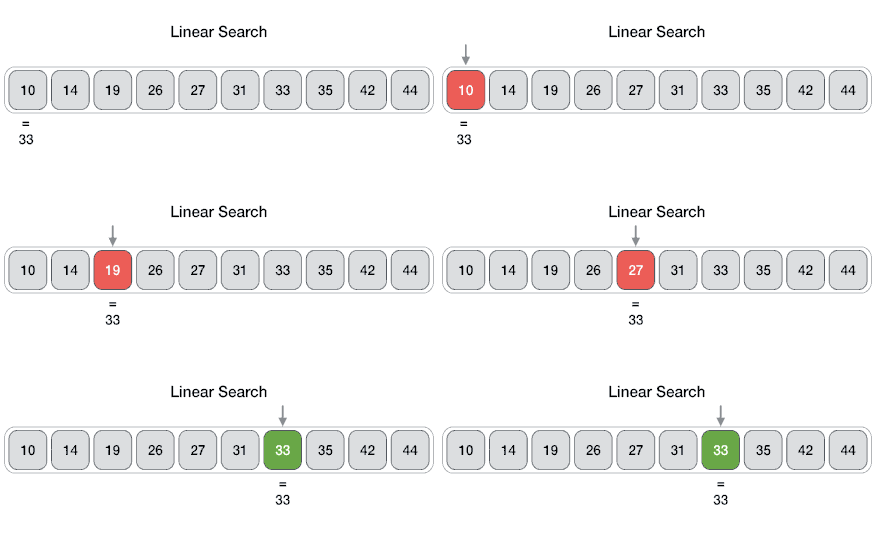
From Wikipedia: linear search or sequential search is a method for finding a target value within a list. It sequentially checks each element of the list for the target value until a match is found or until all the elements have been searched. Linear search runs in at worst linear time and makes at most n comparisons, where n is the length of the list.
Properties
- Worst case performance O(n)
- Best case performance O(1)
- Average case performance O(n)
- Worst case space complexity O(1) iterative
#![allow(unused)]
fn main() {
use std::cmp::PartialEq;

pub fn linear_search<T: PartialEq>(item: &T, arr: &[T]) -> Option<usize> {
    for (i, data) in arr.iter().enumerate() {
        if item == data {
            return Some(i);
        }
    }

    None
}

#[cfg(test)]
mod tests {
    use super::*;

    #[test]
    fn search_strings() {
        let index = linear_search(&"a", &vec!["a", "b", "c", "d", "google", "zoo"]);
        assert_eq!(index, Some(0));
    }

    #[test]
    fn search_ints() {
        let index = linear_search(&4, &vec![1, 2, 3, 4]);
        assert_eq!(index, Some(3));

        let index = linear_search(&3, &vec![1, 2, 3, 4]);
        assert_eq!(index, Some(2));

        let index = linear_search(&2, &vec![1, 2, 3, 4]);
        assert_eq!(index, Some(1));

        let index = linear_search(&1, &vec![1, 2, 3, 4]);
        assert_eq!(index, Some(0));
    }

    #[test]
    fn not_found() {
        let index = linear_search(&5, &vec![1, 2, 3, 4]);
        assert_eq!(index, None);
    }

    #[test]
    fn empty() {
        let index = linear_search(&1, &vec![]);
        assert_eq!(index, None);
    }
}
}
Теория графов
Алгоритмы теории графов играют важную роль в информатике, предоставляя простой и систематический способ моделирования многих задач. Большое количество проблем можно свести к задачам на графах и решить с помощью базовых алгоритмов теории графов.
Кратчайший путь — Беллман — Форд
#![allow(unused)]
fn main() {
use std::collections::BTreeMap;
use std::ops::Add;

use std::ops::Neg;

type Graph<V, E> = BTreeMap<V, BTreeMap<V, E>>;

// performs the Bellman-Ford algorithm on the given graph from the given start
// the graph is an undirected graph
//
// if there is a negative weighted loop it returns None
// else it returns a map that for each reachable vertex associates the distance and the predecessor
// since the start has no predecessor but is reachable, map[start] will be None
pub fn bellman_ford<
    V: Ord + Copy,
    E: Ord + Copy + Add<Output = E> + Neg<Output = E> + std::ops::Sub<Output = E>,
>(
    graph: &Graph<V, E>,
    start: &V,
) -> Option<BTreeMap<V, Option<(V, E)>>> {
    let mut ans: BTreeMap<V, Option<(V, E)>> = BTreeMap::new();

    ans.insert(*start, None);

    for _ in 1..(graph.len()) {
        for (u, edges) in graph {
            let dist_u = match ans.get(u) {
                Some(Some((_, d))) => Some(*d),
                Some(None) => None,
                None => continue,
            };

            for (v, d) in edges {
                match ans.get(v) {
                    Some(Some((_, dist)))
                        // if this is a longer path, do nothing
                        if match dist_u {
                            Some(dist_u) => dist_u + *d >= *dist,
                            None => d >= dist,
                        } => {}
                    Some(None) => {
                        match dist_u {
                            // if dist_u + d < 0 there is a negative loop going by start
                            // else it's just a longer path
                            Some(dist_u) if dist_u >= -*d => {}
                            // negative self edge or negative loop
                            _ => {
                                if *d > *d + *d {
                                    return None;
                                }
                            }
                        };
                    }
                    // it's a shorter path: either dist_v was infinite or it was longer than dist_u + d
                    _ => {
                        ans.insert(
                            *v,
                            Some((
                                *u,
                                match dist_u {
                                    Some(dist) => dist + *d,
                                    None => *d,
                                },
                            )),
                        );
                    }
                }
            }
        }
    }

    for (u, edges) in graph {
        for (v, d) in edges {
            match (ans.get(u), ans.get(v)) {
                (Some(None), Some(None)) if *d > *d + *d => return None,
                (Some(None), Some(Some((_, dv)))) if d < dv => return None,
                (Some(Some((_, du))), Some(None)) if *du < -*d => return None,
                (Some(Some((_, du))), Some(Some((_, dv)))) if *du + *d < *dv => return None,
                (_, _) => {}
            }
        }
    }

    Some(ans)
}

#[cfg(test)]
mod tests {
    use super::{bellman_ford, Graph};
    use std::collections::BTreeMap;

    fn add_edge<V: Ord + Copy, E: Ord>(graph: &mut Graph<V, E>, v1: V, v2: V, c: E) {
        graph.entry(v1).or_insert_with(BTreeMap::new).insert(v2, c);
        graph.entry(v2).or_insert_with(BTreeMap::new);
    }

    #[test]
    fn single_vertex() {
        let mut graph: Graph<isize, isize> = BTreeMap::new();
        graph.insert(0, BTreeMap::new());

        let mut dists = BTreeMap::new();
        dists.insert(0, None);

        assert_eq!(bellman_ford(&graph, &0), Some(dists));
    }

    #[test]
    fn single_edge() {
        let mut graph = BTreeMap::new();
        add_edge(&mut graph, 0, 1, 2);

        let mut dists_0 = BTreeMap::new();
        dists_0.insert(0, None);
        dists_0.insert(1, Some((0, 2)));

        assert_eq!(bellman_ford(&graph, &0), Some(dists_0));

        let mut dists_1 = BTreeMap::new();
        dists_1.insert(1, None);

        assert_eq!(bellman_ford(&graph, &1), Some(dists_1));
    }

    #[test]
    fn tree_1() {
        let mut graph = BTreeMap::new();
        let mut dists = BTreeMap::new();
        dists.insert(1, None);
        for i in 1..100 {
            add_edge(&mut graph, i, i * 2, i * 2);
            add_edge(&mut graph, i, i * 2 + 1, i * 2 + 1);

            match dists[&i] {
                Some((_, d)) => {
                    dists.insert(i * 2, Some((i, d + i * 2)));
                    dists.insert(i * 2 + 1, Some((i, d + i * 2 + 1)));
                }
                None => {
                    dists.insert(i * 2, Some((i, i * 2)));
                    dists.insert(i * 2 + 1, Some((i, i * 2 + 1)));
                }
            }
        }

        assert_eq!(bellman_ford(&graph, &1), Some(dists));
    }

    #[test]
    fn graph_1() {
        let mut graph = BTreeMap::new();
        add_edge(&mut graph, 'a', 'c', 12);
        add_edge(&mut graph, 'a', 'd', 60);
        add_edge(&mut graph, 'b', 'a', 10);
        add_edge(&mut graph, 'c', 'b', 20);
        add_edge(&mut graph, 'c', 'd', 32);
        add_edge(&mut graph, 'e', 'a', 7);

        let mut dists_a = BTreeMap::new();
        dists_a.insert('a', None);
        dists_a.insert('c', Some(('a', 12)));
        dists_a.insert('d', Some(('c', 44)));
        dists_a.insert('b', Some(('c', 32)));
        assert_eq!(bellman_ford(&graph, &'a'), Some(dists_a));

        let mut dists_b = BTreeMap::new();
        dists_b.insert('b', None);
        dists_b.insert('a', Some(('b', 10)));
        dists_b.insert('c', Some(('a', 22)));
        dists_b.insert('d', Some(('c', 54)));
        assert_eq!(bellman_ford(&graph, &'b'), Some(dists_b));

        let mut dists_c = BTreeMap::new();
        dists_c.insert('c', None);
        dists_c.insert('b', Some(('c', 20)));
        dists_c.insert('d', Some(('c', 32)));
        dists_c.insert('a', Some(('b', 30)));
        assert_eq!(bellman_ford(&graph, &'c'), Some(dists_c));

        let mut dists_d = BTreeMap::new();
        dists_d.insert('d', None);
        assert_eq!(bellman_ford(&graph, &'d'), Some(dists_d));

        let mut dists_e = BTreeMap::new();
        dists_e.insert('e', None);
        dists_e.insert('a', Some(('e', 7)));
        dists_e.insert('c', Some(('a', 19)));
        dists_e.insert('d', Some(('c', 51)));
        dists_e.insert('b', Some(('c', 39)));
        assert_eq!(bellman_ford(&graph, &'e'), Some(dists_e));
    }

    #[test]
    fn graph_2() {
        let mut graph = BTreeMap::new();
        add_edge(&mut graph, 0, 1, 6);
        add_edge(&mut graph, 0, 3, 7);
        add_edge(&mut graph, 1, 2, 5);
        add_edge(&mut graph, 1, 3, 8);
        add_edge(&mut graph, 1, 4, -4);
        add_edge(&mut graph, 2, 1, -2);
        add_edge(&mut graph, 3, 2, -3);
        add_edge(&mut graph, 3, 4, 9);
        add_edge(&mut graph, 4, 0, 3);
        add_edge(&mut graph, 4, 2, 7);

        let mut dists_0 = BTreeMap::new();
        dists_0.insert(0, None);
        dists_0.insert(1, Some((2, 2)));
        dists_0.insert(2, Some((3, 4)));
        dists_0.insert(3, Some((0, 7)));
        dists_0.insert(4, Some((1, -2)));
        assert_eq!(bellman_ford(&graph, &0), Some(dists_0));

        let mut dists_1 = BTreeMap::new();
        dists_1.insert(0, Some((4, -1)));
        dists_1.insert(1, None);
        dists_1.insert(2, Some((4, 3)));
        dists_1.insert(3, Some((0, 6)));
        dists_1.insert(4, Some((1, -4)));
        assert_eq!(bellman_ford(&graph, &1), Some(dists_1));

        let mut dists_2 = BTreeMap::new();
        dists_2.insert(0, Some((4, -3)));
        dists_2.insert(1, Some((2, -2)));
        dists_2.insert(2, None);
        dists_2.insert(3, Some((0, 4)));
        dists_2.insert(4, Some((1, -6)));
        assert_eq!(bellman_ford(&graph, &2), Some(dists_2));

        let mut dists_3 = BTreeMap::new();
        dists_3.insert(0, Some((4, -6)));
        dists_3.insert(1, Some((2, -5)));
        dists_3.insert(2, Some((3, -3)));
        dists_3.insert(3, None);
        dists_3.insert(4, Some((1, -9)));
        assert_eq!(bellman_ford(&graph, &3), Some(dists_3));

        let mut dists_4 = BTreeMap::new();
        dists_4.insert(0, Some((4, 3)));
        dists_4.insert(1, Some((2, 5)));
        dists_4.insert(2, Some((4, 7)));
        dists_4.insert(3, Some((0, 10)));
        dists_4.insert(4, None);
        assert_eq!(bellman_ford(&graph, &4), Some(dists_4));
    }

    #[test]
    fn graph_with_negative_loop() {
        let mut graph = BTreeMap::new();
        add_edge(&mut graph, 0, 1, 6);
        add_edge(&mut graph, 0, 3, 7);
        add_edge(&mut graph, 1, 2, 5);
        add_edge(&mut graph, 1, 3, 8);
        add_edge(&mut graph, 1, 4, -4);
        add_edge(&mut graph, 2, 1, -4);
        add_edge(&mut graph, 3, 2, -3);
        add_edge(&mut graph, 3, 4, 9);
        add_edge(&mut graph, 4, 0, 3);
        add_edge(&mut graph, 4, 2, 7);

        assert_eq!(bellman_ford(&graph, &0), None);
        assert_eq!(bellman_ford(&graph, &1), None);
        assert_eq!(bellman_ford(&graph, &2), None);
        assert_eq!(bellman_ford(&graph, &3), None);
        assert_eq!(bellman_ford(&graph, &4), None);
    }
}
}
Кратчайший путь — Дейкстра
#![allow(unused)]
fn main() {
use std::cmp::Reverse;
use std::collections::{BTreeMap, BinaryHeap};
use std::ops::Add;

type Graph<V, E> = BTreeMap<V, BTreeMap<V, E>>;

// performs Dijsktra's algorithm on the given graph from the given start
// the graph is a positively-weighted undirected graph
//
// returns a map that for each reachable vertex associates the distance and the predecessor
// since the start has no predecessor but is reachable, map[start] will be None
pub fn dijkstra<V: Ord + Copy, E: Ord + Copy + Add<Output = E>>(
    graph: &Graph<V, E>,
    start: &V,
) -> BTreeMap<V, Option<(V, E)>> {
    let mut ans = BTreeMap::new();
    let mut prio = BinaryHeap::new();

    // start is the special case that doesn't have a predecessor
    ans.insert(*start, None);

    for (new, weight) in &graph[start] {
        ans.insert(*new, Some((*start, *weight)));
        prio.push(Reverse((*weight, new, start)));
    }

    while let Some(Reverse((dist_new, new, prev))) = prio.pop() {
        match ans[new] {
            // what we popped is what is in ans, we'll compute it
            Some((p, d)) if p == *prev && d == dist_new => {}
            // otherwise it's not interesting
            _ => continue,
        }

        for (next, weight) in &graph[new] {
            match ans.get(next) {
                // if ans[next] is a lower dist than the alternative one, we do nothing
                Some(Some((_, dist_next))) if dist_new + *weight >= *dist_next => {}
                // if ans[next] is None then next is start and so the distance won't be changed, it won't be added again in prio
                Some(None) => {}
                // the new path is shorter, either new was not in ans or it was farther
                _ => {
                    ans.insert(*next, Some((*new, *weight + dist_new)));
                    prio.push(Reverse((*weight + dist_new, next, new)));
                }
            }
        }
    }

    ans
}

#[cfg(test)]
mod tests {
    use super::{dijkstra, Graph};
    use std::collections::BTreeMap;

    fn add_edge<V: Ord + Copy, E: Ord>(graph: &mut Graph<V, E>, v1: V, v2: V, c: E) {
        graph.entry(v1).or_insert_with(BTreeMap::new).insert(v2, c);
        graph.entry(v2).or_insert_with(BTreeMap::new);
    }

    #[test]
    fn single_vertex() {
        let mut graph: Graph<usize, usize> = BTreeMap::new();
        graph.insert(0, BTreeMap::new());

        let mut dists = BTreeMap::new();
        dists.insert(0, None);

        assert_eq!(dijkstra(&graph, &0), dists);
    }

    #[test]
    fn single_edge() {
        let mut graph = BTreeMap::new();
        add_edge(&mut graph, 0, 1, 2);

        let mut dists_0 = BTreeMap::new();
        dists_0.insert(0, None);
        dists_0.insert(1, Some((0, 2)));

        assert_eq!(dijkstra(&graph, &0), dists_0);

        let mut dists_1 = BTreeMap::new();
        dists_1.insert(1, None);

        assert_eq!(dijkstra(&graph, &1), dists_1);
    }

    #[test]
    fn tree_1() {
        let mut graph = BTreeMap::new();
        let mut dists = BTreeMap::new();
        dists.insert(1, None);
        for i in 1..100 {
            add_edge(&mut graph, i, i * 2, i * 2);
            add_edge(&mut graph, i, i * 2 + 1, i * 2 + 1);

            match dists[&i] {
                Some((_, d)) => {
                    dists.insert(i * 2, Some((i, d + i * 2)));
                    dists.insert(i * 2 + 1, Some((i, d + i * 2 + 1)));
                }
                None => {
                    dists.insert(i * 2, Some((i, i * 2)));
                    dists.insert(i * 2 + 1, Some((i, i * 2 + 1)));
                }
            }
        }

        assert_eq!(dijkstra(&graph, &1), dists);
    }

    #[test]
    fn graph_1() {
        let mut graph = BTreeMap::new();
        add_edge(&mut graph, 'a', 'c', 12);
        add_edge(&mut graph, 'a', 'd', 60);
        add_edge(&mut graph, 'b', 'a', 10);
        add_edge(&mut graph, 'c', 'b', 20);
        add_edge(&mut graph, 'c', 'd', 32);
        add_edge(&mut graph, 'e', 'a', 7);

        let mut dists_a = BTreeMap::new();
        dists_a.insert('a', None);
        dists_a.insert('c', Some(('a', 12)));
        dists_a.insert('d', Some(('c', 44)));
        dists_a.insert('b', Some(('c', 32)));
        assert_eq!(dijkstra(&graph, &'a'), dists_a);

        let mut dists_b = BTreeMap::new();
        dists_b.insert('b', None);
        dists_b.insert('a', Some(('b', 10)));
        dists_b.insert('c', Some(('a', 22)));
        dists_b.insert('d', Some(('c', 54)));
        assert_eq!(dijkstra(&graph, &'b'), dists_b);

        let mut dists_c = BTreeMap::new();
        dists_c.insert('c', None);
        dists_c.insert('b', Some(('c', 20)));
        dists_c.insert('d', Some(('c', 32)));
        dists_c.insert('a', Some(('b', 30)));
        assert_eq!(dijkstra(&graph, &'c'), dists_c);

        let mut dists_d = BTreeMap::new();
        dists_d.insert('d', None);
        assert_eq!(dijkstra(&graph, &'d'), dists_d);

        let mut dists_e = BTreeMap::new();
        dists_e.insert('e', None);
        dists_e.insert('a', Some(('e', 7)));
        dists_e.insert('c', Some(('a', 19)));
        dists_e.insert('d', Some(('c', 51)));
        dists_e.insert('b', Some(('c', 39)));
        assert_eq!(dijkstra(&graph, &'e'), dists_e);
    }
}
}
Поиск в глубину
#![allow(unused)]
fn main() {
use std::collections::HashSet;
use std::collections::VecDeque;

// Perform a Depth First Search Algorithm to find a element in a graph
//
// Return a Optional with a vector with history of vertex visiteds
// or a None if the element not exists on the graph
pub fn depth_first_search(graph: &Graph, root: Vertex, objective: Vertex) -> Option<Vec<u32>> {
    let mut visited: HashSet<Vertex> = HashSet::new();
    let mut history: Vec<u32> = Vec::new();
    let mut queue = VecDeque::new();
    queue.push_back(root);

    // While there is an element in the queue
    // get the first element of the vertex queue
    while let Some(current_vertex) = queue.pop_front() {
        // Added current vertex in the history of visiteds vertex
        history.push(current_vertex.value());

        // Verify if this vertex is the objective
        if current_vertex == objective {
            // Return the Optional with the history of visiteds vertex
            return Some(history);
        }

        // For each over the neighbors of current vertex
        for neighbor in current_vertex.neighbors(graph).into_iter().rev() {
            // Insert in the HashSet of visiteds if this value not exist yet
            if visited.insert(neighbor) {
                // Add the neighbor on front of queue
                queue.push_front(neighbor);
            }
        }
    }

    // If all vertex is visited and the objective is not found
    // return a Optional with None value
    None
}

// Data Structures

#[derive(Copy, Clone, PartialEq, Eq, Hash)]
pub struct Vertex(u32);
#[derive(Copy, Clone, PartialEq, Eq, Hash)]
pub struct Edge(u32, u32);
#[derive(Clone)]
pub struct Graph {
    vertices: Vec<Vertex>,
    edges: Vec<Edge>,
}

impl Graph {
    pub fn new(vertices: Vec<Vertex>, edges: Vec<Edge>) -> Self {
        Graph { vertices, edges }
    }
}

impl From<u32> for Vertex {
    fn from(item: u32) -> Self {
        Vertex(item)
    }
}

impl Vertex {
    pub fn value(&self) -> u32 {
        self.0
    }

    pub fn neighbors(&self, graph: &Graph) -> VecDeque<Vertex> {
        graph
            .edges
            .iter()
            .filter(|e| e.0 == self.0)
            .map(|e| e.1.into())
            .collect()
    }
}

impl From<(u32, u32)> for Edge {
    fn from(item: (u32, u32)) -> Self {
        Edge(item.0, item.1)
    }
}

#[cfg(test)]
mod tests {
    use super::*;

    #[test]
    fn find_1_fail() {
        let vertices = vec![1, 2, 3, 4, 5, 6, 7];
        let edges = vec![(1, 2), (1, 3), (2, 4), (2, 5), (3, 6), (3, 7)];

        let root = 1;
        let objective = 99;

        let graph = Graph::new(
            vertices.into_iter().map(|v| v.into()).collect(),
            edges.into_iter().map(|e| e.into()).collect(),
        );

        assert_eq!(
            depth_first_search(&graph, root.into(), objective.into()),
            None
        );
    }

    #[test]
    fn find_1_sucess() {
        let vertices = vec![1, 2, 3, 4, 5, 6, 7];
        let edges = vec![(1, 2), (1, 3), (2, 4), (2, 5), (3, 6), (3, 7)];

        let root = 1;
        let objective = 7;

        let correct_path = vec![1, 2, 4, 5, 3, 6, 7];

        let graph = Graph::new(
            vertices.into_iter().map(|v| v.into()).collect(),
            edges.into_iter().map(|e| e.into()).collect(),
        );

        assert_eq!(
            depth_first_search(&graph, root.into(), objective.into()),
            Some(correct_path)
        );
    }

    #[test]
    fn find_2_sucess() {
        let vertices = vec![0, 1, 2, 3, 4, 5, 6, 7];
        let edges = vec![
            (0, 1),
            (1, 3),
            (3, 2),
            (2, 1),
            (3, 4),
            (4, 5),
            (5, 7),
            (7, 6),
            (6, 4),
        ];

        let root = 0;
        let objective = 6;

        let correct_path = vec![0, 1, 3, 2, 4, 5, 7, 6];

        let graph = Graph::new(
            vertices.into_iter().map(|v| v.into()).collect(),
            edges.into_iter().map(|e| e.into()).collect(),
        );

        assert_eq!(
            depth_first_search(&graph, root.into(), objective.into()),
            Some(correct_path)
        );
    }

    #[test]
    fn find_3_sucess() {
        let vertices = vec![0, 1, 2, 3, 4, 5, 6, 7];
        let edges = vec![
            (0, 1),
            (1, 3),
            (3, 2),
            (2, 1),
            (3, 4),
            (4, 5),
            (5, 7),
            (7, 6),
            (6, 4),
        ];

        let root = 0;
        let objective = 4;

        let correct_path = vec![0, 1, 3, 2, 4];

        let graph = Graph::new(
            vertices.into_iter().map(|v| v.into()).collect(),
            edges.into_iter().map(|e| e.into()).collect(),
        );

        assert_eq!(
            depth_first_search(&graph, root.into(), objective.into()),
            Some(correct_path)
        );
    }
}
}
Поиск в ширину
#![allow(unused)]
fn main() {
use std::collections::HashSet;
use std::collections::VecDeque;

/// Perform a breadth-first search on Graph `graph`.
///
/// # Parameters
///
/// - `graph`: The graph to search.
/// - `root`: The starting node of the graph from which to begin searching.
/// - `target`: The target node for the search.
///
/// # Returns
///
/// If the target is found, an Optional vector is returned with the history
/// of nodes visited as its contents.
///
/// If the target is not found or there is no path from the root,
/// `None` is returned.
///
pub fn breadth_first_search(graph: &Graph, root: Node, target: Node) -> Option<Vec<u32>> {
    let mut visited: HashSet<Node> = HashSet::new();
    let mut history: Vec<u32> = Vec::new();
    let mut queue = VecDeque::new();

    visited.insert(root);
    queue.push_back(root);
    while let Some(currentnode) = queue.pop_front() {
        history.push(currentnode.value());

        // If we reach the goal, return our travel history.
        if currentnode == target {
            return Some(history);
        }

        // Check the neighboring nodes for any that we've not visited yet.
        for neighbor in currentnode.neighbors(graph) {
            if !visited.contains(&neighbor) {
                visited.insert(neighbor);
                queue.push_back(neighbor);
            }
        }
    }

    // All nodes were visited, yet the target was not found.
    None
}

// Data Structures

#[derive(Copy, Clone, PartialEq, Eq, Hash)]
pub struct Node(u32);

#[derive(Copy, Clone, PartialEq, Eq, Hash)]
pub struct Edge(u32, u32);

#[derive(Clone)]
pub struct Graph {
    nodes: Vec<Node>,
    edges: Vec<Edge>,
}

impl Graph {
    pub fn new(nodes: Vec<Node>, edges: Vec<Edge>) -> Self {
        Graph { nodes, edges }
    }
}

impl From<u32> for Node {
    fn from(item: u32) -> Self {
        Node(item)
    }
}

impl Node {
    pub fn value(&self) -> u32 {
        self.0
    }

    pub fn neighbors(&self, graph: &Graph) -> Vec<Node> {
        graph
            .edges
            .iter()
            .filter(|e| e.0 == self.0)
            .map(|e| e.1.into())
            .collect()
    }
}

impl From<(u32, u32)> for Edge {
    fn from(item: (u32, u32)) -> Self {
        Edge(item.0, item.1)
    }
}

#[cfg(test)]
mod tests {
    use super::*;

    /* Example graph #1:
     *
     *            (1)   <--- Root
     *           /   \
     *         (2)   (3)
     *        / |     | \
     *     (4) (5)   (6) (7)
     *          |
     *         (8)
     */
    fn graph1() -> Graph {
        let nodes = vec![1, 2, 3, 4, 5, 6, 7];
        let edges = vec![(1, 2), (1, 3), (2, 4), (2, 5), (3, 6), (3, 7), (5, 8)];

        Graph::new(
            nodes.into_iter().map(|v| v.into()).collect(),
            edges.into_iter().map(|e| e.into()).collect(),
        )
    }

    #[test]
    fn breadth_first_search_graph1_when_node_not_found_returns_none() {
        let graph = graph1();
        let root = 1;
        let target = 10;

        assert_eq!(
            breadth_first_search(&graph, root.into(), target.into()),
            None
        );
    }

    #[test]
    fn breadth_first_search_graph1_when_target_8_should_evaluate_all_nodes_first() {
        let graph = graph1();
        let root = 1;
        let target = 8;

        let expected_path = vec![1, 2, 3, 4, 5, 6, 7, 8];

        assert_eq!(
            breadth_first_search(&graph, root.into(), target.into()),
            Some(expected_path)
        );
    }

    /* Example graph #2:
     *
     *     (1) --- (2)     (3) --- (4)
     *            / |     /       /
     *          /   |   /       /
     *        /     | /       /
     *     (5)     (6) --- (7)     (8)
     */
    fn graph2() -> Graph {
        let nodes = vec![1, 2, 3, 4, 5, 6, 7, 8];
        let undirected_edges = vec![
            (1, 2),
            (2, 1),
            (2, 5),
            (5, 2),
            (2, 6),
            (6, 2),
            (3, 4),
            (4, 3),
            (3, 6),
            (6, 3),
            (4, 7),
            (7, 4),
            (6, 7),
            (7, 6),
        ];

        Graph::new(
            nodes.into_iter().map(|v| v.into()).collect(),
            undirected_edges.into_iter().map(|e| e.into()).collect(),
        )
    }

    #[test]
    fn breadth_first_search_graph2_when_no_path_to_node_returns_none() {
        let graph = graph2();
        let root = 8;
        let target = 4;

        assert_eq!(
            breadth_first_search(&graph, root.into(), target.into()),
            None
        );
    }

    #[test]
    fn breadth_first_search_graph2_should_find_path_from_4_to_1() {
        let graph = graph2();
        let root = 4;
        let target = 1;

        let expected_path = vec![4, 3, 7, 6, 2, 1];

        assert_eq!(
            breadth_first_search(&graph, root.into(), target.into()),
            Some(expected_path)
        );
    }
}
}
Поиск в глубину — Крестики-нолики
#[derive(Copy, Clone, PartialEq, Debug)]
struct Position {
    x: u8,
    y: u8,
}

#[derive(Copy, Clone, PartialEq, Debug)]
pub enum Players {
    Blank,
    PlayerX,
    PlayerO,
}

#[derive(Copy, Clone, PartialEq, Debug)]
struct SinglePlayAction {
    position: Position,
    side: Players,
}

#[derive(Clone, PartialEq, Debug)]
pub struct PlayActions {
    positions: Vec<Position>,
    side: Players,
}

#[allow(dead_code)]
fn display_board(board: &[Vec<Players>]) {
    println!();
    for (y, board_row) in board.iter().enumerate() {
        print!("{} ", (y + 1));
        for board_cell in board_row {
            match board_cell {
                Players::PlayerX => print!("X "),
                Players::PlayerO => print!("O "),
                Players::Blank => print!("_ "),
            }
        }
        println!();
    }
    println!("  a b c");
}

fn available_positions(board: &[Vec<Players>]) -> Vec<Position> {
    let mut available: Vec<Position> = Vec::new();
    for (y, board_row) in board.iter().enumerate() {
        for (x, board_cell) in board_row.iter().enumerate() {
            if *board_cell == Players::Blank {
                available.push(Position {
                    x: x as u8,
                    y: y as u8,
                });
            }
        }
    }
    available
}

fn win_check(player: Players, board: &[Vec<Players>]) -> bool {
    if player == Players::Blank {
        return false;
    }

    //Check for a win on the diagonals.
    if (board[0][0] == board[1][1]) && (board[1][1] == board[2][2]) && (board[2][2] == player)
        || (board[2][0] == board[1][1]) && (board[1][1] == board[0][2]) && (board[0][2] == player)
    {
        return true;
    }

    for i in 0..3 {
        //Check for a win on the horizontals.
        if (board[i][0] == board[i][1]) && (board[i][1] == board[i][2]) && (board[i][2] == player) {
            return true;
        }

        //Check for a win on the verticals.
        if (board[0][i] == board[1][i]) && (board[1][i] == board[2][i]) && (board[2][i] == player) {
            return true;
        }
    }

    false
}

//Minimize the actions of the opponent while maximizing the game state of the current player.
pub fn minimax(side: Players, board: &[Vec<Players>]) -> Option<PlayActions> {
    //Check that board is in a valid state.
    if win_check(Players::PlayerX, board) || win_check(Players::PlayerO, board) {
        return None;
    }

    let opposite = match side {
        Players::PlayerX => Players::PlayerO,
        Players::PlayerO => Players::PlayerX,
        Players::Blank => panic!("Minimax can't operate when a player isn't specified."),
    };

    let positions = available_positions(board);
    if positions.is_empty() {
        return None;
    }

    //Play position
    let mut best_move: Option<PlayActions> = None;

    for pos in positions {
        let mut board_next = board.to_owned();
        board_next[pos.y as usize][pos.x as usize] = side;

        //Check for a win condition before recursion to determine if this node is terminal.
        if win_check(Players::PlayerX, &board_next) {
            append_playaction(
                side,
                &mut best_move,
                SinglePlayAction {
                    position: pos,
                    side: Players::PlayerX,
                },
            );
            continue;
        }

        if win_check(Players::PlayerO, &board_next) {
            append_playaction(
                side,
                &mut best_move,
                SinglePlayAction {
                    position: pos,
                    side: Players::PlayerO,
                },
            );
            continue;
        }

        let result = minimax(opposite, &board_next);
        let current_score = match result {
            Some(x) => x.side,
            _ => Players::Blank,
        };

        append_playaction(
            side,
            &mut best_move,
            SinglePlayAction {
                position: pos,
                side: current_score,
            },
        )
    }
    best_move
}

//Promote only better or collate equally scored game plays
fn append_playaction(
    current_side: Players,
    opt_play_actions: &mut Option<PlayActions>,
    appendee: SinglePlayAction,
) {
    if opt_play_actions.is_none() {
        *opt_play_actions = Some(PlayActions {
            positions: vec![appendee.position],
            side: appendee.side,
        });
        return;
    }

    let mut play_actions = opt_play_actions.as_mut().unwrap();

    //New game action is scored from the current side and the current saved best score against the new game action.
    match (current_side, play_actions.side, appendee.side) {
        (Players::Blank, _, _) => panic!("Unreachable state."),

        //Winning scores
        (Players::PlayerX, Players::PlayerX, Players::PlayerX) => {
            play_actions.positions.push(appendee.position);
        }
        (Players::PlayerX, Players::PlayerX, _) => {}
        (Players::PlayerO, Players::PlayerO, Players::PlayerO) => {
            play_actions.positions.push(appendee.position);
        }
        (Players::PlayerO, Players::PlayerO, _) => {}

        //Non-winning to Winning scores
        (Players::PlayerX, _, Players::PlayerX) => {
            play_actions.side = Players::PlayerX;
            play_actions.positions.clear();
            play_actions.positions.push(appendee.position);
        }
        (Players::PlayerO, _, Players::PlayerO) => {
            play_actions.side = Players::PlayerO;
            play_actions.positions.clear();
            play_actions.positions.push(appendee.position);
        }

        //Losing to Neutral scores
        (Players::PlayerX, Players::PlayerO, Players::Blank) => {
            play_actions.side = Players::Blank;
            play_actions.positions.clear();
            play_actions.positions.push(appendee.position);
        }

        (Players::PlayerO, Players::PlayerX, Players::Blank) => {
            play_actions.side = Players::Blank;
            play_actions.positions.clear();
            play_actions.positions.push(appendee.position);
        }

        //Ignoring lower scored plays
        (Players::PlayerX, Players::Blank, Players::PlayerO) => {}
        (Players::PlayerO, Players::Blank, Players::PlayerX) => {}

        //No change hence append only
        (_, _, _) => {
            assert!(play_actions.side == appendee.side);
            play_actions.positions.push(appendee.position);
        }
    }
}

#[cfg(test)]
mod test {
    use super::*;

    #[test]
    fn win_state_check() {
        let mut board = vec![vec![Players::Blank; 3]; 3];
        board[0][0] = Players::PlayerX;
        board[0][1] = Players::PlayerX;
        board[0][2] = Players::PlayerX;
        let responses = minimax(Players::PlayerO, &board);
        assert_eq!(responses, None);
    }

    #[test]
    fn win_state_check2() {
        let mut board = vec![vec![Players::Blank; 3]; 3];
        board[0][0] = Players::PlayerX;
        board[0][1] = Players::PlayerO;
        board[1][0] = Players::PlayerX;
        board[1][1] = Players::PlayerO;
        board[2][1] = Players::PlayerO;
        let responses = minimax(Players::PlayerO, &board);
        assert_eq!(responses, None);
    }

    #[test]
    fn block_win_move() {
        let mut board = vec![vec![Players::Blank; 3]; 3];
        board[0][0] = Players::PlayerX;
        board[0][1] = Players::PlayerX;
        board[1][2] = Players::PlayerO;
        board[2][2] = Players::PlayerO;
        let responses = minimax(Players::PlayerX, &board);
        assert_eq!(
            responses,
            Some(PlayActions {
                positions: vec![Position { x: 2, y: 0 }],
                side: Players::PlayerX
            })
        );
    }

    #[test]
    fn block_move() {
        let mut board = vec![vec![Players::Blank; 3]; 3];
        board[0][1] = Players::PlayerX;
        board[0][2] = Players::PlayerO;
        board[2][0] = Players::PlayerO;
        let responses = minimax(Players::PlayerX, &board);
        assert_eq!(
            responses,
            Some(PlayActions {
                positions: vec![Position { x: 1, y: 1 }],
                side: Players::Blank
            })
        );
    }

    #[test]
    fn expected_loss() {
        let mut board = vec![vec![Players::Blank; 3]; 3];
        board[0][0] = Players::PlayerX;
        board[0][2] = Players::PlayerO;
        board[1][0] = Players::PlayerX;
        board[2][0] = Players::PlayerO;
        board[2][2] = Players::PlayerO;
        let responses = minimax(Players::PlayerX, &board);
        assert_eq!(
            responses,
            Some(PlayActions {
                positions: vec![
                    Position { x: 1, y: 0 },
                    Position { x: 1, y: 1 },
                    Position { x: 2, y: 1 },
                    Position { x: 1, y: 2 }
                ],
                side: Players::PlayerO
            })
        );
    }
}

fn main() {}
Минимальное остовное дерево
#![allow(unused)]
fn main() {
use std::vec::Vec;

#[derive(Debug)]
pub struct Edge {
    source: i64,
    destination: i64,
    cost: i64,
}

impl PartialEq for Edge {
    fn eq(&self, other: &Self) -> bool {
        self.source == other.source
            && self.destination == other.destination
            && self.cost == other.cost
    }
}

impl Eq for Edge {}

impl Edge {
    fn new(source: i64, destination: i64, cost: i64) -> Self {
        Self {
            source,
            destination,
            cost,
        }
    }
}

fn make_sets(number_of_vertices: i64) -> Vec<i64> {
    let mut parent: Vec<i64> = Vec::with_capacity(number_of_vertices as usize);
    for i in 0..number_of_vertices {
        parent.push(i);
    }
    parent
}

fn find(parent: &mut Vec<i64>, x: i64) -> i64 {
    let idx: usize = x as usize;
    if parent[idx] != x {
        parent[idx] = find(parent, parent[idx]);
    }
    parent[idx]
}

fn merge(parent: &mut Vec<i64>, x: i64, y: i64) {
    let idx_x: usize = find(parent, x) as usize;
    let parent_y: i64 = find(parent, y);
    parent[idx_x] = parent_y;
}

fn is_same_set(parent: &mut Vec<i64>, x: i64, y: i64) -> bool {
    find(parent, x) == find(parent, y)
}

pub fn kruskal(mut edges: Vec<Edge>, number_of_vertices: i64) -> (i64, Vec<Edge>) {
    let mut parent: Vec<i64> = make_sets(number_of_vertices);

    edges.sort_unstable_by(|a, b| a.cost.cmp(&b.cost));
    let mut total_cost: i64 = 0;
    let mut final_edges: Vec<Edge> = Vec::new();
    let mut merge_count: i64 = 0;
    for edge in edges.iter() {
        if merge_count >= number_of_vertices - 1 {
            break;
        }

        let source: i64 = edge.source;
        let destination: i64 = edge.destination;
        if !is_same_set(&mut parent, source, destination) {
            merge(&mut parent, source, destination);
            merge_count += 1;
            let cost: i64 = edge.cost;
            total_cost += cost;
            let final_edge: Edge = Edge::new(source, destination, cost);
            final_edges.push(final_edge);
        }
    }
    (total_cost, final_edges)
}

#[cfg(test)]
mod tests {
    use super::*;

    #[test]
    fn test_seven_vertices_eleven_edges() {
        let mut edges: Vec<Edge> = Vec::new();
        edges.push(Edge::new(0, 1, 7));
        edges.push(Edge::new(0, 3, 5));
        edges.push(Edge::new(1, 2, 8));
        edges.push(Edge::new(1, 3, 9));
        edges.push(Edge::new(1, 4, 7));
        edges.push(Edge::new(2, 4, 5));
        edges.push(Edge::new(3, 4, 15));
        edges.push(Edge::new(3, 5, 6));
        edges.push(Edge::new(4, 5, 8));
        edges.push(Edge::new(4, 6, 9));
        edges.push(Edge::new(5, 6, 11));

        let number_of_vertices: i64 = 7;

        let expected_total_cost = 39;
        let mut expected_used_edges: Vec<Edge> = Vec::new();
        expected_used_edges.push(Edge::new(0, 3, 5));
        expected_used_edges.push(Edge::new(2, 4, 5));
        expected_used_edges.push(Edge::new(3, 5, 6));
        expected_used_edges.push(Edge::new(0, 1, 7));
        expected_used_edges.push(Edge::new(1, 4, 7));
        expected_used_edges.push(Edge::new(4, 6, 9));

        let (actual_total_cost, actual_final_edges) = kruskal(edges, number_of_vertices);

        assert_eq!(actual_total_cost, expected_total_cost);
        assert_eq!(actual_final_edges, expected_used_edges);
    }

    #[test]
    fn test_ten_vertices_twenty_edges() {
        let mut edges: Vec<Edge> = Vec::new();
        edges.push(Edge::new(0, 1, 3));
        edges.push(Edge::new(0, 3, 6));
        edges.push(Edge::new(0, 4, 9));
        edges.push(Edge::new(1, 2, 2));
        edges.push(Edge::new(1, 3, 4));
        edges.push(Edge::new(1, 4, 9));
        edges.push(Edge::new(2, 3, 2));
        edges.push(Edge::new(2, 5, 8));
        edges.push(Edge::new(2, 6, 9));
        edges.push(Edge::new(3, 6, 9));
        edges.push(Edge::new(4, 5, 8));
        edges.push(Edge::new(4, 9, 18));
        edges.push(Edge::new(5, 6, 7));
        edges.push(Edge::new(5, 8, 9));
        edges.push(Edge::new(5, 9, 10));
        edges.push(Edge::new(6, 7, 4));
        edges.push(Edge::new(6, 8, 5));
        edges.push(Edge::new(7, 8, 1));
        edges.push(Edge::new(7, 9, 4));
        edges.push(Edge::new(8, 9, 3));

        let number_of_vertices: i64 = 10;

        let expected_total_cost = 38;
        let mut expected_used_edges = Vec::new();
        expected_used_edges.push(Edge::new(7, 8, 1));
        expected_used_edges.push(Edge::new(1, 2, 2));
        expected_used_edges.push(Edge::new(2, 3, 2));
        expected_used_edges.push(Edge::new(0, 1, 3));
        expected_used_edges.push(Edge::new(8, 9, 3));
        expected_used_edges.push(Edge::new(6, 7, 4));
        expected_used_edges.push(Edge::new(5, 6, 7));
        expected_used_edges.push(Edge::new(2, 5, 8));
        expected_used_edges.push(Edge::new(4, 5, 8));

        let (actual_total_cost, actual_final_edges) = kruskal(edges, number_of_vertices);

        assert_eq!(actual_total_cost, expected_total_cost);
        assert_eq!(actual_final_edges, expected_used_edges);
    }
}
}
Алгоритм Прима (MST)
#![allow(unused)]
fn main() {
use std::cmp::Reverse;
use std::collections::{BTreeMap, BinaryHeap};
use std::ops::Add;

type Graph<V, E> = BTreeMap<V, BTreeMap<V, E>>;

fn add_edge<V: Ord + Copy, E: Ord + Add + Copy>(graph: &mut Graph<V, E>, v1: V, v2: V, c: E) {
    graph.entry(v1).or_insert_with(BTreeMap::new).insert(v2, c);
    graph.entry(v2).or_insert_with(BTreeMap::new).insert(v1, c);
}

// selects a start and run the algorithm from it
pub fn prim<V: Ord + Copy + std::fmt::Debug, E: Ord + Add + Copy + std::fmt::Debug>(
    graph: &Graph<V, E>,
) -> Graph<V, E> {
    match graph.keys().next() {
        Some(v) => prim_with_start(graph, *v),
        None => BTreeMap::new(),
    }
}

// only works for a connected graph
// if the given graph is not connected it will return the MST of the connected subgraph
pub fn prim_with_start<V: Ord + Copy, E: Ord + Add + Copy>(
    graph: &Graph<V, E>,
    start: V,
) -> Graph<V, E> {
    // will contain the MST
    let mut mst: Graph<V, E> = Graph::new();
    // a priority queue based on a binary heap, used to get the cheapest edge
    // the elements are an edge: the cost, destination and source
    let mut prio = BinaryHeap::new();

    mst.insert(start, BTreeMap::new());

    for (v, c) in &graph[&start] {
        // the heap is a max heap, we have to use Reverse when adding to simulate a min heap
        prio.push(Reverse((*c, v, start)));
    }

    while let Some(Reverse((dist, t, prev))) = prio.pop() {
        // the destination of the edge has already been seen
        if mst.contains_key(t) {
            continue;
        }

        // the destination is a new vertex
        add_edge(&mut mst, prev, *t, dist);

        for (v, c) in &graph[t] {
            if !mst.contains_key(v) {
                prio.push(Reverse((*c, v, *t)));
            }
        }
    }

    mst
}

#[cfg(test)]
mod tests {
    use super::{add_edge, prim, Graph};
    use std::collections::BTreeMap;

    #[test]
    fn empty() {
        assert_eq!(prim::<usize, usize>(&BTreeMap::new()), BTreeMap::new());
    }

    #[test]
    fn single_vertex() {
        let mut graph: Graph<usize, usize> = BTreeMap::new();
        graph.insert(42, BTreeMap::new());

        assert_eq!(prim(&graph), graph);
    }

    #[test]
    fn single_edge() {
        let mut graph = BTreeMap::new();

        add_edge(&mut graph, 42, 666, 12);

        assert_eq!(prim(&graph), graph);
    }

    #[test]
    fn tree_1() {
        let mut graph = BTreeMap::new();

        add_edge(&mut graph, 0, 1, 10);
        add_edge(&mut graph, 0, 2, 11);
        add_edge(&mut graph, 2, 3, 12);
        add_edge(&mut graph, 2, 4, 13);
        add_edge(&mut graph, 1, 5, 14);
        add_edge(&mut graph, 1, 6, 15);
        add_edge(&mut graph, 3, 7, 16);

        assert_eq!(prim(&graph), graph);
    }

    #[test]
    fn tree_2() {
        let mut graph = BTreeMap::new();

        add_edge(&mut graph, 1, 2, 11);
        add_edge(&mut graph, 2, 3, 12);
        add_edge(&mut graph, 2, 4, 13);
        add_edge(&mut graph, 4, 5, 14);
        add_edge(&mut graph, 4, 6, 15);
        add_edge(&mut graph, 6, 7, 16);

        assert_eq!(prim(&graph), graph);
    }

    #[test]
    fn tree_3() {
        let mut graph = BTreeMap::new();

        for i in 1..100 {
            add_edge(&mut graph, i, 2 * i, i);
            add_edge(&mut graph, i, 2 * i + 1, -i);
        }

        assert_eq!(prim(&graph), graph);
    }

    #[test]
    fn graph_1() {
        let mut graph = BTreeMap::new();
        add_edge(&mut graph, 'a', 'b', 6);
        add_edge(&mut graph, 'a', 'c', 7);
        add_edge(&mut graph, 'a', 'e', 2);
        add_edge(&mut graph, 'a', 'f', 3);
        add_edge(&mut graph, 'b', 'c', 5);
        add_edge(&mut graph, 'c', 'e', 5);
        add_edge(&mut graph, 'd', 'e', 4);
        add_edge(&mut graph, 'd', 'f', 1);
        add_edge(&mut graph, 'e', 'f', 2);

        let mut ans = BTreeMap::new();
        add_edge(&mut ans, 'd', 'f', 1);
        add_edge(&mut ans, 'e', 'f', 2);
        add_edge(&mut ans, 'a', 'e', 2);
        add_edge(&mut ans, 'b', 'c', 5);
        add_edge(&mut ans, 'c', 'e', 5);

        assert_eq!(prim(&graph), ans);
    }

    #[test]
    fn graph_2() {
        let mut graph = BTreeMap::new();
        add_edge(&mut graph, 1, 2, 6);
        add_edge(&mut graph, 1, 3, 1);
        add_edge(&mut graph, 1, 4, 5);
        add_edge(&mut graph, 2, 3, 5);
        add_edge(&mut graph, 2, 5, 3);
        add_edge(&mut graph, 3, 4, 5);
        add_edge(&mut graph, 3, 5, 6);
        add_edge(&mut graph, 3, 6, 4);
        add_edge(&mut graph, 4, 6, 2);
        add_edge(&mut graph, 5, 6, 6);

        let mut ans = BTreeMap::new();
        add_edge(&mut ans, 1, 3, 1);
        add_edge(&mut ans, 4, 6, 2);
        add_edge(&mut ans, 2, 5, 3);
        add_edge(&mut ans, 2, 3, 5);
        add_edge(&mut ans, 3, 6, 4);

        assert_eq!(prim(&graph), ans);
    }

    #[test]
    fn graph_3() {
        let mut graph = BTreeMap::new();
        add_edge(&mut graph, "v1", "v2", 1);
        add_edge(&mut graph, "v1", "v3", 3);
        add_edge(&mut graph, "v1", "v5", 6);
        add_edge(&mut graph, "v2", "v3", 2);
        add_edge(&mut graph, "v2", "v4", 3);
        add_edge(&mut graph, "v2", "v5", 5);
        add_edge(&mut graph, "v3", "v4", 5);
        add_edge(&mut graph, "v3", "v6", 2);
        add_edge(&mut graph, "v4", "v5", 2);
        add_edge(&mut graph, "v4", "v6", 4);
        add_edge(&mut graph, "v5", "v6", 1);

        let mut ans = BTreeMap::new();
        add_edge(&mut ans, "v1", "v2", 1);
        add_edge(&mut ans, "v5", "v6", 1);
        add_edge(&mut ans, "v2", "v3", 2);
        add_edge(&mut ans, "v3", "v6", 2);
        add_edge(&mut ans, "v4", "v5", 2);

        assert_eq!(prim(&graph), ans);
    }
}
}
Динамическое программирование
Динамическое программирование — это метод решения задач путём их разбиения на подзадачи, определения состояний и связей между ними, что позволяет решать задачу рекуррентно (или методом «разделяй и властвуй»).
Основная идея динамического программирования похожа на метод «разделяй и властвуй»: исходная задача разбивается на несколько подзадач (этапов), которые решаются последовательно. Решение предыдущей подзадачи предоставляет полезную информацию для решения следующей. При решении каждой подзадачи перебираются возможные локальные решения и сохраняются только те, которые могут привести к оптимальному результату. Последняя решённая подзадача и является решением исходной задачи.
Числа Фибоначчи
#![allow(unused)]
fn main() {
/// Fibonacci via Dynamic Programming

/// fibonacci(n) returns the nth fibonacci number
/// This function uses the definition of Fibonacci where:
/// F(0) = F(1) = 1 and F(n+1) = F(n) + F(n-1) for n>0
///
/// Warning: This will overflow the 128-bit unsigned integer at n=186
pub fn fibonacci(n: u32) -> u128 {
    // Use a and b to store the previous two values in the sequence
    let mut a = 0;
    let mut b = 1;
    for _i in 0..n {
        // As we iterate through, move b's value into a and the new computed
        // value into b.
        let c = a + b;
        a = b;
        b = c;
    }
    b
}

/// fibonacci(n) returns the nth fibonacci number
/// This function uses the definition of Fibonacci where:
/// F(0) = F(1) = 1 and F(n+1) = F(n) + F(n-1) for n>0
///
/// Warning: This will overflow the 128-bit unsigned integer at n=186
pub fn recursive_fibonacci(n: u32) -> u128 {
    // Call the actual tail recursive implementation, with the extra
    // arguments set up.
    _recursive_fibonacci(n, 0, 1)
}

fn _recursive_fibonacci(n: u32, previous: u128, current: u128) -> u128 {
    if n == 0 {
        current
    } else {
        _recursive_fibonacci(n - 1, current, current + previous)
    }
}

/// classical_fibonacci(n) returns the nth fibonacci number
/// This function uses the definition of Fibonacci where:
/// F(0) = 0, F(1) = 1 and F(n+1) = F(n) + F(n-1) for n>0
///
/// Warning: This will overflow the 128-bit unsigned integer at n=186
pub fn classical_fibonacci(n: u32) -> u128 {
    match n {
        0 => 0,
        1 => 1,
        _ => {
            let k = n / 2;
            let f1 = classical_fibonacci(k);
            let f2 = classical_fibonacci(k - 1);

            match n % 4 {
                0 | 2 => f1 * (f1 + 2 * f2),
                1 => (2 * f1 + f2) * (2 * f1 - f2) + 2,
                _ => (2 * f1 + f2) * (2 * f1 - f2) - 2,
            }
        }
    }
}

/// logarithmic_fibonacci(n) returns the nth fibonacci number
/// This function uses the definition of Fibonacci where:
/// F(0) = 0, F(1) = 1 and F(n+1) = F(n) + F(n-1) for n>0
///
/// Warning: This will overflow the 128-bit unsigned integer at n=186
pub fn logarithmic_fibonacci(n: u32) -> u128 {
    // if it is the max value before overflow, use n-1 then get the second
    // value in the tuple
    if n == 186 {
        let (_, second) = _logarithmic_fibonacci(185);
        second
    } else {
        let (first, _) = _logarithmic_fibonacci(n);
        first
    }
}

fn _logarithmic_fibonacci(n: u32) -> (u128, u128) {
    match n {
        0 => (0, 1),
        _ => {
            let (current, next) = _logarithmic_fibonacci(n / 2);
            let c = current * (next * 2 - current);
            let d = current * current + next * next;

            match n % 2 {
                0 => (c, d),
                _ => (d, c + d),
            }
        }
    }
}

#[cfg(test)]
mod tests {
    use super::classical_fibonacci;
    use super::fibonacci;
    use super::logarithmic_fibonacci;
    use super::recursive_fibonacci;

    #[test]
    fn test_fibonacci() {
        assert_eq!(fibonacci(0), 1);
        assert_eq!(fibonacci(1), 1);
        assert_eq!(fibonacci(2), 2);
        assert_eq!(fibonacci(3), 3);
        assert_eq!(fibonacci(4), 5);
        assert_eq!(fibonacci(5), 8);
        assert_eq!(fibonacci(10), 89);
        assert_eq!(fibonacci(20), 10946);
        assert_eq!(fibonacci(100), 573147844013817084101);
        assert_eq!(fibonacci(184), 205697230343233228174223751303346572685);
    }

    #[test]
    fn test_recursive_fibonacci() {
        assert_eq!(recursive_fibonacci(0), 1);
        assert_eq!(recursive_fibonacci(1), 1);
        assert_eq!(recursive_fibonacci(2), 2);
        assert_eq!(recursive_fibonacci(3), 3);
        assert_eq!(recursive_fibonacci(4), 5);
        assert_eq!(recursive_fibonacci(5), 8);
        assert_eq!(recursive_fibonacci(10), 89);
        assert_eq!(recursive_fibonacci(20), 10946);
        assert_eq!(recursive_fibonacci(100), 573147844013817084101);
        assert_eq!(
            recursive_fibonacci(184),
            205697230343233228174223751303346572685
        );
    }

    #[test]
    fn test_classical_fibonacci() {
        assert_eq!(classical_fibonacci(0), 0);
        assert_eq!(classical_fibonacci(1), 1);
        assert_eq!(classical_fibonacci(2), 1);
        assert_eq!(classical_fibonacci(3), 2);
        assert_eq!(classical_fibonacci(4), 3);
        assert_eq!(classical_fibonacci(5), 5);
        assert_eq!(classical_fibonacci(10), 55);
        assert_eq!(classical_fibonacci(20), 6765);
        assert_eq!(classical_fibonacci(21), 10946);
        assert_eq!(classical_fibonacci(100), 354224848179261915075);
        assert_eq!(
            classical_fibonacci(184),
            127127879743834334146972278486287885163
        );
    }

    #[test]
    fn test_logarithmic_fibonacci() {
        assert_eq!(logarithmic_fibonacci(0), 0);
        assert_eq!(logarithmic_fibonacci(1), 1);
        assert_eq!(logarithmic_fibonacci(2), 1);
        assert_eq!(logarithmic_fibonacci(3), 2);
        assert_eq!(logarithmic_fibonacci(4), 3);
        assert_eq!(logarithmic_fibonacci(5), 5);
        assert_eq!(logarithmic_fibonacci(10), 55);
        assert_eq!(logarithmic_fibonacci(20), 6765);
        assert_eq!(logarithmic_fibonacci(21), 10946);
        assert_eq!(logarithmic_fibonacci(100), 354224848179261915075);
        assert_eq!(
            logarithmic_fibonacci(184),
            127127879743834334146972278486287885163
        );
    }

    #[test]
    /// Check that the itterative and recursive fibonacci
    /// produce the same value. Both are combinatorial ( F(0) = F(1) = 1 )
    fn test_iterative_and_recursive_equivalence() {
        assert_eq!(fibonacci(0), recursive_fibonacci(0));
        assert_eq!(fibonacci(1), recursive_fibonacci(1));
        assert_eq!(fibonacci(2), recursive_fibonacci(2));
        assert_eq!(fibonacci(3), recursive_fibonacci(3));
        assert_eq!(fibonacci(4), recursive_fibonacci(4));
        assert_eq!(fibonacci(5), recursive_fibonacci(5));
        assert_eq!(fibonacci(10), recursive_fibonacci(10));
        assert_eq!(fibonacci(20), recursive_fibonacci(20));
        assert_eq!(fibonacci(100), recursive_fibonacci(100));
        assert_eq!(fibonacci(184), recursive_fibonacci(184));
    }

    #[test]
    /// Check that classical and combinatorial fibonacci produce the
    /// same value when 'n' differs by 1.
    /// classical fibonacci: ( F(0) = 0, F(1) = 1 )
    /// combinatorial fibonacci: ( F(0) = F(1) = 1 )
    fn test_classical_and_combinatorial_are_off_by_one() {
        assert_eq!(classical_fibonacci(1), fibonacci(0));
        assert_eq!(classical_fibonacci(2), fibonacci(1));
        assert_eq!(classical_fibonacci(3), fibonacci(2));
        assert_eq!(classical_fibonacci(4), fibonacci(3));
        assert_eq!(classical_fibonacci(5), fibonacci(4));
        assert_eq!(classical_fibonacci(6), fibonacci(5));
        assert_eq!(classical_fibonacci(11), fibonacci(10));
        assert_eq!(classical_fibonacci(20), fibonacci(19));
        assert_eq!(classical_fibonacci(21), fibonacci(20));
        assert_eq!(classical_fibonacci(101), fibonacci(100));
        assert_eq!(classical_fibonacci(185), fibonacci(184));
    }
}
}
Размен монет
#![allow(unused)]
fn main() {
/// Coin change via Dynamic Programming

/// coin_change(coins, amount) returns the fewest number of coins that need to make up that amount.
/// If that amount of money cannot be made up by any combination of the coins, return `None`.
///
/// Arguments:
///     * `coins` - coins of different denominations
///     * `amount` - a total amount of money be made up.
/// Complexity
///     - time complexity: O(amount * coins.length),
///     - space complexity: O(amount),
pub fn coin_change(coins: &[usize], amount: usize) -> Option<usize> {
    let mut dp = vec![std::usize::MAX; amount + 1];
    dp[0] = 0;

    // Assume dp[i] is the fewest number of coins making up amount i,
    // then for every coin in coins, dp[i] = min(dp[i - coin] + 1).
    for i in 0..=amount {
        for j in 0..coins.len() {
            if i >= coins[j] && dp[i - coins[j]] != std::usize::MAX {
                dp[i] = dp[i].min(dp[i - coins[j]] + 1);
            }
        }
    }

    match dp[amount] {
        std::usize::MAX => None,
        _ => Some(dp[amount]),
    }
}

#[cfg(test)]
mod tests {
    use super::*;

    #[test]
    fn basic() {
        // 11 = 5 * 2 + 1 * 1
        let coins = vec![1, 2, 5];
        assert_eq!(Some(3), coin_change(&coins, 11));

        // 119 = 11 * 10 + 7 * 1 + 2 * 1
        let coins = vec![2, 3, 5, 7, 11];
        assert_eq!(Some(12), coin_change(&coins, 119));
    }

    #[test]
    fn coins_empty() {
        let coins = vec![];
        assert_eq!(None, coin_change(&coins, 1));
    }

    #[test]
    fn amount_zero() {
        let coins = vec![1, 2, 3];
        assert_eq!(Some(0), coin_change(&coins, 0));
    }

    #[test]
    fn fail_change() {
        // 3 can't be change by 2.
        let coins = vec![2];
        assert_eq!(None, coin_change(&coins, 3));
        let coins = vec![10, 20, 50, 100];
        assert_eq!(None, coin_change(&coins, 5));
    }
}
}
Расстояние Левенштейна
#![allow(unused)]
fn main() {
/// Coin change via Dynamic Programming

/// coin_change(coins, amount) returns the fewest number of coins that need to make up that amount.
/// If that amount of money cannot be made up by any combination of the coins, return `None`.
///
/// Arguments:
///     * `coins` - coins of different denominations
///     * `amount` - a total amount of money be made up.
/// Complexity
///     - time complexity: O(amount * coins.length),
///     - space complexity: O(amount),
pub fn coin_change(coins: &[usize], amount: usize) -> Option<usize> {
    let mut dp = vec![std::usize::MAX; amount + 1];
    dp[0] = 0;

    // Assume dp[i] is the fewest number of coins making up amount i,
    // then for every coin in coins, dp[i] = min(dp[i - coin] + 1).
    for i in 0..=amount {
        for j in 0..coins.len() {
            if i >= coins[j] && dp[i - coins[j]] != std::usize::MAX {
                dp[i] = dp[i].min(dp[i - coins[j]] + 1);
            }
        }
    }

    match dp[amount] {
        std::usize::MAX => None,
        _ => Some(dp[amount]),
    }
}

#[cfg(test)]
mod tests {
    use super::*;

    #[test]
    fn basic() {
        // 11 = 5 * 2 + 1 * 1
        let coins = vec![1, 2, 5];
        assert_eq!(Some(3), coin_change(&coins, 11));

        // 119 = 11 * 10 + 7 * 1 + 2 * 1
        let coins = vec![2, 3, 5, 7, 11];
        assert_eq!(Some(12), coin_change(&coins, 119));
    }

    #[test]
    fn coins_empty() {
        let coins = vec![];
        assert_eq!(None, coin_change(&coins, 1));
    }

    #[test]
    fn amount_zero() {
        let coins = vec![1, 2, 3];
        assert_eq!(Some(0), coin_change(&coins, 0));
    }

    #[test]
    fn fail_change() {
        // 3 can't be change by 2.
        let coins = vec![2];
        assert_eq!(None, coin_change(&coins, 3));
        let coins = vec![10, 20, 50, 100];
        assert_eq!(None, coin_change(&coins, 5));
    }
}
}
Задача о яйцах
#![allow(unused)]
fn main() {
/// # Egg Dropping Puzzle

/// `egg_drop(eggs, floors)` returns the least number of egg droppings
///     required to determine the highest floor from which an egg will not
///     break upon dropping
///
/// Assumptions: n > 0
pub fn egg_drop(eggs: u32, floors: u32) -> u32 {
    assert!(eggs > 0);

    // Explicity handle edge cases (optional)
    if eggs == 1 || floors == 0 || floors == 1 {
        return floors;
    }

    let eggs_index = eggs as usize;
    let floors_index = floors as usize;

    // Store solutions to subproblems in 2D Vec,
    // where egg_drops[i][j] represents the solution to the egg dropping
    // problem with i eggs and j floors
    let mut egg_drops: Vec<Vec<u32>> = vec![vec![0; floors_index + 1]; eggs_index + 1];

    // Assign solutions for egg_drop(n, 0) = 0, egg_drop(n, 1) = 1
    for egg_drop in egg_drops.iter_mut().skip(1) {
        egg_drop[0] = 0;
        egg_drop[1] = 1;
    }

    // Assign solutions to egg_drop(1, k) = k
    for j in 1..=floors_index {
        egg_drops[1][j] = j as u32;
    }

    // Complete solutions vector using optimal substructure property
    for i in 2..=eggs_index {
        for j in 2..=floors_index {
            egg_drops[i][j] = std::u32::MAX;

            for k in 1..=j {
                let res = 1 + std::cmp::max(egg_drops[i - 1][k - 1], egg_drops[i][j - k]);

                if res < egg_drops[i][j] {
                    egg_drops[i][j] = res;
                }
            }
        }
    }

    egg_drops[eggs_index][floors_index]
}

#[cfg(test)]
mod tests {
    use super::egg_drop;

    #[test]
    fn zero_floors() {
        assert_eq!(egg_drop(5, 0), 0);
    }

    #[test]
    fn one_egg() {
        assert_eq!(egg_drop(1, 8), 8);
    }

    #[test]
    fn eggs2_floors2() {
        assert_eq!(egg_drop(2, 2), 2);
    }

    #[test]
    fn eggs3_floors5() {
        assert_eq!(egg_drop(3, 5), 3);
    }

    #[test]
    fn eggs2_floors10() {
        assert_eq!(egg_drop(2, 10), 4);
    }

    #[test]
    fn eggs2_floors36() {
        assert_eq!(egg_drop(2, 36), 8);
    }

    #[test]
    fn large_floors() {
        assert_eq!(egg_drop(2, 100), 14);
    }
}
}
Проверка подпоследовательности
#![allow(unused)]
fn main() {
/// Fibonacci via Dynamic Programming

/// fibonacci(n) returns the nth fibonacci number
/// This function uses the definition of Fibonacci where:
/// F(0) = F(1) = 1 and F(n+1) = F(n) + F(n-1) for n>0
///
/// Warning: This will overflow the 128-bit unsigned integer at n=186
pub fn fibonacci(n: u32) -> u128 {
    // Use a and b to store the previous two values in the sequence
    let mut a = 0;
    let mut b = 1;
    for _i in 0..n {
        // As we iterate through, move b's value into a and the new computed
        // value into b.
        let c = a + b;
        a = b;
        b = c;
    }
    b
}

/// fibonacci(n) returns the nth fibonacci number
/// This function uses the definition of Fibonacci where:
/// F(0) = F(1) = 1 and F(n+1) = F(n) + F(n-1) for n>0
///
/// Warning: This will overflow the 128-bit unsigned integer at n=186
pub fn recursive_fibonacci(n: u32) -> u128 {
    // Call the actual tail recursive implementation, with the extra
    // arguments set up.
    _recursive_fibonacci(n, 0, 1)
}

fn _recursive_fibonacci(n: u32, previous: u128, current: u128) -> u128 {
    if n == 0 {
        current
    } else {
        _recursive_fibonacci(n - 1, current, current + previous)
    }
}

/// classical_fibonacci(n) returns the nth fibonacci number
/// This function uses the definition of Fibonacci where:
/// F(0) = 0, F(1) = 1 and F(n+1) = F(n) + F(n-1) for n>0
///
/// Warning: This will overflow the 128-bit unsigned integer at n=186
pub fn classical_fibonacci(n: u32) -> u128 {
    match n {
        0 => 0,
        1 => 1,
        _ => {
            let k = n / 2;
            let f1 = classical_fibonacci(k);
            let f2 = classical_fibonacci(k - 1);

            match n % 4 {
                0 | 2 => f1 * (f1 + 2 * f2),
                1 => (2 * f1 + f2) * (2 * f1 - f2) + 2,
                _ => (2 * f1 + f2) * (2 * f1 - f2) - 2,
            }
        }
    }
}

/// logarithmic_fibonacci(n) returns the nth fibonacci number
/// This function uses the definition of Fibonacci where:
/// F(0) = 0, F(1) = 1 and F(n+1) = F(n) + F(n-1) for n>0
///
/// Warning: This will overflow the 128-bit unsigned integer at n=186
pub fn logarithmic_fibonacci(n: u32) -> u128 {
    // if it is the max value before overflow, use n-1 then get the second
    // value in the tuple
    if n == 186 {
        let (_, second) = _logarithmic_fibonacci(185);
        second
    } else {
        let (first, _) = _logarithmic_fibonacci(n);
        first
    }
}

fn _logarithmic_fibonacci(n: u32) -> (u128, u128) {
    match n {
        0 => (0, 1),
        _ => {
            let (current, next) = _logarithmic_fibonacci(n / 2);
            let c = current * (next * 2 - current);
            let d = current * current + next * next;

            match n % 2 {
                0 => (c, d),
                _ => (d, c + d),
            }
        }
    }
}

#[cfg(test)]
mod tests {
    use super::classical_fibonacci;
    use super::fibonacci;
    use super::logarithmic_fibonacci;
    use super::recursive_fibonacci;

    #[test]
    fn test_fibonacci() {
        assert_eq!(fibonacci(0), 1);
        assert_eq!(fibonacci(1), 1);
        assert_eq!(fibonacci(2), 2);
        assert_eq!(fibonacci(3), 3);
        assert_eq!(fibonacci(4), 5);
        assert_eq!(fibonacci(5), 8);
        assert_eq!(fibonacci(10), 89);
        assert_eq!(fibonacci(20), 10946);
        assert_eq!(fibonacci(100), 573147844013817084101);
        assert_eq!(fibonacci(184), 205697230343233228174223751303346572685);
    }

    #[test]
    fn test_recursive_fibonacci() {
        assert_eq!(recursive_fibonacci(0), 1);
        assert_eq!(recursive_fibonacci(1), 1);
        assert_eq!(recursive_fibonacci(2), 2);
        assert_eq!(recursive_fibonacci(3), 3);
        assert_eq!(recursive_fibonacci(4), 5);
        assert_eq!(recursive_fibonacci(5), 8);
        assert_eq!(recursive_fibonacci(10), 89);
        assert_eq!(recursive_fibonacci(20), 10946);
        assert_eq!(recursive_fibonacci(100), 573147844013817084101);
        assert_eq!(
            recursive_fibonacci(184),
            205697230343233228174223751303346572685
        );
    }

    #[test]
    fn test_classical_fibonacci() {
        assert_eq!(classical_fibonacci(0), 0);
        assert_eq!(classical_fibonacci(1), 1);
        assert_eq!(classical_fibonacci(2), 1);
        assert_eq!(classical_fibonacci(3), 2);
        assert_eq!(classical_fibonacci(4), 3);
        assert_eq!(classical_fibonacci(5), 5);
        assert_eq!(classical_fibonacci(10), 55);
        assert_eq!(classical_fibonacci(20), 6765);
        assert_eq!(classical_fibonacci(21), 10946);
        assert_eq!(classical_fibonacci(100), 354224848179261915075);
        assert_eq!(
            classical_fibonacci(184),
            127127879743834334146972278486287885163
        );
    }

    #[test]
    fn test_logarithmic_fibonacci() {
        assert_eq!(logarithmic_fibonacci(0), 0);
        assert_eq!(logarithmic_fibonacci(1), 1);
        assert_eq!(logarithmic_fibonacci(2), 1);
        assert_eq!(logarithmic_fibonacci(3), 2);
        assert_eq!(logarithmic_fibonacci(4), 3);
        assert_eq!(logarithmic_fibonacci(5), 5);
        assert_eq!(logarithmic_fibonacci(10), 55);
        assert_eq!(logarithmic_fibonacci(20), 6765);
        assert_eq!(logarithmic_fibonacci(21), 10946);
        assert_eq!(logarithmic_fibonacci(100), 354224848179261915075);
        assert_eq!(
            logarithmic_fibonacci(184),
            127127879743834334146972278486287885163
        );
    }

    #[test]
    /// Check that the itterative and recursive fibonacci
    /// produce the same value. Both are combinatorial ( F(0) = F(1) = 1 )
    fn test_iterative_and_recursive_equivalence() {
        assert_eq!(fibonacci(0), recursive_fibonacci(0));
        assert_eq!(fibonacci(1), recursive_fibonacci(1));
        assert_eq!(fibonacci(2), recursive_fibonacci(2));
        assert_eq!(fibonacci(3), recursive_fibonacci(3));
        assert_eq!(fibonacci(4), recursive_fibonacci(4));
        assert_eq!(fibonacci(5), recursive_fibonacci(5));
        assert_eq!(fibonacci(10), recursive_fibonacci(10));
        assert_eq!(fibonacci(20), recursive_fibonacci(20));
        assert_eq!(fibonacci(100), recursive_fibonacci(100));
        assert_eq!(fibonacci(184), recursive_fibonacci(184));
    }

    #[test]
    /// Check that classical and combinatorial fibonacci produce the
    /// same value when 'n' differs by 1.
    /// classical fibonacci: ( F(0) = 0, F(1) = 1 )
    /// combinatorial fibonacci: ( F(0) = F(1) = 1 )
    fn test_classical_and_combinatorial_are_off_by_one() {
        assert_eq!(classical_fibonacci(1), fibonacci(0));
        assert_eq!(classical_fibonacci(2), fibonacci(1));
        assert_eq!(classical_fibonacci(3), fibonacci(2));
        assert_eq!(classical_fibonacci(4), fibonacci(3));
        assert_eq!(classical_fibonacci(5), fibonacci(4));
        assert_eq!(classical_fibonacci(6), fibonacci(5));
        assert_eq!(classical_fibonacci(11), fibonacci(10));
        assert_eq!(classical_fibonacci(20), fibonacci(19));
        assert_eq!(classical_fibonacci(21), fibonacci(20));
        assert_eq!(classical_fibonacci(101), fibonacci(100));
        assert_eq!(classical_fibonacci(185), fibonacci(184));
    }
}
}
Задача о рюкзаке
#![allow(unused)]
fn main() {
//! Solves the knapsack problem
use std::cmp::max;

/// knapsack_table(w, weights, values) returns the knapsack table (`n`, `m`) with maximum values, where `n` is number of items
///
/// Arguments:
///     * `w` - knapsack capacity
///     * `weights` - set of weights for each item
///     * `values` - set of values for each item
fn knapsack_table(w: &usize, weights: &[usize], values: &[usize]) -> Vec<Vec<usize>> {
    // Initialize `n` - number of items
    let n: usize = weights.len();
    // Initialize `m`
    // m[i, w] - the maximum value that can be attained with weight less that or equal to `w` using items up to `i`
    let mut m: Vec<Vec<usize>> = vec![vec![0; w + 1]; n + 1];

    for i in 0..=n {
        for j in 0..=*w {
            // m[i, j] compiled according to the following rule:
            if i == 0 || j == 0 {
                m[i][j] = 0;
            } else if weights[i - 1] <= j {
                // If `i` is in the knapsack
                // Then m[i, j] is equal to the maximum value of the knapsack,
                // where the weight `j` is reduced by the weight of the `i-th` item and the set of admissible items plus the value `k`
                m[i][j] = max(values[i - 1] + m[i - 1][j - weights[i - 1]], m[i - 1][j]);
            } else {
                // If the item `i` did not get into the knapsack
                // Then m[i, j] is equal to the maximum cost of a knapsack with the same capacity and a set of admissible items
                m[i][j] = m[i - 1][j]
            }
        }
    }
    m
}

/// knapsack_items(weights, m, i, j) returns the indices of the items of the optimal knapsack (from 1 to `n`)
///
/// Arguments:
///     * `weights` - set of weights for each item
///     * `m` - knapsack table with maximum values
///     * `i` - include items 1 through `i` in knapsack (for the initial value, use `n`)
///     * `j` - maximum weight of the knapsack
fn knapsack_items(weights: &[usize], m: &[Vec<usize>], i: usize, j: usize) -> Vec<usize> {
    if i == 0 {
        return vec![];
    }
    if m[i][j] > m[i - 1][j] {
        let mut knap: Vec<usize> = knapsack_items(weights, m, i - 1, j - weights[i - 1]);
        knap.push(i);
        knap
    } else {
        knapsack_items(weights, m, i - 1, j)
    }
}

/// knapsack(w, weights, values) returns the tuple where first value is `optimal profit`,
/// second value is `knapsack optimal weight` and the last value is `indices of items`, that we got (from 1 to `n`)
///
/// Arguments:
///     * `w` - knapsack capacity
///     * `weights` - set of weights for each item
///     * `values` - set of values for each item
///
/// Complexity
///     - time complexity: O(nw),
///     - space complexity: O(nw),
///
/// where `n` and `w` are `number of items` and `knapsack capacity`
pub fn knapsack(w: usize, weights: Vec<usize>, values: Vec<usize>) -> (usize, usize, Vec<usize>) {
    // Checks if the number of items in the list of weights is the same as the number of items in the list of values
    assert_eq!(weights.len(), values.len(), "Number of items in the list of weights doesn't match the number of items in the list of values!");
    // Initialize `n` - number of items
    let n: usize = weights.len();
    // Find the knapsack table
    let m: Vec<Vec<usize>> = knapsack_table(&w, &weights, &values);
    // Find the indices of the items
    let items: Vec<usize> = knapsack_items(&weights, &m, n, w);
    // Find the total weight of optimal knapsack
    let mut total_weight: usize = 0;
    for i in items.iter() {
        total_weight += weights[i - 1];
    }
    // Return result
    (m[n][w], total_weight, items)
}

#[cfg(test)]
mod tests {
    // Took test datasets from https://people.sc.fsu.edu/~jburkardt/datasets/bin_packing/bin_packing.html
    use super::*;

    #[test]
    fn test_p02() {
        assert_eq!(
            (51, 26, vec![2, 3, 4]),
            knapsack(26, vec![12, 7, 11, 8, 9], vec![24, 13, 23, 15, 16])
        );
    }

    #[test]
    fn test_p04() {
        assert_eq!(
            (150, 190, vec![1, 2, 5]),
            knapsack(
                190,
                vec![56, 59, 80, 64, 75, 17],
                vec![50, 50, 64, 46, 50, 5]
            )
        );
    }

    #[test]
    fn test_p01() {
        assert_eq!(
            (309, 165, vec![1, 2, 3, 4, 6]),
            knapsack(
                165,
                vec![23, 31, 29, 44, 53, 38, 63, 85, 89, 82],
                vec![92, 57, 49, 68, 60, 43, 67, 84, 87, 72]
            )
        );
    }

    #[test]
    fn test_p06() {
        assert_eq!(
            (1735, 169, vec![2, 4, 7]),
            knapsack(
                170,
                vec![41, 50, 49, 59, 55, 57, 60],
                vec![442, 525, 511, 593, 546, 564, 617]
            )
        );
    }

    #[test]
    fn test_p07() {
        assert_eq!(
            (1458, 749, vec![1, 3, 5, 7, 8, 9, 14, 15]),
            knapsack(
                750,
                vec![70, 73, 77, 80, 82, 87, 90, 94, 98, 106, 110, 113, 115, 118, 120],
                vec![135, 139, 149, 150, 156, 163, 173, 184, 192, 201, 210, 214, 221, 229, 240]
            )
        );
    }
}
}
Наибольшая общая подпоследовательность
#![allow(unused)]
fn main() {
/// Longest common subsequence via Dynamic Programming

/// longest_common_subsequence(a, b) returns the longest common subsequence
/// between the strings a and b.
pub fn longest_common_subsequence(a: &str, b: &str) -> String {
    let a: Vec<_> = a.chars().collect();
    let b: Vec<_> = b.chars().collect();
    let (na, nb) = (a.len(), b.len());

    // solutions[i][j] is the length of the longest common subsequence
    // between a[0..i-1] and b[0..j-1]
    let mut solutions = vec![vec![0; nb + 1]; na + 1];

    for (i, ci) in a.iter().enumerate() {
        for (j, cj) in b.iter().enumerate() {
            // if ci == cj, there is a new common character;
            // otherwise, take the best of the two solutions
            // at (i-1,j) and (i,j-1)
            solutions[i + 1][j + 1] = if ci == cj {
                solutions[i][j] + 1
            } else {
                solutions[i][j + 1].max(solutions[i + 1][j])
            }
        }
    }

    // reconstitute the solution string from the lengths
    let mut result: Vec<char> = Vec::new();
    let (mut i, mut j) = (na, nb);
    while i > 0 && j > 0 {
        if a[i - 1] == b[j - 1] {
            result.push(a[i - 1]);
            i -= 1;
            j -= 1;
        } else if solutions[i - 1][j] > solutions[i][j - 1] {
            i -= 1;
        } else {
            j -= 1;
        }
    }

    result.reverse();
    result.iter().collect()
}

#[cfg(test)]
mod tests {
    use super::longest_common_subsequence;

    #[test]
    fn test_longest_common_subsequence() {
        // empty case
        assert_eq!(&longest_common_subsequence("", ""), "");
        assert_eq!(&longest_common_subsequence("", "abcd"), "");
        assert_eq!(&longest_common_subsequence("abcd", ""), "");

        // simple cases
        assert_eq!(&longest_common_subsequence("abcd", "c"), "c");
        assert_eq!(&longest_common_subsequence("abcd", "d"), "d");
        assert_eq!(&longest_common_subsequence("abcd", "e"), "");
        assert_eq!(&longest_common_subsequence("abcdefghi", "acegi"), "acegi");

        // less simple cases
        assert_eq!(&longest_common_subsequence("abcdgh", "aedfhr"), "adh");
        assert_eq!(&longest_common_subsequence("aggtab", "gxtxayb"), "gtab");

        // unicode
        assert_eq!(
            &longest_common_subsequence("привет, мир", "прощай, мир"),
            "мир"
        );
    }
}
}
Наибольшая непрерывная возрастающая подпоследовательность
#![allow(unused)]
fn main() {
pub fn longest_continuous_increasing_subsequence<T: Ord>(input_array: &[T]) -> &[T] {
    let length: usize = input_array.len();

    //Handle the base cases
    if length <= 1 {
        return input_array;
    }

    //Create the array to store the longest subsequence at each location
    let mut tracking_vec = vec![1; length];

    //Iterate through the input and store longest subsequences at each location in the vector
    for i in (0..length - 1).rev() {
        if input_array[i] < input_array[i + 1] {
            tracking_vec[i] = tracking_vec[i + 1] + 1;
        }
    }

    //Find the longest subsequence
    let mut max_index: usize = 0;
    let mut max_value: i32 = 0;
    for (index, value) in tracking_vec.iter().enumerate() {
        if value > &max_value {
            max_value = *value;
            max_index = index;
        }
    }

    &input_array[max_index..max_index + max_value as usize]
}

#[cfg(test)]
mod tests {
    use super::longest_continuous_increasing_subsequence;

    #[test]
    fn test_longest_increasing_subsequence() {
        //Base Cases
        let base_case_array: [i32; 0] = [];
        assert_eq!(
            &longest_continuous_increasing_subsequence(&base_case_array),
            &[]
        );
        assert_eq!(&longest_continuous_increasing_subsequence(&[1]), &[1]);

        //Normal i32 Cases
        assert_eq!(
            &longest_continuous_increasing_subsequence(&[1, 2, 3, 4]),
            &[1, 2, 3, 4]
        );
        assert_eq!(
            &longest_continuous_increasing_subsequence(&[1, 2, 2, 3, 4, 2]),
            &[2, 3, 4]
        );
        assert_eq!(
            &longest_continuous_increasing_subsequence(&[5, 4, 3, 2, 1]),
            &[5]
        );
        assert_eq!(
            &longest_continuous_increasing_subsequence(&[5, 4, 3, 4, 2, 1]),
            &[3, 4]
        );

        //Non-Numeric case
        assert_eq!(
            &longest_continuous_increasing_subsequence(&['a', 'b', 'c']),
            &['a', 'b', 'c']
        );
        assert_eq!(
            &longest_continuous_increasing_subsequence(&['d', 'c', 'd']),
            &['c', 'd']
        );
    }
}
}
Наибольшая возрастающая подпоследовательность
#![allow(unused)]
fn main() {
/// Finds the longest increasing subsequence and returns it.
///
/// If multiple subsequences with the longest possible subsequence length can be found, the
/// subsequence which appeared first will be returned (see `test_example_1`).
///
/// Inspired by [this LeetCode problem](https://leetcode.com/problems/longest-increasing-subsequence/).
pub fn longest_increasing_subsequence<T: Ord + Clone>(input_array: Vec<T>) -> Vec<T> {
let n = input_array.len();
if n <= 1 {
return input_array;
}
// Find longest increasing subsequence
let mut dp = vec![(1, None); n];
let mut pair = 0;
for i in 0..n {
for j in 0..i {
if input_array[j] < input_array[i] && dp[j].0 + 1 > dp[i].0 {
dp[i] = (dp[j].0 + 1, Some(j));
if dp[i].0 > dp[pair].0 {
pair = i;
}
}
}
}
// Construct subsequence
let mut out: Vec<T> = Vec::with_capacity(dp[pair].0);
out.push(input_array[pair].clone());
while let Some(next) = dp[pair].1 {
pair = next;
out.push(input_array[pair].clone());
}
out.into_iter().rev().collect()
}
#[cfg(test)]
mod tests {
use super::longest_increasing_subsequence;
#[test]
/// Need to specify generic type T in order to function
fn test_empty_vec() {
assert_eq!(longest_increasing_subsequence::<i32>(vec![]), vec![]);
}
#[test]
fn test_example_1() {
assert_eq!(
longest_increasing_subsequence(vec![10, 9, 2, 5, 3, 7, 101, 18]),
vec![2, 5, 7, 101]
);
}
#[test]
fn test_example_2() {
assert_eq!(
longest_increasing_subsequence(vec![0, 1, 0, 3, 2, 3]),
vec![0, 1, 2, 3]
);
}
#[test]
fn test_example_3() {
assert_eq!(
longest_increasing_subsequence(vec![7, 7, 7, 7, 7, 7, 7]),
vec![7]
);
}
#[test]
#[ignore]
fn test_tle() {
assert_eq!(
longest_increasing_subsequence(vec![
1, 2, 3, 4, 5, 6, 7, 8, 9, 10, 11, 12, 13, 14, 15, 16, 17, 18, 19, 20, 21, 22, 23,
24, 25, 26, 27, 28, 29, 30, 31, 32, 33, 34, 35, 36, 37, 38, 39, 40, 41, 42, 43, 44,
45, 46, 47, 48, 49, 50, 51, 52, 53, 54, 55, 56, 57, 58, 59, 60, 61, 62, 63, 64, 65,
66, 67, 68, 69, 70, 71, 72, 73, 74, 75, 76, 77, 78, 79, 80, 81, 82, 83, 84, 85, 86,
87, 88, 89, 90, 91, 92, 93, 94, 95, 96, 97, 98, 99, 100, 101, 102, 103, 104, 105,
106, 107, 108, 109, 110, 111, 112, 113, 114, 115, 116, 117, 118, 119, 120, 121,
122, 123, 124, 125, 126, 127, 128, 129, 130, 131, 132, 133, 134, 135, 136, 137,
138, 139, 140, 141, 142, 143, 144, 145, 146, 147, 148, 149, 150, 151, 152, 153,
154, 155, 156, 157, 158, 159, 160, 161, 162, 163, 164, 165, 166, 167, 168, 169,
170, 171, 172, 173, 174, 175, 176, 177, 178, 179, 180, 181, 182, 183, 184, 185,
186, 187, 188, 189, 190, 191, 192, 193, 194, 195, 196, 197, 198, 199, 200, 201,
202, 203, 204, 205, 206, 207, 208, 209, 210, 211, 212, 213, 214, 215, 216, 217,
218, 219, 220, 221, 222, 223, 224, 225, 226, 227, 228, 229, 230, 231, 232, 233,
234, 235, 236, 237, 238, 239, 240, 241, 242, 243, 244, 245, 246, 247, 248, 249,
250, 251, 252, 253, 254, 255, 256, 257, 258, 259, 260, 261, 262, 263, 264, 265,
266, 267, 268, 269, 270, 271, 272, 273, 274, 275, 276, 277, 278, 279, 280, 281,
282, 283, 284, 285, 286, 287, 288, 289, 290, 291, 292, 293, 294, 295, 296, 297,
298, 299, 300, 301, 302, 303, 304, 305, 306, 307, 308, 309, 310, 311, 312, 313,
314, 315, 316, 317, 318, 319, 320, 321, 322, 323, 324, 325, 326, 327, 328, 329,
330, 331, 332, 333, 334, 335, 336, 337, 338, 339, 340, 341, 342, 343, 344, 345,
346, 347, 348, 349, 350, 351, 352, 353, 354, 355, 356, 357, 358, 359, 360, 361,
362, 363, 364, 365, 366, 367, 368, 369, 370, 371, 372, 373, 374, 375, 376, 377,
378, 379, 380, 381, 382, 383, 384, 385, 386, 387, 388, 389, 390, 391, 392, 393,
394, 395, 396, 397, 398, 399, 400, 401, 402, 403, 404, 405, 406, 407, 408, 409,
410, 411, 412, 413, 414, 415, 416, 417, 418, 419, 420, 421, 422, 423, 424, 425,
426, 427, 428, 429, 430, 431, 432, 433, 434, 435, 436, 437, 438, 439, 440, 441,
442, 443, 444, 445, 446, 447, 448, 449, 450, 451, 452, 453, 454, 455, 456, 457,
458, 459, 460, 461, 462, 463, 464, 465, 466, 467, 468, 469, 470, 471, 472, 473,
474, 475, 476, 477, 478, 479, 480, 481, 482, 483, 484, 485, 486, 487, 488, 489,
490, 491, 492, 493, 494, 495, 496, 497, 498, 499, 500, 501, 502, 503, 504, 505,
506, 507, 508, 509, 510, 511, 512, 513, 514, 515, 516, 517, 518, 519, 520, 521,
522, 523, 524, 525, 526, 527, 528, 529, 530, 531, 532, 533, 534, 535, 536, 537,
538, 539, 540, 541, 542, 543, 544, 545, 546, 547, 548, 549, 550, 551, 552, 553,
554, 555, 556, 557, 558, 559, 560, 561, 562, 563, 564, 565, 566, 567, 568, 569,
570, 571, 572, 573, 574, 575, 576, 577, 578, 579, 580, 581, 582, 583, 584, 585,
586, 587, 588, 589, 590, 591, 592, 593, 594, 595, 596, 597, 598, 599, 600, 601,
602, 603, 604, 605, 606, 607, 608, 609, 610, 611, 612, 613, 614, 615, 616, 617,
618, 619, 620, 621, 622, 623, 624, 625, 626, 627, 628, 629, 630, 631, 632, 633,
634, 635, 636, 637, 638, 639, 640, 641, 642, 643, 644, 645, 646, 647, 648, 649,
650, 651, 652, 653, 654, 655, 656, 657, 658, 659, 660, 661, 662, 663, 664, 665,
666, 667, 668, 669, 670, 671, 672, 673, 674, 675, 676, 677, 678, 679, 680, 681,
682, 683, 684, 685, 686, 687, 688, 689, 690, 691, 692, 693, 694, 695, 696, 697,
698, 699, 700, 701, 702, 703, 704, 705, 706, 707, 708, 709, 710, 711, 712, 713,
714, 715, 716, 717, 718, 719, 720, 721, 722, 723, 724, 725, 726, 727, 728, 729,
730, 731, 732, 733, 734, 735, 736, 737, 738, 739, 740, 741, 742, 743, 744, 745,
746, 747, 748, 749, 750, 751, 752, 753, 754, 755, 756, 757, 758, 759, 760, 761,
762, 763, 764, 765, 766, 767, 768, 769, 770, 771, 772, 773, 774, 775, 776, 777,
778, 779, 780, 781, 782, 783, 784, 785, 786, 787, 788, 789, 790, 791, 792, 793,
794, 795, 796, 797, 798, 799, 800, 801, 802, 803, 804, 805, 806, 807, 808, 809,
810, 811, 812, 813, 814, 815, 816, 817, 818, 819, 820, 821, 822, 823, 824, 825,
826, 827, 828, 829, 830, 831, 832, 833, 834, 835, 836, 837, 838, 839, 840, 841,
842, 843, 844, 845, 846, 847, 848, 849, 850, 851, 852, 853, 854, 855, 856, 857,
858, 859, 860, 861, 862, 863, 864, 865, 866, 867, 868, 869, 870, 871, 872, 873,
874, 875, 876, 877, 878, 879, 880, 881, 882, 883, 884, 885, 886, 887, 888, 889,
890, 891, 892, 893, 894, 895, 896, 897, 898, 899, 900, 901, 902, 903, 904, 905,
906, 907, 908, 909, 910, 911, 912, 913, 914, 915, 916, 917, 918, 919, 920, 921,
922, 923, 924, 925, 926, 927, 928, 929, 930, 931, 932, 933, 934, 935, 936, 937,
938, 939, 940, 941, 942, 943, 944, 945, 946, 947, 948, 949, 950, 951, 952, 953,
954, 955, 956, 957, 958, 959, 960, 961, 962, 963, 964, 965, 966, 967, 968, 969,
970, 971, 972, 973, 974, 975, 976, 977, 978, 979, 980, 981, 982, 983, 984, 985,
986, 987, 988, 989, 990, 991, 992, 993, 994, 995, 996, 997, 998, 999, 1000, 1001,
1002, 1003, 1004, 1005, 1006, 1007, 1008, 1009, 1010, 1011, 1012, 1013, 1014, 1015,
1016, 1017, 1018, 1019, 1020, 1021, 1022, 1023, 1024, 1025, 1026, 1027, 1028, 1029,
1030, 1031, 1032, 1033, 1034, 1035, 1036, 1037, 1038, 1039, 1040, 1041, 1042, 1043,
1044, 1045, 1046, 1047, 1048, 1049, 1050, 1051, 1052, 1053, 1054, 1055, 1056, 1057,
1058, 1059, 1060, 1061, 1062, 1063, 1064, 1065, 1066, 1067, 1068, 1069, 1070, 1071,
1072, 1073, 1074, 1075, 1076, 1077, 1078, 1079, 1080, 1081, 1082, 1083, 1084, 1085,
1086, 1087, 1088, 1089, 1090, 1091, 1092, 1093, 1094, 1095, 1096, 1097, 1098, 1099,
1100, 1101, 1102, 1103, 1104, 1105, 1106, 1107, 1108, 1109, 1110, 1111, 1112, 1113,
1114, 1115, 1116, 1117, 1118, 1119, 1120, 1121, 1122, 1123, 1124, 1125, 1126, 1127,
1128, 1129, 1130, 1131, 1132, 1133, 1134, 1135, 1136, 1137, 1138, 1139, 1140, 1141,
1142, 1143, 1144, 1145, 1146, 1147, 1148, 1149, 1150, 1151, 1152, 1153, 1154, 1155,
1156, 1157, 1158, 1159, 1160, 1161, 1162, 1163, 1164, 1165, 1166, 1167, 1168, 1169,
1170, 1171, 1172, 1173, 1174, 1175, 1176, 1177, 1178, 1179, 1180, 1181, 1182, 1183,
1184, 1185, 1186, 1187, 1188, 1189, 1190, 1191, 1192, 1193, 1194, 1195, 1196, 1197,
1198, 1199, 1200, 1201, 1202, 1203, 1204, 1205, 1206, 1207, 1208, 1209, 1210, 1211,
1212, 1213, 1214, 1215, 1216, 1217, 1218, 1219, 1220, 1221, 1222, 1223, 1224, 1225,
1226, 1227, 1228, 1229, 1230, 1231, 1232, 1233, 1234, 1235, 1236, 1237, 1238, 1239,
1240, 1241, 1242, 1243, 1244, 1245, 1246, 1247, 1248, 1249, 1250, 1251, 1252, 1253,
1254, 1255, 1256, 1257, 1258, 1259, 1260, 1261, 1262, 1263, 1264, 1265, 1266, 1267,
1268, 1269, 1270, 1271, 1272, 1273, 1274, 1275, 1276, 1277, 1278, 1279, 1280, 1281,
1282, 1283, 1284, 1285, 1286, 1287, 1288, 1289, 1290, 1291, 1292, 1293, 1294, 1295,
1296, 1297, 1298, 1299, 1300, 1301, 1302, 1303, 1304, 1305, 1306, 1307, 1308, 1309,
1310, 1311, 1312, 1313, 1314, 1315, 1316, 1317, 1318, 1319, 1320, 1321, 1322, 1323,
1324, 1325, 1326, 1327, 1328, 1329, 1330, 1331, 1332, 1333, 1334, 1335, 1336, 1337,
1338, 1339, 1340, 1341, 1342, 1343, 1344, 1345, 1346, 1347, 1348, 1349, 1350, 1351,
1352, 1353, 1354, 1355, 1356, 1357, 1358, 1359, 1360, 1361, 1362, 1363, 1364, 1365,
1366, 1367, 1368, 1369, 1370, 1371, 1372, 1373, 1374, 1375, 1376, 1377, 1378, 1379,
1380, 1381, 1382, 1383, 1384, 1385, 1386, 1387, 1388, 1389, 1390, 1391, 1392, 1393,
1394, 1395, 1396, 1397, 1398, 1399, 1400, 1401, 1402, 1403, 1404, 1405, 1406, 1407,
1408, 1409, 1410, 1411, 1412, 1413, 1414, 1415, 1416, 1417, 1418, 1419, 1420, 1421,
1422, 1423, 1424, 1425, 1426, 1427, 1428, 1429, 1430, 1431, 1432, 1433, 1434, 1435,
1436, 1437, 1438, 1439, 1440, 1441, 1442, 1443, 1444, 1445, 1446, 1447, 1448, 1449,
1450, 1451, 1452, 1453, 1454, 1455, 1456, 1457, 1458, 1459, 1460, 1461, 1462, 1463,
1464, 1465, 1466, 1467, 1468, 1469, 1470, 1471, 1472, 1473, 1474, 1475, 1476, 1477,
1478, 1479, 1480, 1481, 1482, 1483, 1484, 1485, 1486, 1487, 1488, 1489, 1490, 1491,
1492, 1493, 1494, 1495, 1496, 1497, 1498, 1499, 1500, 1501, 1502, 1503, 1504, 1505,
1506, 1507, 1508, 1509, 1510, 1511, 1512, 1513, 1514, 1515, 1516, 1517, 1518, 1519,
1520, 1521, 1522, 1523, 1524, 1525, 1526, 1527, 1528, 1529, 1530, 1531, 1532, 1533,
1534, 1535, 1536, 1537, 1538, 1539, 1540, 1541, 1542, 1543, 1544, 1545, 1546, 1547,
1548, 1549, 1550, 1551, 1552, 1553, 1554, 1555, 1556, 1557, 1558, 1559, 1560, 1561,
1562, 1563, 1564, 1565, 1566, 1567, 1568, 1569, 1570, 1571, 1572, 1573, 1574, 1575,
1576, 1577, 1578, 1579, 1580, 1581, 1582, 1583, 1584, 1585, 1586, 1587, 1588, 1589,
1590, 1591, 1592, 1593, 1594, 1595, 1596, 1597, 1598, 1599, 1600, 1601, 1602, 1603,
1604, 1605, 1606, 1607, 1608, 1609, 1610, 1611, 1612, 1613, 1614, 1615, 1616, 1617,
1618, 1619, 1620, 1621, 1622, 1623, 1624, 1625, 1626, 1627, 1628, 1629, 1630, 1631,
1632, 1633, 1634, 1635, 1636, 1637, 1638, 1639, 1640, 1641, 1642, 1643, 1644, 1645,
1646, 1647, 1648, 1649, 1650, 1651, 1652, 1653, 1654, 1655, 1656, 1657, 1658, 1659,
1660, 1661, 1662, 1663, 1664, 1665, 1666, 1667, 1668, 1669, 1670, 1671, 1672, 1673,
1674, 1675, 1676, 1677, 1678, 1679, 1680, 1681, 1682, 1683, 1684, 1685, 1686, 1687,
1688, 1689, 1690, 1691, 1692, 1693, 1694, 1695, 1696, 1697, 1698, 1699, 1700, 1701,
1702, 1703, 1704, 1705, 1706, 1707, 1708, 1709, 1710, 1711, 1712, 1713, 1714, 1715,
1716, 1717, 1718, 1719, 1720, 1721, 1722, 1723, 1724, 1725, 1726, 1727, 1728, 1729,
1730, 1731, 1732, 1733, 1734, 1735, 1736, 1737, 1738, 1739, 1740, 1741, 1742, 1743,
1744, 1745, 1746, 1747, 1748, 1749, 1750, 1751, 1752, 1753, 1754, 1755, 1756, 1757,
1758, 1759, 1760, 1761, 1762, 1763, 1764, 1765, 1766, 1767, 1768, 1769, 1770, 1771,
1772, 1773, 1774, 1775, 1776, 1777, 1778, 1779, 1780, 1781, 1782, 1783, 1784, 1785,
1786, 1787, 1788, 1789, 1790, 1791, 1792, 1793, 1794, 1795, 1796, 1797, 1798, 1799,
1800, 1801, 1802, 1803, 1804, 1805, 1806, 1807, 1808, 1809, 1810, 1811, 1812, 1813,
1814, 1815, 1816, 1817, 1818, 1819, 1820, 1821, 1822, 1823, 1824, 1825, 1826, 1827,
1828, 1829, 1830, 1831, 1832, 1833, 1834, 1835, 1836, 1837, 1838, 1839, 1840, 1841,
1842, 1843, 1844, 1845, 1846, 1847, 1848, 1849, 1850, 1851, 1852, 1853, 1854, 1855,
1856, 1857, 1858, 1859, 1860, 1861, 1862, 1863, 1864, 1865, 1866, 1867, 1868, 1869,
1870, 1871, 1872, 1873, 1874, 1875, 1876, 1877, 1878, 1879, 1880, 1881, 1882, 1883,
1884, 1885, 1886, 1887, 1888, 1889, 1890, 1891, 1892, 1893, 1894, 1895, 1896, 1897,
1898, 1899, 1900, 1901, 1902, 1903, 1904, 1905, 1906, 1907, 1908, 1909, 1910, 1911,
1912, 1913, 1914, 1915, 1916, 1917, 1918, 1919, 1920, 1921, 1922, 1923, 1924, 1925,
1926, 1927, 1928, 1929, 1930, 1931, 1932, 1933, 1934, 1935, 1936, 1937, 1938, 1939,
1940, 1941, 1942, 1943, 1944, 1945, 1946, 1947, 1948, 1949, 1950, 1951, 1952, 1953,
1954, 1955, 1956, 1957, 1958, 1959, 1960, 1961, 1962, 1963, 1964, 1965, 1966, 1967,
1968, 1969, 1970, 1971, 1972, 1973, 1974, 1975, 1976, 1977, 1978, 1979, 1980, 1981,
1982, 1983, 1984, 1985, 1986, 1987, 1988, 1989, 1990, 1991, 1992, 1993, 1994, 1995,
1996, 1997, 1998, 1999, 2000, 2001, 2002, 2003, 2004, 2005, 2006, 2007, 2008, 2009,
2010, 2011, 2012, 2013, 2014, 2015, 2016, 2017, 2018, 2019, 2020, 2021, 2022, 2023,
2024, 2025, 2026, 2027, 2028, 2029, 2030, 2031, 2032, 2033, 2034, 2035, 2036, 2037,
2038, 2039, 2040, 2041, 2042, 2043, 2044, 2045, 2046, 2047, 2048, 2049, 2050, 2051,
2052, 2053, 2054, 2055, 2056, 2057, 2058, 2059, 2060, 2061, 2062, 2063, 2064, 2065,
2066, 2067, 2068, 2069, 2070, 2071, 2072, 2073, 2074, 2075, 2076, 2077, 2078, 2079,
2080, 2081, 2082, 2083, 2084, 2085, 2086, 2087, 2088, 2089, 2090, 2091, 2092, 2093,
2094, 2095, 2096, 2097, 2098, 2099, 2100, 2101, 2102, 2103, 2104, 2105, 2106, 2107,
2108, 2109, 2110, 2111, 2112, 2113, 2114, 2115, 2116, 2117, 2118, 2119, 2120, 2121,
2122, 2123, 2124, 2125, 2126, 2127, 2128, 2129, 2130, 2131, 2132, 2133, 2134, 2135,
2136, 2137, 2138, 2139, 2140, 2141, 2142, 2143, 2144, 2145, 2146, 2147, 2148, 2149,
2150, 2151, 2152, 2153, 2154, 2155, 2156, 2157, 2158, 2159, 2160, 2161, 2162, 2163,
2164, 2165, 2166, 2167, 2168, 2169, 2170, 2171, 2172, 2173, 2174, 2175, 2176, 2177,
2178, 2179, 2180, 2181, 2182, 2183, 2184, 2185, 2186, 2187, 2188, 2189, 2190, 2191,
2192, 2193, 2194, 2195, 2196, 2197, 2198, 2199, 2200, 2201, 2202, 2203, 2204, 2205,
2206, 2207, 2208, 2209, 2210, 2211, 2212, 2213, 2214, 2215, 2216, 2217, 2218, 2219,
2220, 2221, 2222, 2223, 2224, 2225, 2226, 2227, 2228, 2229, 2230, 2231, 2232, 2233,
2234, 2235, 2236, 2237, 2238, 2239, 2240, 2241, 2242, 2243, 2244, 2245, 2246, 2247,
2248, 2249, 2250, 2251, 2252, 2253, 2254, 2255, 2256, 2257, 2258, 2259, 2260, 2261,
2262, 2263, 2264, 2265, 2266, 2267, 2268, 2269, 2270, 2271, 2272, 2273, 2274, 2275,
2276, 2277, 2278, 2279, 2280, 2281, 2282, 2283, 2284, 2285, 2286, 2287, 2288, 2289,
2290, 2291, 2292, 2293, 2294, 2295, 2296, 2297, 2298, 2299, 2300, 2301, 2302, 2303,
2304, 2305, 2306, 2307, 2308, 2309, 2310, 2311, 2312, 2313, 2314, 2315, 2316, 2317,
2318, 2319, 2320, 2321, 2322, 2323, 2324, 2325, 2326, 2327, 2328, 2329, 2330, 2331,
2332, 2333, 2334, 2335, 2336, 2337, 2338, 2339, 2340, 2341, 2342, 2343, 2344, 2345,
2346, 2347, 2348, 2349, 2350, 2351, 2352, 2353, 2354, 2355, 2356, 2357, 2358, 2359,
2360, 2361, 2362, 2363, 2364, 2365, 2366, 2367, 2368, 2369, 2370, 2371, 2372, 2373,
2374, 2375, 2376, 2377, 2378, 2379, 2380, 2381, 2382, 2383, 2384, 2385, 2386, 2387,
2388, 2389, 2390, 2391, 2392, 2393, 2394, 2395, 2396, 2397, 2398, 2399, 2400, 2401,
2402, 2403, 2404, 2405, 2406, 2407, 2408, 2409, 2410, 2411, 2412, 2413, 2414, 2415,
2416, 2417, 2418, 2419, 2420, 2421, 2422, 2423, 2424, 2425, 2426, 2427, 2428, 2429,
2430, 2431, 2432, 2433, 2434, 2435, 2436, 2437, 2438, 2439, 2440, 2441, 2442, 2443,
2444, 2445, 2446, 2447, 2448, 2449, 2450, 2451, 2452, 2453, 2454, 2455, 2456, 2457,
2458, 2459, 2460, 2461, 2462, 2463, 2464, 2465, 2466, 2467, 2468, 2469, 2470, 2471,
2472, 2473, 2474, 2475, 2476, 2477, 2478, 2479, 2480, 2481, 2482, 2483, 2484, 2485,
2486, 2487, 2488, 2489, 2490, 2491, 2492, 2493, 2494, 2495, 2496, 2497, 2498, 2499,
2500
]),
vec![
1, 2, 3, 4, 5, 6, 7, 8, 9, 10, 11, 12, 13, 14, 15, 16, 17, 18, 19, 20, 21, 22, 23,
24, 25, 26, 27, 28, 29, 30, 31, 32, 33, 34, 35, 36, 37, 38, 39, 40, 41, 42, 43, 44,
45, 46, 47, 48, 49, 50, 51, 52, 53, 54, 55, 56, 57, 58, 59, 60, 61, 62, 63, 64, 65,
66, 67, 68, 69, 70, 71, 72, 73, 74, 75, 76, 77, 78, 79, 80, 81, 82, 83, 84, 85, 86,
87, 88, 89, 90, 91, 92, 93, 94, 95, 96, 97, 98, 99, 100, 101, 102, 103, 104, 105,
106, 107, 108, 109, 110, 111, 112, 113, 114, 115, 116, 117, 118, 119, 120, 121,
122, 123, 124, 125, 126, 127, 128, 129, 130, 131, 132, 133, 134, 135, 136, 137,
138, 139, 140, 141, 142, 143, 144, 145, 146, 147, 148, 149, 150, 151, 152, 153,
154, 155, 156, 157, 158, 159, 160, 161, 162, 163, 164, 165, 166, 167, 168, 169,
170, 171, 172, 173, 174, 175, 176, 177, 178, 179, 180, 181, 182, 183, 184, 185,
186, 187, 188, 189, 190, 191, 192, 193, 194, 195, 196, 197, 198, 199, 200, 201,
202, 203, 204, 205, 206, 207, 208, 209, 210, 211, 212, 213, 214, 215, 216, 217,
218, 219, 220, 221, 222, 223, 224, 225, 226, 227, 228, 229, 230, 231, 232, 233,
234, 235, 236, 237, 238, 239, 240, 241, 242, 243, 244, 245, 246, 247, 248, 249,
250, 251, 252, 253, 254, 255, 256, 257, 258, 259, 260, 261, 262, 263, 264, 265,
266, 267, 268, 269, 270, 271, 272, 273, 274, 275, 276, 277, 278, 279, 280, 281,
282, 283, 284, 285, 286, 287, 288, 289, 290, 291, 292, 293, 294, 295, 296, 297,
298, 299, 300, 301, 302, 303, 304, 305, 306, 307, 308, 309, 310, 311, 312, 313,
314, 315, 316, 317, 318, 319, 320, 321, 322, 323, 324, 325, 326, 327, 328, 329,
330, 331, 332, 333, 334, 335, 336, 337, 338, 339, 340, 341, 342, 343, 344, 345,
346, 347, 348, 349, 350, 351, 352, 353, 354, 355, 356, 357, 358, 359, 360, 361,
362, 363, 364, 365, 366, 367, 368, 369, 370, 371, 372, 373, 374, 375, 376, 377,
378, 379, 380, 381, 382, 383, 384, 385, 386, 387, 388, 389, 390, 391, 392, 393,
394, 395, 396, 397, 398, 399, 400, 401, 402, 403, 404, 405, 406, 407, 408, 409,
410, 411, 412, 413, 414, 415, 416, 417, 418, 419, 420, 421, 422, 423, 424, 425,
426, 427, 428, 429, 430, 431, 432, 433, 434, 435, 436, 437, 438, 439, 440, 441,
442, 443, 444, 445, 446, 447, 448, 449, 450, 451, 452, 453, 454, 455, 456, 457,
458, 459, 460, 461, 462, 463, 464, 465, 466, 467, 468, 469, 470, 471, 472, 473,
474, 475, 476, 477, 478, 479, 480, 481, 482, 483, 484, 485, 486, 487, 488, 489,
490, 491, 492, 493, 494, 495, 496, 497, 498, 499, 500, 501, 502, 503, 504, 505,
506, 507, 508, 509, 510, 511, 512, 513, 514, 515, 516, 517, 518, 519, 520, 521,
522, 523, 524, 525, 526, 527, 528, 529, 530, 531, 532, 533, 534, 535, 536, 537,
538, 539, 540, 541, 542, 543, 544, 545, 546, 547, 548, 549, 550, 551, 552, 553,
554, 555, 556, 557, 558, 559, 560, 561, 562, 563, 564, 565, 566, 567, 568, 569,
570, 571, 572, 573, 574, 575, 576, 577, 578, 579, 580, 581, 582, 583, 584, 585,
586, 587, 588, 589, 590, 591, 592, 593, 594, 595, 596, 597, 598, 599, 600, 601,
602, 603, 604, 605, 606, 607, 608, 609, 610, 611, 612, 613, 614, 615, 616, 617,
618, 619, 620, 621, 622, 623, 624, 625, 626, 627, 628, 629, 630, 631, 632, 633,
634, 635, 636, 637, 638, 639, 640, 641, 642, 643, 644, 645, 646, 647, 648, 649,
650, 651, 652, 653, 654, 655, 656, 657, 658, 659, 660, 661, 662, 663, 664, 665,
666, 667, 668, 669, 670, 671, 672, 673, 674, 675, 676, 677, 678, 679, 680, 681,
682, 683, 684, 685, 686, 687, 688, 689, 690, 691, 692, 693, 694, 695, 696, 697,
698, 699, 700, 701, 702, 703, 704, 705, 706, 707, 708, 709, 710, 711, 712, 713,
714, 715, 716, 717, 718, 719, 720, 721, 722, 723, 724, 725, 726, 727, 728, 729,
730, 731, 732, 733, 734, 735, 736, 737, 738, 739, 740, 741, 742, 743, 744, 745,
746, 747, 748, 749, 750, 751, 752, 753, 754, 755, 756, 757, 758, 759, 760, 761,
762, 763, 764, 765, 766, 767, 768, 769, 770, 771, 772, 773, 774, 775, 776, 777,
778, 779, 780, 781, 782, 783, 784, 785, 786, 787, 788, 789, 790, 791, 792, 793,
794, 795, 796, 797, 798, 799, 800, 801, 802, 803, 804, 805, 806, 807, 808, 809,
810, 811, 812, 813, 814, 815, 816, 817, 818, 819, 820, 821, 822, 823, 824, 825,
826, 827, 828, 829, 830, 831, 832, 833, 834, 835, 836, 837, 838, 839, 840, 841,
842, 843, 844, 845, 846, 847, 848, 849, 850, 851, 852, 853, 854, 855, 856, 857,
858, 859, 860, 861, 862, 863, 864, 865, 866, 867, 868, 869, 870, 871, 872, 873,
874, 875, 876, 877, 878, 879, 880, 881, 882, 883, 884, 885, 886, 887, 888, 889,
890, 891, 892, 893, 894, 895, 896, 897, 898, 899, 900, 901, 902, 903, 904, 905,
906, 907, 908, 909, 910, 911, 912, 913, 914, 915, 916, 917, 918, 919, 920, 921,
922, 923, 924, 925, 926, 927, 928, 929, 930, 931, 932, 933, 934, 935, 936, 937,
938, 939, 940, 941, 942, 943, 944, 945, 946, 947, 948, 949, 950, 951, 952, 953,
954, 955, 956, 957, 958, 959, 960, 961, 962, 963, 964, 965, 966, 967, 968, 969,
970, 971, 972, 973, 974, 975, 976, 977, 978, 979, 980, 981, 982, 983, 984, 985,
986, 987, 988, 989, 990, 991, 992, 993, 994, 995, 996, 997, 998, 999, 1000, 1001,
1002, 1003, 1004, 1005, 1006, 1007, 1008, 1009, 1010, 1011, 1012, 1013, 1014, 1015,
1016, 1017, 1018, 1019, 1020, 1021, 1022, 1023, 1024, 1025, 1026, 1027, 1028, 1029,
1030, 1031, 1032, 1033, 1034, 1035, 1036, 1037, 1038, 1039, 1040, 1041, 1042, 1043,
1044, 1045, 1046, 1047, 1048, 1049, 1050, 1051, 1052, 1053, 1054, 1055, 1056, 1057,
1058, 1059, 1060, 1061, 1062, 1063, 1064, 1065, 1066, 1067, 1068, 1069, 1070, 1071,
1072, 1073, 1074, 1075, 1076, 1077, 1078, 1079, 1080, 1081, 1082, 1083, 1084, 1085,
1086, 1087, 1088, 1089, 1090, 1091, 1092, 1093, 1094, 1095, 1096, 1097, 1098, 1099,
1100, 1101, 1102, 1103, 1104, 1105, 1106, 1107, 1108, 1109, 1110, 1111, 1112, 1113,
1114, 1115, 1116, 1117, 1118, 1119, 1120, 1121, 1122, 1123, 1124, 1125, 1126, 1127,
1128, 1129, 1130, 1131, 1132, 1133, 1134, 1135, 1136, 1137, 1138, 1139, 1140, 1141,
1142, 1143, 1144, 1145, 1146, 1147, 1148, 1149, 1150, 1151, 1152, 1153, 1154, 1155,
1156, 1157, 1158, 1159, 1160, 1161, 1162, 1163, 1164, 1165, 1166, 1167, 1168, 1169,
1170, 1171, 1172, 1173, 1174, 1175, 1176, 1177, 1178, 1179, 1180, 1181, 1182, 1183,
1184, 1185, 1186, 1187, 1188, 1189, 1190, 1191, 1192, 1193, 1194, 1195, 1196, 1197,
1198, 1199, 1200, 1201, 1202, 1203, 1204, 1205, 1206, 1207, 1208, 1209, 1210, 1211,
1212, 1213, 1214, 1215, 1216, 1217, 1218, 1219, 1220, 1221, 1222, 1223, 1224, 1225,
1226, 1227, 1228, 1229, 1230, 1231, 1232, 1233, 1234, 1235, 1236, 1237, 1238, 1239,
1240, 1241, 1242, 1243, 1244, 1245, 1246, 1247, 1248, 1249, 1250, 1251, 1252, 1253,
1254, 1255, 1256, 1257, 1258, 1259, 1260, 1261, 1262, 1263, 1264, 1265, 1266, 1267,
1268, 1269, 1270, 1271, 1272, 1273, 1274, 1275, 1276, 1277, 1278, 1279, 1280, 1281,
1282, 1283, 1284, 1285, 1286, 1287, 1288, 1289, 1290, 1291, 1292, 1293, 1294, 1295,
1296, 1297, 1298, 1299, 1300, 1301, 1302, 1303, 1304, 1305, 1306, 1307, 1308, 1309,
1310, 1311, 1312, 1313, 1314, 1315, 1316, 1317, 1318, 1319, 1320, 1321, 1322, 1323,
1324, 1325, 1326, 1327, 1328, 1329, 1330, 1331, 1332, 1333, 1334, 1335, 1336, 1337,
1338, 1339, 1340, 1341, 1342, 1343, 1344, 1345, 1346, 1347, 1348, 1349, 1350, 1351,
1352, 1353, 1354, 1355, 1356, 1357, 1358, 1359, 1360, 1361, 1362, 1363, 1364, 1365,
1366, 1367, 1368, 1369, 1370, 1371, 1372, 1373, 1374, 1375, 1376, 1377, 1378, 1379,
1380, 1381, 1382, 1383, 1384, 1385, 1386, 1387, 1388, 1389, 1390, 1391, 1392, 1393,
1394, 1395, 1396, 1397, 1398, 1399, 1400, 1401, 1402, 1403, 1404, 1405, 1406, 1407,
1408, 1409, 1410, 1411, 1412, 1413, 1414, 1415, 1416, 1417, 1418, 1419, 1420, 1421,
1422, 1423, 1424, 1425, 1426, 1427, 1428, 1429, 1430, 1431, 1432, 1433, 1434, 1435,
1436, 1437, 1438, 1439, 1440, 1441, 1442, 1443, 1444, 1445, 1446, 1447, 1448, 1449,
1450, 1451, 1452, 1453, 1454, 1455, 1456, 1457, 1458, 1459, 1460, 1461, 1462, 1463,
1464, 1465, 1466, 1467, 1468, 1469, 1470, 1471, 1472, 1473, 1474, 1475, 1476, 1477,
1478, 1479, 1480, 1481, 1482, 1483, 1484, 1485, 1486, 1487, 1488, 1489, 1490, 1491,
1492, 1493, 1494, 1495, 1496, 1497, 1498, 1499, 1500, 1501, 1502, 1503, 1504, 1505,
1506, 1507, 1508, 1509, 1510, 1511, 1512, 1513, 1514, 1515, 1516, 1517, 1518, 1519,
1520, 1521, 1522, 1523, 1524, 1525, 1526, 1527, 1528, 1529, 1530, 1531, 1532, 1533,
1534, 1535, 1536, 1537, 1538, 1539, 1540, 1541, 1542, 1543, 1544, 1545, 1546, 1547,
1548, 1549, 1550, 1551, 1552, 1553, 1554, 1555, 1556, 1557, 1558, 1559, 1560, 1561,
1562, 1563, 1564, 1565, 1566, 1567, 1568, 1569, 1570, 1571, 1572, 1573, 1574, 1575,
1576, 1577, 1578, 1579, 1580, 1581, 1582, 1583, 1584, 1585, 1586, 1587, 1588, 1589,
1590, 1591, 1592, 1593, 1594, 1595, 1596, 1597, 1598, 1599, 1600, 1601, 1602, 1603,
1604, 1605, 1606, 1607, 1608, 1609, 1610, 1611, 1612, 1613, 1614, 1615, 1616, 1617,
1618, 1619, 1620, 1621, 1622, 1623, 1624, 1625, 1626, 1627, 1628, 1629, 1630, 1631,
1632, 1633, 1634, 1635, 1636, 1637, 1638, 1639, 1640, 1641, 1642, 1643, 1644, 1645,
1646, 1647, 1648, 1649, 1650, 1651, 1652, 1653, 1654, 1655, 1656, 1657, 1658, 1659,
1660, 1661, 1662, 1663, 1664, 1665, 1666, 1667, 1668, 1669, 1670, 1671, 1672, 1673,
1674, 1675, 1676, 1677, 1678, 1679, 1680, 1681, 1682, 1683, 1684, 1685, 1686, 1687,
1688, 1689, 1690, 1691, 1692, 1693, 1694, 1695, 1696, 1697, 1698, 1699, 1700, 1701,
1702, 1703, 1704, 1705, 1706, 1707, 1708, 1709, 1710, 1711, 1712, 1713, 1714, 1715,
1716, 1717, 1718, 1719, 1720, 1721, 1722, 1723, 1724, 1725, 1726, 1727, 1728, 1729,
1730, 1731, 1732, 1733, 1734, 1735, 1736, 1737, 1738, 1739, 1740, 1741, 1742, 1743,
1744, 1745, 1746, 1747, 1748, 1749, 1750, 1751, 1752, 1753, 1754, 1755, 1756, 1757,
1758, 1759, 1760, 1761, 1762, 1763, 1764, 1765, 1766, 1767, 1768, 1769, 1770, 1771,
1772, 1773, 1774, 1775, 1776, 1777, 1778, 1779, 1780, 1781, 1782, 1783, 1784, 1785,
1786, 1787, 1788, 1789, 1790, 1791, 1792, 1793, 1794, 1795, 1796, 1797, 1798, 1799,
1800, 1801, 1802, 1803, 1804, 1805, 1806, 1807, 1808, 1809, 1810, 1811, 1812, 1813,
1814, 1815, 1816, 1817, 1818, 1819, 1820, 1821, 1822, 1823, 1824, 1825, 1826, 1827,
1828, 1829, 1830, 1831, 1832, 1833, 1834, 1835, 1836, 1837, 1838, 1839, 1840, 1841,
1842, 1843, 1844, 1845, 1846, 1847, 1848, 1849, 1850, 1851, 1852, 1853, 1854, 1855,
1856, 1857, 1858, 1859, 1860, 1861, 1862, 1863, 1864, 1865, 1866, 1867, 1868, 1869,
1870, 1871, 1872, 1873, 1874, 1875, 1876, 1877, 1878, 1879, 1880, 1881, 1882, 1883,
1884, 1885, 1886, 1887, 1888, 1889, 1890, 1891, 1892, 1893, 1894, 1895, 1896, 1897,
1898, 1899, 1900, 1901, 1902, 1903, 1904, 1905, 1906, 1907, 1908, 1909, 1910, 1911,
1912, 1913, 1914, 1915, 1916, 1917, 1918, 1919, 1920, 1921, 1922, 1923, 1924, 1925,
1926, 1927, 1928, 1929, 1930, 1931, 1932, 1933, 1934, 1935, 1936, 1937, 1938, 1939,
1940, 1941, 1942, 1943, 1944, 1945, 1946, 1947, 1948, 1949, 1950, 1951, 1952, 1953,
1954, 1955, 1956, 1957, 1958, 1959, 1960, 1961, 1962, 1963, 1964, 1965, 1966, 1967,
1968, 1969, 1970, 1971, 1972, 1973, 1974, 1975, 1976, 1977, 1978, 1979, 1980, 1981,
1982, 1983, 1984, 1985, 1986, 1987, 1988, 1989, 1990, 1991, 1992, 1993, 1994, 1995,
1996, 1997, 1998, 1999, 2000, 2001, 2002, 2003, 2004, 2005, 2006, 2007, 2008, 2009,
2010, 2011, 2012, 2013, 2014, 2015, 2016, 2017, 2018, 2019, 2020, 2021, 2022, 2023,
2024, 2025, 2026, 2027, 2028, 2029, 2030, 2031, 2032, 2033, 2034, 2035, 2036, 2037,
2038, 2039, 2040, 2041, 2042, 2043, 2044, 2045, 2046, 2047, 2048, 2049, 2050, 2051,
2052, 2053, 2054, 2055, 2056, 2057, 2058, 2059, 2060, 2061, 2062, 2063, 2064, 2065,
2066, 2067, 2068, 2069, 2070, 2071, 2072, 2073, 2074, 2075, 2076, 2077, 2078, 2079,
2080, 2081, 2082, 2083, 2084, 2085, 2086, 2087, 2088, 2089, 2090, 2091, 2092, 2093,
2094, 2095, 2096, 2097, 2098, 2099, 2100, 2101, 2102, 2103, 2104, 2105, 2106, 2107,
2108, 2109, 2110, 2111, 2112, 2113, 2114, 2115, 2116, 2117, 2118, 2119, 2120, 2121,
2122, 2123, 2124, 2125, 2126, 2127, 2128, 2129, 2130, 2131, 2132, 2133, 2134, 2135,
2136, 2137, 2138, 2139, 2140, 2141, 2142, 2143, 2144, 2145, 2146, 2147, 2148, 2149,
2150, 2151, 2152, 2153, 2154, 2155, 2156, 2157, 2158, 2159, 2160, 2161, 2162, 2163,
2164, 2165, 2166, 2167, 2168, 2169, 2170, 2171, 2172, 2173, 2174, 2175, 2176, 2177,
2178, 2179, 2180, 2181, 2182, 2183, 2184, 2185, 2186, 2187, 2188, 2189, 2190, 2191,
2192, 2193, 2194, 2195, 2196, 2197, 2198, 2199, 2200, 2201, 2202, 2203, 2204, 2205,
2206, 2207, 2208, 2209, 2210, 2211, 2212, 2213, 2214, 2215, 2216, 2217, 2218, 2219,
2220, 2221, 2222, 2223, 2224, 2225, 2226, 2227, 2228, 2229, 2230, 2231, 2232, 2233,
2234, 2235, 2236, 2237, 2238, 2239, 2240, 2241, 2242, 2243, 2244, 2245, 2246, 2247,
2248, 2249, 2250, 2251, 2252, 2253, 2254, 2255, 2256, 2257, 2258, 2259, 2260, 2261,
2262, 2263, 2264, 2265, 2266, 2267, 2268, 2269, 2270, 2271, 2272, 2273, 2274, 2275,
2276, 2277, 2278, 2279, 2280, 2281, 2282, 2283, 2284, 2285, 2286, 2287, 2288, 2289,
2290, 2291, 2292, 2293, 2294, 2295, 2296, 2297, 2298, 2299, 2300, 2301, 2302, 2303,
2304, 2305, 2306, 2307, 2308, 2309, 2310, 2311, 2312, 2313, 2314, 2315, 2316, 2317,
2318, 2319, 2320, 2321, 2322, 2323, 2324, 2325, 2326, 2327, 2328, 2329, 2330, 2331,
2332, 2333, 2334, 2335, 2336, 2337, 2338, 2339, 2340, 2341, 2342, 2343, 2344, 2345,
2346, 2347, 2348, 2349, 2350, 2351, 2352, 2353, 2354, 2355, 2356, 2357, 2358, 2359,
2360, 2361, 2362, 2363, 2364, 2365, 2366, 2367, 2368, 2369, 2370, 2371, 2372, 2373,
2374, 2375, 2376, 2377, 2378, 2379, 2380, 2381, 2382, 2383, 2384, 2385, 2386, 2387,
2388, 2389, 2390, 2391, 2392, 2393, 2394, 2395, 2396, 2397, 2398, 2399, 2400, 2401,
2402, 2403, 2404, 2405, 2406, 2407, 2408, 2409, 2410, 2411, 2412, 2413, 2414, 2415,
2416, 2417, 2418, 2419, 2420, 2421, 2422, 2423, 2424, 2425, 2426, 2427, 2428, 2429,
2430, 2431, 2432, 2433, 2434, 2435, 2436, 2437, 2438, 2439, 2440, 2441, 2442, 2443,
2444, 2445, 2446, 2447, 2448, 2449, 2450, 2451, 2452, 2453, 2454, 2455, 2456, 2457,
2458, 2459, 2460, 2461, 2462, 2463, 2464, 2465, 2466, 2467, 2468, 2469, 2470, 2471,
2472, 2473, 2474, 2475, 2476, 2477, 2478, 2479, 2480, 2481, 2482, 2483, 2484, 2485,
2486, 2487, 2488, 2489, 2490, 2491, 2492, 2493, 2494, 2495, 2496, 2497, 2498, 2499,
2500
]
);
}
#[test]
fn test_negative_elements() {
assert_eq!(longest_increasing_subsequence(vec![-2, -1]), vec![-2, -1]);
}
}
}Максимальный квадрат
#![allow(unused)]
fn main() {
use std::cmp::max;
use std::cmp::min;

/// Maximal Square
/// Given an m x n binary matrix filled with 0's and 1's, find the largest square containing only 1's and return its area.
/// https://leetcode.com/problems/maximal-square/
///
/// Arguments:
///     * `matrix` - an array of integer array
/// Complexity
///     - time complexity: O(n^2),
///     - space complexity: O(n),
pub fn maximal_square(matrix: &mut Vec<Vec<i32>>) -> i32 {
    if matrix.is_empty() {
        return 0;
    }

    let rows = matrix.len();
    let cols = matrix[0].len();
    let mut result: i32 = 0;

    for row in 0..rows {
        for col in 0..cols {
            if matrix[row][col] == 1 {
                if row == 0 || col == 0 {
                    result = max(result, 1);
                } else {
                    let temp = min(matrix[row - 1][col - 1], matrix[row - 1][col]);

                    let count: i32 = min(temp, matrix[row][col - 1]) + 1;
                    result = max(result, count);

                    matrix[row][col] = count;
                }
            }
        }
    }

    result * result
}

#[cfg(test)]
mod tests {
    use super::*;

    #[test]
    fn test() {
        assert_eq!(maximal_square(&mut vec![]), 0);

        let mut matrix = vec![vec![0, 1], vec![1, 0]];
        assert_eq!(maximal_square(&mut matrix), 1);

        let mut matrix = vec![
            vec![1, 0, 1, 0, 0],
            vec![1, 0, 1, 1, 1],
            vec![1, 1, 1, 1, 1],
            vec![1, 0, 0, 1, 0],
        ];
        assert_eq!(maximal_square(&mut matrix), 4);

        let mut matrix = vec![vec![0]];
        assert_eq!(maximal_square(&mut matrix), 0);
    }
}
}
Максимальный подмассив
#![allow(unused)]
fn main() {
/// ## maximum subarray via Dynamic Programming

/// maximum_subarray(array) find the subarray (containing at least one number) which has the largest sum
/// and return its sum.
///
/// A subarray is a contiguous part of an array.
///
/// Arguments:
///     * `array` - an integer array
/// Complexity
///     - time complexity: O(array.length),
///     - space complexity: O(array.length),
pub fn maximum_subarray(array: &[i32]) -> i32 {
    let mut dp = vec![0; array.len()];
    dp[0] = array[0];
    let mut result = dp[0];

    for i in 1..array.len() {
        if dp[i - 1] > 0 {
            dp[i] = dp[i - 1] + array[i];
        } else {
            dp[i] = array[i];
        }
        result = result.max(dp[i]);
    }

    result
}

#[cfg(test)]
mod tests {
    use super::*;

    #[test]
    fn non_negative() {
        //the maximum value: 1 + 0 + 5 + 8 = 14
        let array = vec![1, 0, 5, 8];
        assert_eq!(maximum_subarray(&array), 14);
    }

    #[test]
    fn negative() {
        //the maximum value: -1
        let array = vec![-3, -1, -8, -2];
        assert_eq!(maximum_subarray(&array), -1);
    }

    #[test]
    fn normal() {
        //the maximum value: 3 + (-2) + 5 = 6
        let array = vec![-4, 3, -2, 5, -8];
        assert_eq!(maximum_subarray(&array), 6);
    }

    #[test]
    fn single_element() {
        let array = vec![6];
        assert_eq!(maximum_subarray(&array), 6);
        let array = vec![-6];
        assert_eq!(maximum_subarray(&array), -6);
    }
}
}
Разрезание стержня
#![allow(unused)]
fn main() {
//! Solves the rod-cutting problem
use std::cmp::max;

/// `rod_cut(p)` returns the maximum possible profit if a rod of length `n` = `p.len()`
/// is cut into up to `n` pieces, where the profit gained from each piece of length
/// `l` is determined by `p[l - 1]` and the total profit is the sum of the profit
/// gained from each piece.
///
/// # Arguments
///    - `p` - profit for rods of length 1 to n inclusive
///
/// # Complexity
///    - time complexity: O(n^2),
///    - space complexity: O(n^2),
///
/// where n is the length of `p`.
pub fn rod_cut(p: &[usize]) -> usize {
    let n = p.len();
    // f is the dynamic programming table
    let mut f = vec![0; n];

    for i in 0..n {
        let mut max_price = p[i];
        for j in 1..=i {
            max_price = max(max_price, p[j - 1] + f[i - j]);
        }
        f[i] = max_price;
    }

    // accomodate for input with length zero
    if n != 0 {
        f[n - 1]
    } else {
        0
    }
}

#[cfg(test)]
mod tests {
    use super::rod_cut;

    #[test]
    fn test_rod_cut() {
        assert_eq!(0, rod_cut(&[]));
        assert_eq!(15, rod_cut(&[5, 8, 2]));
        assert_eq!(10, rod_cut(&[1, 5, 8, 9]));
        assert_eq!(25, rod_cut(&[5, 8, 2, 1, 7]));
        assert_eq!(87, rod_cut(&[0, 0, 0, 0, 0, 87]));
        assert_eq!(49, rod_cut(&[7, 6, 5, 4, 3, 2, 1]));
        assert_eq!(22, rod_cut(&[1, 5, 8, 9, 10, 17, 17, 20]));
        assert_eq!(60, rod_cut(&[6, 4, 8, 2, 5, 8, 2, 3, 7, 11]));
        assert_eq!(30, rod_cut(&[1, 5, 8, 9, 10, 17, 17, 20, 24, 30]));
        assert_eq!(12, rod_cut(&[1, 2, 3, 4, 5, 6, 7, 8, 9, 10, 11, 12]));
    }
}
}
Расширенный алгоритм Евклида
#![allow(unused)]
fn main() {
fn update_step(a: &mut i32, old_a: &mut i32, quotient: i32) {
    let temp = *a;
    *a = *old_a - quotient * temp;
    *old_a = temp;
}

pub fn extended_euclidean_algorithm(a: i32, b: i32) -> (i32, i32, i32) {
    let (mut old_r, mut rem) = (a, b);
    let (mut old_s, mut coeff_s) = (1, 0);
    let (mut old_t, mut coeff_t) = (0, 1);

    while rem != 0 {
        let quotient = old_r / rem;

        update_step(&mut rem, &mut old_r, quotient);
        update_step(&mut coeff_s, &mut old_s, quotient);
        update_step(&mut coeff_t, &mut old_t, quotient);
    }

    (old_r, old_s, old_t)
}

#[cfg(test)]
mod tests {
    use super::*;

    #[test]
    fn basic() {
        assert_eq!(extended_euclidean_algorithm(101, 13), (1, 4, -31));
        assert_eq!(extended_euclidean_algorithm(123, 19), (1, -2, 13));
        assert_eq!(extended_euclidean_algorithm(25, 36), (1, 13, -9));
        assert_eq!(extended_euclidean_algorithm(69, 54), (3, -7, 9));
        assert_eq!(extended_euclidean_algorithm(55, 79), (1, 23, -16));
        assert_eq!(extended_euclidean_algorithm(33, 44), (11, -1, 1));
        assert_eq!(extended_euclidean_algorithm(50, 70), (10, 3, -2));
    }
}
}
Наибольший общий делитель
#![allow(unused)]
fn main() {
/// Greatest Common Divisor.
///
/// greatest_common_divisor(num1, num2) returns the greatest number of num1 and num2.
///
/// Wikipedia reference: https://en.wikipedia.org/wiki/Greatest_common_divisor
/// gcd(a, b) = gcd(a, -b) = gcd(-a, b) = gcd(-a, -b) by definition of divisibility

pub fn greatest_common_divisor_recursive(a: i64, b: i64) -> i64 {
    if a == 0 {
        b.abs()
    } else {
        greatest_common_divisor_recursive(b % a, a)
    }
}

pub fn greatest_common_divisor_iterative(mut a: i64, mut b: i64) -> i64 {
    while a != 0 {
        let remainder = b % a;
        b = a;
        a = remainder;
    }
    b.abs()
}

#[cfg(test)]
mod tests {
    use super::*;

    #[test]
    fn positive_number_recursive() {
        assert_eq!(greatest_common_divisor_recursive(4, 16), 4);
        assert_eq!(greatest_common_divisor_recursive(16, 4), 4);
        assert_eq!(greatest_common_divisor_recursive(3, 5), 1);
        assert_eq!(greatest_common_divisor_recursive(40, 40), 40);
        assert_eq!(greatest_common_divisor_recursive(27, 12), 3);
    }

    #[test]
    fn positive_number_iterative() {
        assert_eq!(greatest_common_divisor_iterative(4, 16), 4);
        assert_eq!(greatest_common_divisor_iterative(16, 4), 4);
        assert_eq!(greatest_common_divisor_iterative(3, 5), 1);
        assert_eq!(greatest_common_divisor_iterative(40, 40), 40);
        assert_eq!(greatest_common_divisor_iterative(27, 12), 3);
    }

    #[test]
    fn negative_number_recursive() {
        assert_eq!(greatest_common_divisor_recursive(-32, -8), 8);
        assert_eq!(greatest_common_divisor_recursive(-8, -32), 8);
        assert_eq!(greatest_common_divisor_recursive(-3, -5), 1);
        assert_eq!(greatest_common_divisor_recursive(-40, -40), 40);
        assert_eq!(greatest_common_divisor_recursive(-12, -27), 3);
    }

    #[test]
    fn negative_number_iterative() {
        assert_eq!(greatest_common_divisor_iterative(-32, -8), 8);
        assert_eq!(greatest_common_divisor_iterative(-8, -32), 8);
        assert_eq!(greatest_common_divisor_iterative(-3, -5), 1);
        assert_eq!(greatest_common_divisor_iterative(-40, -40), 40);
        assert_eq!(greatest_common_divisor_iterative(-12, -27), 3);
    }

    #[test]
    fn mix_recursive() {
        assert_eq!(greatest_common_divisor_recursive(0, -5), 5);
        assert_eq!(greatest_common_divisor_recursive(-5, 0), 5);
        assert_eq!(greatest_common_divisor_recursive(-64, 32), 32);
        assert_eq!(greatest_common_divisor_recursive(-32, 64), 32);
        assert_eq!(greatest_common_divisor_recursive(-40, 40), 40);
        assert_eq!(greatest_common_divisor_recursive(12, -27), 3);
    }

    #[test]
    fn mix_iterative() {
        assert_eq!(greatest_common_divisor_iterative(0, -5), 5);
        assert_eq!(greatest_common_divisor_iterative(-5, 0), 5);
        assert_eq!(greatest_common_divisor_iterative(-64, 32), 32);
        assert_eq!(greatest_common_divisor_iterative(-32, 64), 32);
        assert_eq!(greatest_common_divisor_iterative(-40, 40), 40);
        assert_eq!(greatest_common_divisor_iterative(12, -27), 3);
    }
}
}
Треугольник Паскаля
#![allow(unused)]
fn main() {
/// ## Paslcal's triangle problem

/// pascal_triangle(num_rows) returns the first num_rows of Pascal's triangle.
/// About Pascal's triangle: https://en.wikipedia.org/wiki/Pascal%27s_triangle
///
/// Arguments:
///     * `num_rows` - number of rows of triangle
/// Complexity
///     - time complexity: O(n^2),
///     - space complexity: O(n^2),
pub fn pascal_triangle(num_rows: i32) -> Vec<Vec<i32>> {
    let mut ans: Vec<Vec<i32>> = vec![];

    for i in 1..num_rows + 1 {
        let mut vec: Vec<i32> = vec![1];

        let mut res: i32 = 1;
        for k in 1..i {
            res *= i - k;
            res /= k;
            vec.push(res);
        }
        ans.push(vec);
    }

    ans
}

#[cfg(test)]
mod tests {
    use super::pascal_triangle;

    #[test]
    fn test() {
        assert_eq!(pascal_triangle(3), vec![vec![1], vec![1, 1], vec![1, 2, 1]]);
        assert_eq!(
            pascal_triangle(4),
            vec![vec![1], vec![1, 1], vec![1, 2, 1], vec![1, 3, 3, 1]]
        );
        assert_eq!(
            pascal_triangle(5),
            vec![
                vec![1],
                vec![1, 1],
                vec![1, 2, 1],
                vec![1, 3, 3, 1],
                vec![1, 4, 6, 4, 1]
            ]
        );
    }
}
}
Совершенные числа
#![allow(unused)]
fn main() {
pub fn is_perfect_number(num: usize) -> bool {
    let mut sum = 0;

    for i in 1..num - 1 {
        if num % i == 0 {
            sum += i;
        }
    }

    num == sum
}

pub fn perfect_numbers(max: usize) -> Vec<usize> {
    let mut result: Vec<usize> = Vec::new();

    // It is not known if there are any odd perfect numbers, so we go around all the numbers.
    for i in 1..max + 1 {
        if is_perfect_number(i) {
            result.push(i);
        }
    }

    result
}

#[cfg(test)]
mod tests {
    use super::*;

    #[test]
    fn basic() {
        assert_eq!(is_perfect_number(6), true);
        assert_eq!(is_perfect_number(28), true);
        assert_eq!(is_perfect_number(496), true);
        assert_eq!(is_perfect_number(8128), true);

        assert_eq!(is_perfect_number(5), false);
        assert_eq!(is_perfect_number(86), false);
        assert_eq!(is_perfect_number(497), false);
        assert_eq!(is_perfect_number(8120), false);

        assert_eq!(perfect_numbers(10), vec![6]);
        assert_eq!(perfect_numbers(100), vec![6, 28]);
        assert_eq!(perfect_numbers(496), vec![6, 28, 496]);
        assert_eq!(perfect_numbers(1000), vec![6, 28, 496]);
    }
}
}
Проверка простоты
#![allow(unused)]
fn main() {
pub fn prime_check(num: usize) -> bool {
    if (num > 1) & (num < 4) {
        return true;
    } else if (num < 2) || (num % 2 == 0) {
        return false;
    }

    let stop: usize = (num as f64).sqrt() as usize + 1;
    for i in (3..stop).step_by(2) {
        if num % i == 0 {
            return false;
        }
    }
    true
}

#[cfg(test)]
mod tests {
    use super::*;

    #[test]
    fn basic() {
        assert_eq!(prime_check(3), true);
        assert_eq!(prime_check(7), true);
        assert_eq!(prime_check(11), true);
        assert_eq!(prime_check(2003), true);

        assert_eq!(prime_check(4), false);
        assert_eq!(prime_check(6), false);
        assert_eq!(prime_check(21), false);
        assert_eq!(prime_check(2004), false);
    }
}
}
Решето простых чисел
#![allow(unused)]
fn main() {
pub fn prime_numbers(max: usize) -> Vec<usize> {
    let mut result: Vec<usize> = Vec::new();

    if max >= 2 {
        result.push(2)
    }
    for i in (3..max + 1).step_by(2) {
        let stop: usize = (i as f64).sqrt() as usize + 1;
        let mut status: bool = true;

        for j in (3..stop).step_by(2) {
            if i % j == 0 {
                status = false
            }
        }
        if status {
            result.push(i)
        }
    }

    result
}

#[cfg(test)]
mod tests {
    use super::*;

    #[test]
    fn basic() {
        assert_eq!(prime_numbers(0), vec![]);
        assert_eq!(prime_numbers(11), vec![2, 3, 5, 7, 11]);
        assert_eq!(prime_numbers(25), vec![2, 3, 5, 7, 11, 13, 17, 19, 23]);
        assert_eq!(
            prime_numbers(33),
            vec![2, 3, 5, 7, 11, 13, 17, 19, 23, 29, 31]
        );
    }
}
}
Метод пробного деления
#![allow(unused)]
fn main() {
fn floor(value: f64, scale: u8) -> f64 {
    let multiplier = 10i64.pow(scale as u32) as f64;
    (value * multiplier).floor()
}

fn double_to_int(amount: f64) -> i128 {
    amount.round() as i128
}

pub fn trial_division(mut num: i128) -> Vec<i128> {
    let mut result: Vec<i128> = vec![];

    while num % 2 == 0 {
        result.push(2);
        num /= 2;
        num = double_to_int(floor(num as f64, 0))
    }
    let mut f: i128 = 3;

    while f.pow(2) <= num {
        if num % f == 0 {
            result.push(f);
            num /= f;
            num = double_to_int(floor(num as f64, 0))
        } else {
            f += 2
        }
    }

    if num != 1 {
        result.push(num)
    }
    result
}

#[cfg(test)]
mod tests {
    use super::*;

    #[test]
    fn basic() {
        assert_eq!(trial_division(9), vec!(3, 3));
        assert_eq!(trial_division(10), vec!(2, 5));
        assert_eq!(trial_division(11), vec!(11));
        assert_eq!(trial_division(33), vec!(3, 11));
        assert_eq!(trial_division(2003), vec!(2003));
        assert_eq!(trial_division(100001), vec!(11, 9091));
    }
}
}
Ближайшие точки
#![allow(unused)]
fn main() {
type Point = (f64, f64);
use std::cmp::Ordering;

fn point_cmp((a1, a2): &Point, (b1, b2): &Point) -> Ordering {
    let acmp = f64_cmp(a1, b1);
    match acmp {
        Ordering::Equal => f64_cmp(a2, b2),
        _ => acmp,
    }
}

fn f64_cmp(a: &f64, b: &f64) -> Ordering {
    a.partial_cmp(b).unwrap()
}

/// returns the two closest points
/// or None if there are zero or one point
pub fn closest_points(points: &[Point]) -> Option<(Point, Point)> {
    let mut points: Vec<Point> = points.to_vec();
    points.sort_by(point_cmp);

    closest_points_aux(&points, 0, points.len())
}

fn dist((x1, y1): &Point, (x2, y2): &Point) -> f64 {
    let dx = *x1 - *x2;
    let dy = *y1 - *y2;

    (dx * dx + dy * dy).sqrt()
}

fn closest_points_aux(
    points: &[Point],
    mut start: usize,
    mut end: usize,
) -> Option<(Point, Point)> {
    let n = end - start;

    if n <= 1 {
        return None;
    }

    if n <= 3 {
        // bruteforce
        let mut min = dist(&points[0], &points[1]);
        let mut pair = (points[0], points[1]);

        for i in 0..n {
            for j in (i + 1)..n {
                let new = dist(&points[i], &points[j]);
                if new < min {
                    min = new;
                    pair = (points[i], points[j]);
                }
            }
        }
        return Some(pair);
    }

    let mid = (start + end) / 2;
    let left = closest_points_aux(points, start, mid);
    let right = closest_points_aux(points, mid, end);

    let (mut min_dist, mut pair) = match (left, right) {
        (Some((l1, l2)), Some((r1, r2))) => {
            let dl = dist(&l1, &l2);
            let dr = dist(&r1, &r2);
            if dl < dr {
                (dl, (l1, l2))
            } else {
                (dr, (r1, r2))
            }
        }
        (Some((a, b)), None) => (dist(&a, &b), (a, b)),
        (None, Some((a, b))) => (dist(&a, &b), (a, b)),
        (None, None) => unreachable!(),
    };

    let mid_x = points[mid].0;
    while points[start].0 < mid_x - min_dist {
        start += 1;
    }
    while points[end - 1].0 > mid_x + min_dist {
        end -= 1;
    }

    let mut mids: Vec<&Point> = points[start..end].iter().collect();
    mids.sort_by(|a, b| f64_cmp(&a.1, &b.1));

    for (i, e) in mids.iter().enumerate() {
        for k in 1..8 {
            if i + k >= mids.len() {
                break;
            }

            let new = dist(e, mids[i + k]);
            if new < min_dist {
                min_dist = new;
                pair = (**e, *mids[i + k]);
            }
        }
    }

    Some(pair)
}

#[cfg(test)]
mod tests {
    use super::closest_points;
    use super::Point;

    fn eq(p1: Option<(Point, Point)>, p2: Option<(Point, Point)>) -> bool {
        match (p1, p2) {
            (None, None) => true,
            (Some((p1, p2)), Some((p3, p4))) => (p1 == p3 && p2 == p4) || (p1 == p4 && p2 == p3),
            _ => false,
        }
    }

    macro_rules! assert_display {
        ($left: expr, $right: expr) => {
            assert!(
                eq($left, $right),
                "assertion failed: `(left == right)`\nleft: `{:?}`,\nright: `{:?}`",
                $left,
                $right
            )
        };
    }

    #[test]
    fn zero_points() {
        let vals: [Point; 0] = [];
        assert_display!(closest_points(&vals), None::<(Point, Point)>);
    }

    #[test]
    fn one_points() {
        let vals = [(0., 0.)];
        assert_display!(closest_points(&vals), None::<(Point, Point)>);
    }

    #[test]
    fn two_points() {
        let vals = [(0., 0.), (1., 1.)];
        assert_display!(closest_points(&vals), Some(((0., 0.), (1., 1.))));
    }

    #[test]
    fn three_points() {
        let vals = [(0., 0.), (1., 1.), (3., 3.)];
        assert_display!(closest_points(&vals), Some(((0., 0.), (1., 1.))));
    }

    #[test]
    fn list_1() {
        let vals = [
            (0., 0.),
            (2., 1.),
            (5., 2.),
            (2., 3.),
            (4., 0.),
            (0., 4.),
            (5., 6.),
            (4., 4.),
            (7., 3.),
            (-1., 2.),
            (2., 6.),
        ];
        assert_display!(closest_points(&vals), Some(((2., 1.), (2., 3.))));
    }

    #[test]
    fn list_2() {
        let vals = [
            (1., 3.),
            (4., 6.),
            (8., 8.),
            (7., 5.),
            (5., 3.),
            (10., 3.),
            (7., 1.),
            (8., 3.),
            (4., 9.),
            (4., 12.),
            (4., 15.),
            (7., 14.),
            (8., 12.),
            (6., 10.),
            (4., 14.),
            (2., 7.),
            (3., 8.),
            (5., 8.),
            (6., 7.),
            (8., 10.),
            (6., 12.),
        ];
        assert_display!(closest_points(&vals), Some(((4., 14.), (4., 15.))));
    }

    #[test]
    fn vertical_points() {
        let vals = [
            (0., 0.),
            (0., 50.),
            (0., -25.),
            (0., 40.),
            (0., 42.),
            (0., 100.),
            (0., 17.),
            (0., 29.),
            (0., -50.),
            (0., 37.),
            (0., 34.),
            (0., 8.),
            (0., 3.),
            (0., 46.),
        ];
        assert_display!(closest_points(&vals), Some(((0., 40.), (0., 42.))));
    }
}
}
Алгоритмы шифрования
Основной процесс шифрования данных заключается в преобразовании исходных данных (открытого текста) с помощью некоторого алгоритма в нечитаемый код — «шифротекст», который можно прочитать только при наличии соответствующего ключа. Таким образом достигается защита данных от несанкционированного доступа. Обратный процесс называется дешифрованием — преобразованием шифротекста обратно в исходные данные.
С развитием информационного общества важность безопасности и конфиденциальности данных постоянно растёт. В 1997 году Национальный институт стандартов США опубликовал «Стандарт шифрования данных DES», после чего началось активное участие общественности в исследованиях и применении криптографии. Используются такие алгоритмы, как DES, RSA, SHA и другие. С ростом потребностей в стойкости шифрования появились AES, ECC и другие алгоритмы.
Криптография позволяет достичь следующих целей:
- Конфиденциальность: защита от чтения идентификационных данных пользователя.
- Целостность данных: защита от изменения данных.
- Аутентификация: подтверждение того, что данные отправлены конкретной стороной.
Шифр Цезаря
#![allow(unused)]
fn main() {
pub fn another_rot13(text: &str) -> String {
    let input = "ABCDEFGHIJKLMNOPQRSTUVWXYZabcdefghijklmnopqrstuvwxyz";
    let output = "NOPQRSTUVWXYZABCDEFGHIJKLMnopqrstuvwxyzabcdefghijklm";
    text.chars()
        .map(|c| match input.find(c) {
            Some(i) => output.chars().nth(i).unwrap(),
            None => c,
        })
        .collect()
}

#[cfg(test)]
mod tests {
    // Note this useful idiom: importing names from outer (for mod tests) scope.
    use super::*;

    #[test]
    fn test_simple() {
        assert_eq!(another_rot13("ABCzyx"), "NOPmlk");
    }

    #[test]
    fn test_every_alphabet_with_space() {
        assert_eq!(
            another_rot13("The quick brown fox jumps over the lazy dog"),
            "Gur dhvpx oebja sbk whzcf bire gur ynml qbt"
        );
    }

    #[test]
    fn test_non_alphabet() {
        assert_eq!(another_rot13("🎃 Jack-o'-lantern"), "🎃 Wnpx-b'-ynagrea");
    }
}
}
Азбука Морзе
#![allow(unused)]
fn main() {
use std::collections::HashMap;
use std::io;

const UNKNOWN_CHARACTER: &str = "........";
const _UNKNOWN_MORSE_CHARACTER: &str = "_";

pub fn encode(message: &str) -> String {
    let dictionary = _morse_dictionary();
    message
        .chars()
        .into_iter()
        .map(|char| char.to_uppercase().to_string())
        .map(|letter| dictionary.get(letter.as_str()))
        .map(|option| option.unwrap_or(&UNKNOWN_CHARACTER).to_string())
        .collect::<Vec<String>>()
        .join(" ")
}

// Declaritive macro for creating readable map declarations, for more info see https://doc.rust-lang.org/book/ch19-06-macros.html
macro_rules! map {
    ($($key:expr => $value:expr),* $(,)?) => {
        std::iter::Iterator::collect(std::array::IntoIter::new([$(($key, $value),)*]))
    };
}

fn _morse_dictionary() -> HashMap<&'static str, &'static str> {
    map! {
        "A" => ".-",      "B" => "-...",    "C" => "-.-.",
        "D" => "-..",     "E" => ".",       "F" => "..-.",
        "G" => "--.",     "H" => "....",    "I" => "..",
        "J" => ".---",    "K" => "-.-",     "L" => ".-..",
        "M" => "--",      "N" => "-.",      "O" => "---",
        "P" => ".--.",    "Q" => "--.-",    "R" => ".-.",
        "S" => "...",     "T" => "-",       "U" => "..-",
        "V" => "...-",    "W" => ".--",     "X" => "-..-",
        "Y" => "-.--",    "Z" => "--..",

        "1" => ".----",   "2" => "..---",   "3" => "...--",
        "4" => "....-",   "5" => ".....",   "6" => "-....",
        "7" => "--...",   "8" => "---..",   "9" => "----.",
        "0" => "-----",

        "&" => ".-...",   "@" => ".--.-.",  ":" => "---...",
        "," => "--..--",  "." => ".-.-.-",  "'" => ".----.",
        "\"" => ".-..-.", "?" => "..--..",  "/" => "-..-.",
        "=" => "-...-",   "+" => ".-.-.",   "-" => "-....-",
        "(" => "-.--.",   ")" => "-.--.-",  " " => "/",
        "!" => "-.-.--",
    }
}

fn _morse_to_alphanumeric_dictionary() -> HashMap<&'static str, &'static str> {
    map! {
        ".-"   =>  "A",      "-..." => "B",    "-.-." => "C",
        "-.."  =>  "D",      "."    => "E",       "..-." => "F",
        "--."  =>  "G",      "...." => "H",    ".." => "I",
        ".---" =>  "J",     "-.-" => "K",     ".-.." => "L",
        "--"   =>  "M",       "-." => "N",      "---" => "O",
        ".--." =>  "P",     "--.-" => "Q",    ".-." => "R",
        "..."  =>  "S",      "-" => "T",       "..-" => "U",
        "...-" =>  "V",     ".--" => "W",     "-..-" => "X",
        "-.--" =>  "Y",     "--.." => "Z",

        ".----" => "1",    "..---" => "2",   "...--" => "3",
        "....-" => "4",    "....." => "5",   "-...." => "6",
        "--..." => "7",    "---.." => "8",   "----." => "9",
        "-----" => "0",

        ".-..." => "&",    ".--.-." => "@",  "---..." => ":",
        "--..--" => ",",   ".-.-.-" => ".",  ".----." => "'",
        ".-..-." => "\"",  "..--.." => "?",  "-..-." => "/",
        "-...-" => "=",   ".-.-." => "+",   "-....-" => "-",
        "-.--." => "(",   "-.--.-" => ")",  "/" => " ",
        "-.-.--" => "!",  " " => " ",       "" => ""
    }
}

fn _check_part(string: &str) -> bool {
    for c in string.chars() {
        match c {
            '.' | '-' | ' ' => (),
            _ => return false,
        }
    }
    true
}

fn _check_all_parts(string: &str) -> bool {
    string.split('/').all(_check_part)
}

fn _decode_token(string: &str) -> String {
    _morse_to_alphanumeric_dictionary()
        .get(string)
        .unwrap_or(&_UNKNOWN_MORSE_CHARACTER)
        .to_string()
}

fn _decode_part(string: &str) -> String {
    string
        .split(' ')
        .map(_decode_token)
        .collect::<Vec<String>>()
        .join("")
}

/// Convert morse code to ascii.
///
/// Given a morse code, return the corresponding message.
/// If the code is invalid, the undecipherable part of the code is replaced by `_`.
pub fn decode(string: &str) -> Result<String, io::Error> {
    if !_check_all_parts(string) {
        return Err(io::Error::new(
            io::ErrorKind::InvalidData,
            "Invalid morse code",
        ));
    }

    let mut partitions: Vec<String> = vec![];

    for part in string.split('/') {
        partitions.push(_decode_part(part));
    }

    Ok(partitions.join(" "))
}

#[cfg(test)]
mod tests {
    use super::*;

    #[test]
    fn encrypt_only_letters() {
        let message = "Hello Morse";
        let cipher = encode(message);
        assert_eq!(
            cipher,
            ".... . .-.. .-.. --- / -- --- .-. ... .".to_string()
        )
    }

    #[test]
    fn encrypt_letters_and_special_characters() {
        let message = "What's a great day!";
        let cipher = encode(message);
        assert_eq!(
            cipher,
            ".-- .... .- - .----. ... / .- / --. .-. . .- - / -.. .- -.-- -.-.--".to_string()
        )
    }

    #[test]
    fn encrypt_message_with_unsupported_character() {
        let message = "Error?? {}";
        let cipher = encode(message);
        assert_eq!(
            cipher,
            ". .-. .-. --- .-. ..--.. ..--.. / ........ ........".to_string()
        )
    }

    #[test]
    fn decrypt_valid_morsecode_with_spaces() {
        let expected = "Hello Morse! How's it goin, \"eh\"?"
            .to_string()
            .to_uppercase();
        let encypted = encode(&expected);
        let result = decode(&encypted).unwrap();

        assert_eq!(expected, result);
    }

    #[test]
    fn decrypt_valid_character_set_invalid_morsecode() {
        let expected = format!(
            "{}{}{}{} {}",
            _UNKNOWN_MORSE_CHARACTER,
            _UNKNOWN_MORSE_CHARACTER,
            _UNKNOWN_MORSE_CHARACTER,
            _UNKNOWN_MORSE_CHARACTER,
            _UNKNOWN_MORSE_CHARACTER,
        );

        let encypted = ".-.-.--.-.-. --------. ..---.-.-. .-.-.--.-.-. / .-.-.--.-.-.".to_string();
        let result = decode(&encypted).unwrap();

        assert_eq!(expected, result);
    }

    #[test]
    fn decrypt_invalid_morsecode_with_spaces() {
        let encypted = "1... . .-.. .-.. --- / -- --- .-. ... .";
        let result = decode(encypted).map_err(|e| e.kind());
        let expected = Err(io::ErrorKind::InvalidData);

        assert_eq!(expected, result);
    }
}
}
Квадрат Полибия
#![allow(unused)]
fn main() {
/// Encode an ASCII string into its location in a Polybius square.
/// Only alphabetical characters are encoded.
pub fn encode_ascii(string: &str) -> String {
    string
        .chars()
        .map(|c| match c {
            'a' | 'A' => "11",
            'b' | 'B' => "12",
            'c' | 'C' => "13",
            'd' | 'D' => "14",
            'e' | 'E' => "15",
            'f' | 'F' => "21",
            'g' | 'G' => "22",
            'h' | 'H' => "23",
            'i' | 'I' | 'j' | 'J' => "24",
            'k' | 'K' => "25",
            'l' | 'L' => "31",
            'm' | 'M' => "32",
            'n' | 'N' => "33",
            'o' | 'O' => "34",
            'p' | 'P' => "35",
            'q' | 'Q' => "41",
            'r' | 'R' => "42",
            's' | 'S' => "43",
            't' | 'T' => "44",
            'u' | 'U' => "45",
            'v' | 'V' => "51",
            'w' | 'W' => "52",
            'x' | 'X' => "53",
            'y' | 'Y' => "54",
            'z' | 'Z' => "55",
            _ => "",
        })
        .collect()
}

/// Decode a string of ints into their corresponding
/// letters in a Polybius square.
///
/// Any invalid characters, or whitespace will be ignored.
pub fn decode_ascii(string: &str) -> String {
    string
        .chars()
        .filter(|c| !c.is_whitespace())
        .collect::<String>()
        .as_bytes()
        .chunks(2)
        .map(|s| match std::str::from_utf8(s) {
            Ok(v) => v.parse::<i32>().unwrap_or(0),
            Err(_) => 0,
        })
        .map(|i| match i {
            11 => 'A',
            12 => 'B',
            13 => 'C',
            14 => 'D',
            15 => 'E',
            21 => 'F',
            22 => 'G',
            23 => 'H',
            24 => 'I',
            25 => 'K',
            31 => 'L',
            32 => 'M',
            33 => 'N',
            34 => 'O',
            35 => 'P',
            41 => 'Q',
            42 => 'R',
            43 => 'S',
            44 => 'T',
            45 => 'U',
            51 => 'V',
            52 => 'W',
            53 => 'X',
            54 => 'Y',
            55 => 'Z',
            _ => ' ',
        })
        .collect::<String>()
        .replace(" ", "")
}

#[cfg(test)]
mod tests {
    use super::{decode_ascii, encode_ascii};

    #[test]
    fn encode_empty() {
        assert_eq!(encode_ascii(""), "");
    }

    #[test]
    fn encode_valid_string() {
        assert_eq!(encode_ascii("This is a test"), "4423244324431144154344");
    }

    #[test]
    fn encode_emoji() {
        assert_eq!(encode_ascii("🙂"), "");
    }

    #[test]
    fn decode_empty() {
        assert_eq!(decode_ascii(""), "");
    }

    #[test]
    fn decode_valid_string() {
        assert_eq!(
            decode_ascii("44 23 24 43 24 43 11 44 15 43 44 "),
            "THISISATEST"
        );
    }

    #[test]
    fn decode_emoji() {
        assert_eq!(decode_ascii("🙂"), "");
    }

    #[test]
    fn decode_string_with_whitespace() {
        assert_eq!(
            decode_ascii("44\n23\t\r24\r\n43   2443\n 11 \t 44\r \r15 \n43 44"),
            "THISISATEST"
        );
    }

    #[test]
    fn decode_unknown_string() {
        assert_eq!(decode_ascii("94 63 64 83 64 48 77 00 05 47 48 "), "");
    }

    #[test]
    fn decode_odd_length() {
        assert_eq!(decode_ascii("11 22 33 4"), "AGN");
    }

    #[test]
    fn encode_and_decode() {
        let string = "Do you ever wonder why we're here?";
        let encode = encode_ascii(string);
        assert_eq!(
            "1434543445155115425234331415425223545215421523154215",
            encode,
        );
        assert_eq!("DOYOUEVERWONDERWHYWEREHERE", decode_ascii(&encode));
    }
}
}
ROT13
#![allow(unused)]
fn main() {
pub fn rot13(text: &str) -> String {
    let to_enc = text.to_uppercase();
    to_enc
        .chars()
        .map(|c| match c {
            'A'..='M' => ((c as u8) + 13) as char,
            'N'..='Z' => ((c as u8) - 13) as char,
            _ => c,
        })
        .collect()
}

#[cfg(test)]
mod test {
    use super::*;

    #[test]
    fn test_single_letter() {
        assert_eq!("N", rot13("A"));
    }

    #[test]
    fn test_bunch_of_letters() {
        assert_eq!("NOP", rot13("ABC"));
    }

    #[test]
    fn test_non_ascii() {
        assert_eq!("😀NO", rot13("😀AB"));
    }

    #[test]
    fn test_twice() {
        assert_eq!("ABCD", rot13(&rot13("ABCD")));
    }
}
}
ROT13 — вторая реализация
#![allow(unused)]
fn main() {
pub fn another_rot13(text: &str) -> String {
    let input = "ABCDEFGHIJKLMNOPQRSTUVWXYZabcdefghijklmnopqrstuvwxyz";
    let output = "NOPQRSTUVWXYZABCDEFGHIJKLMnopqrstuvwxyzabcdefghijklm";
    text.chars()
        .map(|c| match input.find(c) {
            Some(i) => output.chars().nth(i).unwrap(),
            None => c,
        })
        .collect()
}

#[cfg(test)]
mod tests {
    // Note this useful idiom: importing names from outer (for mod tests) scope.
    use super::*;

    #[test]
    fn test_simple() {
        assert_eq!(another_rot13("ABCzyx"), "NOPmlk");
    }

    #[test]
    fn test_every_alphabet_with_space() {
        assert_eq!(
            another_rot13("The quick brown fox jumps over the lazy dog"),
            "Gur dhvpx oebja sbk whzcf bire gur ynml qbt"
        );
    }

    #[test]
    fn test_non_alphabet() {
        assert_eq!(another_rot13("🎃 Jack-o'-lantern"), "🎃 Wnpx-b'-ynagrea");
    }
}
}
SHA256
#![allow(unused)]
fn main() {
//! SHA-2 (256 Bit)

struct BufState {
    data: Vec<u8>,
    len: usize,
    total_len: usize,
    single: bool,
    total: bool,
}

pub fn sha256(data: &[u8]) -> [u8; 32] {
    let mut hash: [u8; 32] = [0; 32];

    let mut h: [u32; 8] = [
        0x6a09e667, 0xbb67ae85, 0x3c6ef372, 0xa54ff53a, 0x510e527f, 0x9b05688c, 0x1f83d9ab,
        0x5be0cd19,
    ];

    let k: [u32; 64] = [
        0x428a2f98, 0x71374491, 0xb5c0fbcf, 0xe9b5dba5, 0x3956c25b, 0x59f111f1, 0x923f82a4,
        0xab1c5ed5, 0xd807aa98, 0x12835b01, 0x243185be, 0x550c7dc3, 0x72be5d74, 0x80deb1fe,
        0x9bdc06a7, 0xc19bf174, 0xe49b69c1, 0xefbe4786, 0x0fc19dc6, 0x240ca1cc, 0x2de92c6f,
        0x4a7484aa, 0x5cb0a9dc, 0x76f988da, 0x983e5152, 0xa831c66d, 0xb00327c8, 0xbf597fc7,
        0xc6e00bf3, 0xd5a79147, 0x06ca6351, 0x14292967, 0x27b70a85, 0x2e1b2138, 0x4d2c6dfc,
        0x53380d13, 0x650a7354, 0x766a0abb, 0x81c2c92e, 0x92722c85, 0xa2bfe8a1, 0xa81a664b,
        0xc24b8b70, 0xc76c51a3, 0xd192e819, 0xd6990624, 0xf40e3585, 0x106aa070, 0x19a4c116,
        0x1e376c08, 0x2748774c, 0x34b0bcb5, 0x391c0cb3, 0x4ed8aa4a, 0x5b9cca4f, 0x682e6ff3,
        0x748f82ee, 0x78a5636f, 0x84c87814, 0x8cc70208, 0x90befffa, 0xa4506ceb, 0xbef9a3f7,
        0xc67178f2,
    ];

    let mut chunk: [u8; 64] = [0; 64];

    let mut state: BufState = BufState {
        data: (*data).to_owned(),
        len: data.len(),
        total_len: data.len(),
        single: false,
        total: false,
    };

    while calc_chunk(&mut chunk, &mut state) {
        let mut ah: [u32; 8] = h;
        let mut w: [u32; 16] = [0; 16];
        for i in 0..4 {
            for j in 0..16 {
                if i == 0 {
                    w[j] = ((chunk[j * 4] as u32) << 24)
                        | ((chunk[j * 4 + 1] as u32) << 16)
                        | ((chunk[j * 4 + 2] as u32) << 8)
                        | (chunk[j * 4 + 3] as u32);
                } else {
                    let s0 = (w[(j + 1) & 0xf].rotate_right(7) ^ w[(j + 1) & 0xf].rotate_right(18))
                        ^ (w[(j + 1) & 0xf] >> 3);
                    let s1 = w[(j + 14) & 0xf].rotate_right(17)
                        ^ w[(j + 14) & 0xf].rotate_right(19)
                        ^ (w[(j + 14) & 0xf] >> 10);
                    w[j] = w[j]
                        .wrapping_add(s0)
                        .wrapping_add(w[(j + 9) & 0xf])
                        .wrapping_add(s1);
                }

                let s1: u32 =
                    ah[4].rotate_right(6) ^ ah[4].rotate_right(11) ^ ah[4].rotate_right(25);
                let ch: u32 = (ah[4] & ah[5]) ^ (!ah[4] & ah[6]);
                let temp1: u32 = ah[7]
                    .wrapping_add(s1)
                    .wrapping_add(ch)
                    .wrapping_add(k[i << 4 | j])
                    .wrapping_add(w[j]);
                let s0: u32 =
                    ah[0].rotate_right(2) ^ ah[0].rotate_right(13) ^ ah[0].rotate_right(22);
                let maj: u32 = (ah[0] & ah[1]) ^ (ah[0] & ah[2]) ^ (ah[1] & ah[2]);
                let temp2: u32 = s0.wrapping_add(maj);

                ah[7] = ah[6];
                ah[6] = ah[5];
                ah[5] = ah[4];
                ah[4] = ah[3].wrapping_add(temp1);
                ah[3] = ah[2];
                ah[2] = ah[1];
                ah[1] = ah[0];
                ah[0] = temp1.wrapping_add(temp2);
            }
        }

        for i in 0..8 {
            h[i] = h[i].wrapping_add(ah[i]);
        }
        chunk = [0; 64];
    }

    for i in 0..8 {
        hash[i * 4] = (h[i] >> 24) as u8;
        hash[i * 4 + 1] = (h[i] >> 16) as u8;
        hash[i * 4 + 2] = (h[i] >> 8) as u8;
        hash[i * 4 + 3] = h[i] as u8;
    }

    hash
}

fn calc_chunk(chunk: &mut [u8; 64], state: &mut BufState) -> bool {
    if state.total {
        return false;
    }

    if state.len >= 64 {
        for x in chunk {
            *x = state.data[0];
            state.data.remove(0);
        }
        state.len -= 64;
        return true;
    }

    let remaining: usize = state.data.len();
    let space: usize = 64 - remaining;
    for x in chunk.iter_mut().take(state.data.len()) {
        *x = state.data[0];
        state.data.remove(0);
    }

    if !state.single {
        chunk[remaining] = 0x80;
        state.single = true;
    }

    if space >= 8 {
        let mut len = state.total_len;
        chunk[63] = (len << 3) as u8;
        len >>= 5;
        for i in 1..8 {
            chunk[(63 - i)] = len as u8;
            len >>= 8;
        }
        state.total = true;
    }

    true
}

#[cfg(test)]
mod tests {
    use super::*;

    #[test]
    fn empty() {
        assert_eq!(
            sha256(&Vec::new()),
            [
                0xe3, 0xb0, 0xc4, 0x42, 0x98, 0xfc, 0x1c, 0x14, 0x9a, 0xfb, 0xf4, 0xc8, 0x99, 0x6f,
                0xb9, 0x24, 0x27, 0xae, 0x41, 0xe4, 0x64, 0x9b, 0x93, 0x4c, 0xa4, 0x95, 0x99, 0x1b,
                0x78, 0x52, 0xb8, 0x55
            ]
        );
    }

    #[test]
    fn ascii() {
        assert_eq!(
            sha256(&b"The quick brown fox jumps over the lazy dog".to_vec()),
            [
                0xD7, 0xA8, 0xFB, 0xB3, 0x07, 0xD7, 0x80, 0x94, 0x69, 0xCA, 0x9A, 0xBC, 0xB0, 0x08,
                0x2E, 0x4F, 0x8D, 0x56, 0x51, 0xE4, 0x6D, 0x3C, 0xDB, 0x76, 0x2D, 0x02, 0xD0, 0xBF,
                0x37, 0xC9, 0xE5, 0x92
            ]
        )
    }

    #[test]
    fn ascii_avalanche() {
        assert_eq!(
            sha256(&b"The quick brown fox jumps over the lazy dog.".to_vec()),
            [
                0xEF, 0x53, 0x7F, 0x25, 0xC8, 0x95, 0xBF, 0xA7, 0x82, 0x52, 0x65, 0x29, 0xA9, 0xB6,
                0x3D, 0x97, 0xAA, 0x63, 0x15, 0x64, 0xD5, 0xD7, 0x89, 0xC2, 0xB7, 0x65, 0x44, 0x8C,
                0x86, 0x35, 0xFB, 0x6C
            ]
        )
    }
}
}
Шифр Виженера
#![allow(unused)]
fn main() {
//! Vigenère Cipher
//!
//! # Algorithm
//!
//! Rotate each ascii character by the offset of the corresponding key character.
//! When we reach the last key character, we start over from the first one.
//! This implementation does not rotate unicode characters.

/// Vigenère cipher to rotate plain_text text by key and return an owned String.
pub fn vigenere(plain_text: &str, key: &str) -> String {
    // Remove all unicode and non-ascii characters from key
    let key: String = key.chars().filter(|&c| c.is_ascii_alphabetic()).collect();
    key.to_ascii_lowercase();

    let key_len = key.len();
    if key_len == 0 {
        return String::from(plain_text);
    }

    let mut index = 0;

    plain_text
        .chars()
        .map(|c| {
            if c.is_ascii_alphabetic() {
                let first = if c.is_ascii_lowercase() { b'a' } else { b'A' };
                let shift = key.as_bytes()[index % key_len] - b'a';
                index += 1;
                // modulo the distance to keep character range
                (first + (c as u8 + shift - first) % 26) as char
            } else {
                c
            }
        })
        .collect()
}

#[cfg(test)]
mod tests {
    use super::*;

    #[test]
    fn empty() {
        assert_eq!(vigenere("", "test"), "");
    }

    #[test]
    fn vigenere_base() {
        assert_eq!(
            vigenere("LoremIpsumDolorSitAmet", "base"),
            "MojinIhwvmVsmojWjtSqft"
        );
    }

    #[test]
    fn vigenere_with_spaces() {
        assert_eq!(
            vigenere(
                "Lorem ipsum dolor sit amet, consectetur adipiscing elit.",
                "spaces"
            ),
            "Ddrgq ahhuo hgddr uml sbev, ggfheexwljr chahxsemfy tlkx."
        );
    }

    #[test]
    fn vigenere_unicode_and_numbers() {
        assert_eq!(
            vigenere("1 Lorem ⏳ ipsum dolor sit amet Ѡ", "unicode"),
            "1 Fbzga ⏳ ltmhu fcosl fqv opin Ѡ"
        );
    }

    #[test]
    fn vigenere_unicode_key() {
        assert_eq!(
            vigenere("Lorem ipsum dolor sit amet", "😉 key!"),
            "Vspoq gzwsw hmvsp cmr kqcd"
        );
    }

    #[test]
    fn vigenere_empty_key() {
        assert_eq!(vigenere("Lorem ipsum", ""), "Lorem ipsum");
    }
}
}
xor
#![allow(unused)]
fn main() {
pub fn xor(text: &str, key: u8) -> String {
    text.chars().map(|c| ((c as u8) ^ key) as char).collect()
}

#[cfg(test)]
mod tests {
    use super::*;

    #[test]
    fn test_simple() {
        let test_string = "test string";
        let ciphered_text = xor(test_string, 32);
        assert_eq!(test_string, xor(&ciphered_text, 32));
    }

    #[test]
    fn test_every_alphabet_with_space() {
        let test_string = "The quick brown fox jumps over the lazy dog";
        let ciphered_text = xor(test_string, 64);
        assert_eq!(test_string, xor(&ciphered_text, 64));
    }
}
}
Выпуклая оболочка
#![allow(unused)]
fn main() {
use std::cmp::Ordering::Equal;

fn sort_by_min_angle(pts: &[(f64, f64)], min: &(f64, f64)) -> Vec<(f64, f64)> {
    let mut points: Vec<(f64, f64, (f64, f64))> = pts
        .iter()
        .map(|x| {
            (
                ((x.1 - min.1) as f64).atan2((x.0 - min.0) as f64),
                // angle
                ((x.1 - min.1) as f64).hypot((x.0 - min.0) as f64),
                // distance (we want the closest to be first)
                *x,
            )
        })
        .collect();
    points.sort_by(|a, b| a.partial_cmp(b).unwrap_or(Equal));
    points.into_iter().map(|x| x.2).collect()
}

// calculates the z coordinate of the vector product of vectors ab and ac
fn calc_z_coord_vector_product(a: &(f64, f64), b: &(f64, f64), c: &(f64, f64)) -> f64 {
    (b.0 - a.0) * (c.1 - a.1) - (c.0 - a.0) * (b.1 - a.1)
}

/*
    If three points are aligned and are part of the convex hull then the three are kept.
    If one doesn't want to keep those points, it is easy to iterate the answer and remove them.
    The first point is the one with the lowest y-coordinate and the lowest x-coordinate.
    Points are then given counter-clockwise, and the closest one is given first if needed.
*/
pub fn convex_hull_graham(pts: &[(f64, f64)]) -> Vec<(f64, f64)> {
    if pts.is_empty() {
        return vec![];
    }

    let mut stack: Vec<(f64, f64)> = vec![];
    let min = pts
        .iter()
        .min_by(|a, b| {
            let ord = a.1.partial_cmp(&b.1).unwrap_or(Equal);
            match ord {
                Equal => a.0.partial_cmp(&b.0).unwrap_or(Equal),
                o => o,
            }
        })
        .unwrap();
    let points = sort_by_min_angle(pts, min);

    if points.len() <= 3 {
        return points;
    }

    for point in points {
        while stack.len() > 1
            && calc_z_coord_vector_product(&stack[stack.len() - 2], &stack[stack.len() - 1], &point)
                < 0.
        {
            stack.pop();
        }
        stack.push(point);
    }

    stack
}

#[cfg(test)]
mod tests {
    use super::*;

    #[test]
    fn empty() {
        assert_eq!(convex_hull_graham(&vec![]), vec![]);
    }

    #[test]
    fn not_enough_points() {
        let list = vec![(0f64, 0f64)];
        assert_eq!(convex_hull_graham(&list), list);
    }

    #[test]
    fn not_enough_points1() {
        let list = vec![(2f64, 2f64), (1f64, 1f64), (0f64, 0f64)];
        let ans = vec![(0f64, 0f64), (1f64, 1f64), (2f64, 2f64)];
        assert_eq!(convex_hull_graham(&list), ans);
    }

    #[test]
    fn not_enough_points2() {
        let list = vec![(2f64, 2f64), (1f64, 2f64), (0f64, 0f64)];
        let ans = vec![(0f64, 0f64), (2f64, 2f64), (1f64, 2f64)];
        assert_eq!(convex_hull_graham(&list), ans);
    }

    #[test]
    // from https://codegolf.stackexchange.com/questions/11035/find-the-convex-hull-of-a-set-of-2d-points
    fn lots_of_points() {
        let list = vec![
            (4.4, 14.),
            (6.7, 15.25),
            (6.9, 12.8),
            (2.1, 11.1),
            (9.5, 14.9),
            (13.2, 11.9),
            (10.3, 12.3),
            (6.8, 9.5),
            (3.3, 7.7),
            (0.6, 5.1),
            (5.3, 2.4),
            (8.45, 4.7),
            (11.5, 9.6),
            (13.8, 7.3),
            (12.9, 3.1),
            (11., 1.1),
        ];
        let ans = vec![
            (11., 1.1),
            (12.9, 3.1),
            (13.8, 7.3),
            (13.2, 11.9),
            (9.5, 14.9),
            (6.7, 15.25),
            (4.4, 14.),
            (2.1, 11.1),
            (0.6, 5.1),
            (5.3, 2.4),
        ];

        assert_eq!(convex_hull_graham(&list), ans);
    }

    #[test]
    // from https://codegolf.stackexchange.com/questions/11035/find-the-convex-hull-of-a-set-of-2d-points
    fn lots_of_points2() {
        let list = vec![
            (1., 0.),
            (1., 1.),
            (1., -1.),
            (0.68957, 0.283647),
            (0.909487, 0.644276),
            (0.0361877, 0.803816),
            (0.583004, 0.91555),
            (-0.748169, 0.210483),
            (-0.553528, -0.967036),
            (0.316709, -0.153861),
            (-0.79267, 0.585945),
            (-0.700164, -0.750994),
            (0.452273, -0.604434),
            (-0.79134, -0.249902),
            (-0.594918, -0.397574),
            (-0.547371, -0.434041),
            (0.958132, -0.499614),
            (0.039941, 0.0990732),
            (-0.891471, -0.464943),
            (0.513187, -0.457062),
            (-0.930053, 0.60341),
            (0.656995, 0.854205),
        ];
        let ans = vec![
            (1., -1.),
            (1., 0.),
            (1., 1.),
            (0.583004, 0.91555),
            (0.0361877, 0.803816),
            (-0.930053, 0.60341),
            (-0.891471, -0.464943),
            (-0.700164, -0.750994),
            (-0.553528, -0.967036),
        ];

        assert_eq!(convex_hull_graham(&list), ans);
    }
}
}
Ханойская башня
#![allow(unused)]
fn main() {
pub fn hanoi(n: i32, from: i32, to: i32, via: i32, moves: &mut Vec<(i32, i32)>) {
    if n > 0 {
        hanoi(n - 1, from, via, to, moves);
        moves.push((from, to));
        hanoi(n - 1, via, to, from, moves);
    }
}

#[cfg(test)]
mod tests {
    use super::*;

    #[test]
    fn hanoi_simple() {
        let correct_solution: Vec<(i32, i32)> =
            vec![(1, 3), (1, 2), (3, 2), (1, 3), (2, 1), (2, 3), (1, 3)];
        let mut our_solution: Vec<(i32, i32)> = Vec::new();
        hanoi(3, 1, 3, 2, &mut our_solution);
        assert_eq!(correct_solution, our_solution);
    }
}
}
К-средних
#![allow(unused)]
fn main() {
// Macro to implement kmeans for both f64 and f32 without writing everything
// twice or importing the `num` crate
macro_rules! impl_kmeans {
($kind: ty, $modname: ident) => {
// Since we can't overload methods in rust, we have to use namespacing
pub mod $modname {
use std::$modname::INFINITY;
/// computes sum of squared deviation between two identically sized vectors
/// `x`, and `y`.
fn distance(x: &[$kind], y: &[$kind]) -> $kind {
x.iter()
.zip(y.iter())
.fold(0.0, |dist, (&xi, &yi)| dist + (xi - yi).powi(2))
}
/// Returns a vector containing the indices z<sub>i</sub> in {0, ..., K-1} of
/// the centroid nearest to each datum.
fn nearest_centroids(xs: &[Vec<$kind>], centroids: &[Vec<$kind>]) -> Vec<usize> {
xs.iter()
.map(|xi| {
// Find the argmin by folding using a tuple containing the argmin
// and the minimum distance.
let (argmin, _) = centroids.iter().enumerate().fold(
(0_usize, INFINITY),
|(min_ix, min_dist), (ix, ci)| {
let dist = distance(xi, ci);
if dist < min_dist {
(ix, dist)
} else {
(min_ix, min_dist)
}
},
);
argmin
})
.collect()
}
/// Recompute the centroids given the current clustering
fn recompute_centroids(
xs: &[Vec<$kind>],
clustering: &[usize],
k: usize,
) -> Vec<Vec<$kind>> {
let ndims = xs[0].len();
// NOTE: Kind of inefficient because we sweep all the data from each of the
// k centroids.
(0..k)
.map(|cluster_ix| {
let mut centroid: Vec<$kind> = vec![0.0; ndims];
let mut n_cluster: $kind = 0.0;
xs.iter().zip(clustering.iter()).for_each(|(xi, &zi)| {
if zi == cluster_ix {
n_cluster += 1.0;
xi.iter().enumerate().for_each(|(j, &x_ij)| {
centroid[j] += x_ij;
});
}
});
centroid.iter().map(|&c_j| c_j / n_cluster).collect()
})
.collect()
}
/// Assign the N D-dimensional data, `xs`, to `k` clusters using K-Means clustering
pub fn kmeans(xs: Vec<Vec<$kind>>, k: usize) -> Vec<usize> {
assert!(xs.len() >= k);
// Rather than pulling in a dependency to radomly select the staring
// points for the centroids, we're going to deterministally choose them by
// slecting evenly spaced points in `xs`
let n_per_cluster: usize = xs.len() / k;
let centroids: Vec<Vec<$kind>> =
(0..k).map(|j| xs[j * n_per_cluster].clone()).collect();
let mut clustering = nearest_centroids(&xs, ¢roids);
loop {
let centroids = recompute_centroids(&xs, &clustering, k);
let new_clustering = nearest_centroids(&xs, ¢roids);
// loop until the clustering doesn't change after the new centroids are computed
if new_clustering
.iter()
.zip(clustering.iter())
.all(|(&za, &zb)| za == zb)
{
// We need to use `return` to break out of the `loop`
return clustering;
} else {
clustering = new_clustering;
}
}
}
}
};
}
// generate code for kmeans for f32 and f64 data
impl_kmeans!(f64, f64);
impl_kmeans!(f32, f32);
#[cfg(test)]
mod test {
use self::super::f64::kmeans;
#[test]
fn easy_univariate_clustering() {
let xs: Vec<Vec<f64>> = vec![
vec![-1.1],
vec![-1.2],
vec![-1.3],
vec![-1.4],
vec![1.1],
vec![1.2],
vec![1.3],
vec![1.4],
];
let clustering = kmeans(xs, 2);
assert_eq!(clustering, vec![0, 0, 0, 0, 1, 1, 1, 1]);
}
#[test]
fn easy_univariate_clustering_odd_number_of_data() {
let xs: Vec<Vec<f64>> = vec![
vec![-1.1],
vec![-1.2],
vec![-1.3],
vec![-1.4],
vec![1.1],
vec![1.2],
vec![1.3],
vec![1.4],
vec![1.5],
];
let clustering = kmeans(xs, 2);
assert_eq!(clustering, vec![0, 0, 0, 0, 1, 1, 1, 1, 1]);
}
#[test]
fn easy_bivariate_clustering() {
let xs: Vec<Vec<f64>> = vec![
vec![-1.1, 0.2],
vec![-1.2, 0.3],
vec![-1.3, 0.1],
vec![-1.4, 0.4],
vec![1.1, -1.1],
vec![1.2, -1.0],
vec![1.3, -1.2],
vec![1.4, -1.3],
];
let clustering = kmeans(xs, 2);
assert_eq!(clustering, vec![0, 0, 0, 0, 1, 1, 1, 1]);
}
#[test]
fn high_dims() {
let xs: Vec<Vec<f64>> = vec![
vec![-2.7825343, -1.7604825, -5.5550113, -2.9752946, -2.7874138],
vec![-2.9847919, -3.8209332, -2.1531757, -2.2710119, -2.3582877],
vec![-3.0109320, -2.2366132, -2.8048492, -1.2632331, -4.5755581],
vec![-2.8432186, -1.0383805, -2.2022826, -2.7435962, -2.0013399],
vec![-2.6638082, -3.5520086, -1.3684702, -2.1562444, -1.3186447],
vec![1.7409171, 1.9687576, 4.7162628, 4.5743537, 3.7905611],
vec![3.2932369, 2.8508700, 2.5580937, 2.0437325, 4.2192562],
vec![2.5843321, 2.8329818, 2.1329531, 3.2562319, 2.4878733],
vec![2.1859638, 3.2880048, 3.7018615, 2.3641232, 1.6281994],
vec![2.6201773, 0.9006588, 2.6774097, 1.8188620, 1.6076493],
];
let clustering = kmeans(xs, 2);
assert_eq!(clustering, vec![0, 0, 0, 0, 0, 1, 1, 1, 1, 1]);
}
}
}N ферзей
#[allow(unused_imports)]
use std::env::args;

#[allow(dead_code)]
fn main() {
    let mut board_width = 0;

    for arg in args() {
        board_width = match arg.parse() {
            Ok(x) => x,
            _ => 0,
        };

        if board_width != 0 {
            break;
        }
    }

    if board_width < 4 {
        println!(
            "Running algorithm with 8 as a default. Specify an alternative Chess board size for \
             N-Queens as a command line argument.\n"
        );
        board_width = 8;
    }

    let board = match nqueens(board_width) {
        Ok(success) => success,
        Err(err) => panic!("{}", err),
    };

    println!("N-Queens {} by {} board result:", board_width, board_width);
    print_board(&board);
}

/*
The n-Queens search is a backtracking algorithm. Each row of the Chess board where a Queen is
placed is dependent on all earlier rows. As only one Queen can fit per row, a one-dimensional
integer array is used to represent the Queen's offset on each row.
*/
pub fn nqueens(board_width: i64) -> Result<Vec<i64>, &'static str> {
    let mut board_rows = vec![0; board_width as usize];
    let mut conflict;
    let mut current_row = 0;

    //Process by row up to the current active row
    loop {
        conflict = false;

        //Column review of previous rows
        for review_index in 0..current_row {
            //Calculate the diagonals of earlier rows where a Queen would be a conflict
            let left = board_rows[review_index] - (current_row as i64 - review_index as i64);
            let right = board_rows[review_index] + (current_row as i64 - review_index as i64);

            if board_rows[current_row] == board_rows[review_index]
                || (left >= 0 && left == board_rows[current_row])
                || (right < board_width as i64 && right == board_rows[current_row])
            {
                conflict = true;
                break;
            }
        }

        match conflict {
            true => {
                board_rows[current_row] += 1;

                if current_row == 0 && board_rows[current_row] == board_width {
                    return Err("No solution exists for specificed board size.");
                }

                while board_rows[current_row] == board_width {
                    board_rows[current_row] = 0;

                    if current_row == 0 {
                        return Err("No solution exists for specificed board size.");
                    }

                    current_row -= 1;
                    board_rows[current_row] += 1;
                }
            }
            _ => {
                current_row += 1;

                if current_row as i64 == board_width {
                    break;
                }
            }
        }
    }

    Ok(board_rows)
}

fn print_board(board: &[i64]) {
    for row in 0..board.len() {
        print!("{}\t", board[row as usize]);

        for column in 0..board.len() as i64 {
            if board[row as usize] == column {
                print!("Q");
            } else {
                print!(".");
            }
        }
        println!();
    }
}

#[cfg(test)]
mod test {
    use super::*;

    fn check_board(board: &Vec<i64>) -> bool {
        for current_row in 0..board.len() {
            //Column review
            for review_index in 0..current_row {
                //Look for any conflict.
                let left = board[review_index] - (current_row as i64 - review_index as i64);
                let right = board[review_index] + (current_row as i64 - review_index as i64);

                if board[current_row] == board[review_index]
                    || (left >= 0 && left == board[current_row])
                    || (right < board.len() as i64 && right == board[current_row])
                {
                    return false;
                }
            }
        }
        true
    }

    #[test]
    fn test_board_size_4() {
        let board = nqueens(4).expect("Error propagated.");
        assert_eq!(board, vec![1, 3, 0, 2]);
        assert!(check_board(&board));
    }

    #[test]
    fn test_board_size_7() {
        let board = nqueens(7).expect("Error propagated.");
        assert_eq!(board, vec![0, 2, 4, 6, 1, 3, 5]);
        assert!(check_board(&board));
    }
}
Сумма двух
#![allow(unused)]
fn main() {
use std::collections::HashMap;
use std::convert::TryInto;

// Given an array of integers nums and an integer target,
// return indices of the two numbers such that they add up to target.

pub fn two_sum(nums: Vec<i32>, target: i32) -> Vec<i32> {
    let mut hash_map: HashMap<i32, i32> = HashMap::new();

    for (i, item) in nums.iter().enumerate() {
        match hash_map.get(&(target - item)) {
            Some(value) => {
                return vec![i.try_into().unwrap(), *value];
            }
            None => {
                hash_map.insert(*item, i.try_into().unwrap());
            }
        }
    }

    vec![]
}

#[cfg(test)]
mod test {
    use super::*;

    #[test]
    fn test() {
        let nums = vec![2, 7, 11, 15];
        assert_eq!(two_sum(nums, 9), vec![1, 0]);

        let nums = vec![3, 2, 4];
        assert_eq!(two_sum(nums, 6), vec![2, 1]);

        let nums = vec![3, 3];
        assert_eq!(two_sum(nums, 6), vec![1, 0]);
    }
}
}
Структуры данных
Структура данных — это способ хранения и организации данных в компьютере. Структура данных представляет собой набор элементов данных, между которыми существуют одна или несколько определённых взаимосвязей. Правильно выбранная структура данных может повысить эффективность выполнения операций и использования памяти. Структуры данных тесно связаны с эффективными алгоритмами поиска и индексации.
С развитием компьютерных наук развивались и структуры данных. Наиболее часто используемые в программировании структуры данных включают:
-
Массив (Array) — это агрегатный тип данных, представляющий собой упорядоченный набор переменных одного типа. Массив — одна из самых базовых структур данных, присутствующая во всех языках программирования. Массив можно разделить на элементы; по типу элементов различают целочисленные, символьные, вещественные массивы, массивы указателей, структурные и т.д. Массивы могут быть одномерными, двумерными и многомерными.
-
Стек (Stack) — это особая линейная структура, в которой вставка и удаление элементов возможны только с одного конца. Стек работает по принципу LIFO (последним пришёл — первым ушёл): данные, вставленные первыми, помещаются на дно, а последние — на вершину; чтение происходит с вершины. Стеки часто используются в ассемблерных программах для сохранения контекста важных данных. Стек без элементов называется пустым стеком.
-
Очередь (Queue) — похожа на стек, также является особой линейной структурой. В отличие от стека, очередь допускает вставку только с одного конца (хвоста), а удаление — с другого (головы), работая по принципу FIFO (первым пришёл — первым ушёл). Очередь без элементов называется пустой очередью.
-
Связный список (Linked List) — структура данных, в которой элементы хранятся в виде узлов, связанных указателями. Физически элементы могут располагаться в памяти не последовательно. Каждый узел состоит из поля данных и поля указателя, хранящего адрес следующего элемента. Логический порядок элементов определяется последовательностью ссылок.
-
Дерево (Tree) — типичная нелинейная структура. Это конечное множество K из n узлов. В дереве есть ровно один корневой узел, не имеющий предшественников. Все остальные узлы имеют ровно одного предшественника и могут иметь m потомков (m ≥ 0).
-
Граф (Graph) — ещё одна нелинейная структура данных. В графе узлы обычно называют вершинами, а связи — рёбрами, представляющими собой упорядоченные пары вершин. Если между двумя вершинами существует ребро, они называются смежными.
-
Куча (Heap) — особая древовидная структура данных, обычно двоичная куча. Характеризуется тем, что значение корневого узла является минимальным или максимальным среди всех узлов, а оба поддерева корня также являются кучами.
-
Хеш-таблица (Hash Table) — основана на хеш-функции. Идея в том, что если в структуре существует запись с ключом T, то её можно найти в позиции F(T) без операции сравнения, просто вычислив хеш-функцию.
-
Циклическая очередь (Circular Queue) — линейная структура данных, работающая по принципу FIFO, в которой хвост соединён с головой, образуя кольцо. Также известна как «кольцевой буфер». Преимущество циклической очереди в том, что она позволяет повторно использовать освободившееся место. В обычной очереди после заполнения вставка нового элемента невозможна, даже если в начале есть свободное место. Циклическая очередь позволяет использовать эти ячейки для хранения новых значений.
B-дерево
B-Trees are version of 2-3 trees, which are self-balancing. They are used to improve Disk reads and have a complexity of O(log(n)), for every tree operations.The number of Childrens/Keys a particular node has, is determined by the Branching Factor/Degree of that tree. B-Trees will always have sorted keys.
- Branching Factor(B) / Degree (D): If B = n, n <= Children per Node < 2(n), n-1 <= Keys per Node < 2(n) - 1
Properties
- Worst/Average case performance for all operations O(log n)
- Space complexity O(n)
#![allow(unused)]
fn main() {
use std::convert::TryFrom;
use std::fmt::Debug;
use std::mem;
struct Node<T> {
keys: Vec<T>,
children: Vec<Node<T>>,
}
pub struct BTree<T> {
root: Node<T>,
props: BTreeProps,
}
// Why to need a different Struct for props...
// Check - http://smallcultfollowing.com/babysteps/blog/2018/11/01/after-nll-interprocedural-conflicts/#fnref:improvement
struct BTreeProps {
degree: usize,
max_keys: usize,
mid_key_index: usize,
}
impl<T> Node<T>
where
T: Ord,
{
fn new(degree: usize, _keys: Option<Vec<T>>, _children: Option<Vec<Node<T>>>) -> Self {
Node {
keys: match _keys {
Some(_keys) => _keys,
None => Vec::with_capacity(degree - 1),
},
children: match _children {
Some(_children) => _children,
None => Vec::with_capacity(degree),
},
}
}
fn is_leaf(&self) -> bool {
self.children.is_empty()
}
}
impl BTreeProps {
fn new(degree: usize) -> Self {
BTreeProps {
degree,
max_keys: degree - 1,
mid_key_index: (degree - 1) / 2,
}
}
fn is_maxed_out<T: Ord + Copy>(&self, node: &Node<T>) -> bool {
node.keys.len() == self.max_keys
}
// Split Child expects the Child Node to be full
/// Move the middle_key to parent node and split the child_node's
/// keys/chilren_nodes into half
fn split_child<T: Ord + Copy + Default>(&self, parent: &mut Node<T>, child_index: usize) {
let child = &mut parent.children[child_index];
let middle_key = child.keys[self.mid_key_index];
let right_keys = match child.keys.split_off(self.mid_key_index).split_first() {
Some((_first, _others)) => {
// We don't need _first, as it will move to parent node.
_others.to_vec()
}
None => Vec::with_capacity(self.max_keys),
};
let right_children = if !child.is_leaf() {
Some(child.children.split_off(self.mid_key_index + 1))
} else {
None
};
let new_child_node: Node<T> = Node::new(self.degree, Some(right_keys), right_children);
parent.keys.insert(child_index, middle_key);
parent.children.insert(child_index + 1, new_child_node);
}
fn insert_non_full<T: Ord + Copy + Default>(&mut self, node: &mut Node<T>, key: T) {
let mut index: isize = isize::try_from(node.keys.len()).ok().unwrap() - 1;
while index >= 0 && node.keys[index as usize] >= key {
index -= 1;
}
let mut u_index: usize = usize::try_from(index + 1).ok().unwrap();
if node.is_leaf() {
// Just insert it, as we know this method will be called only when node is not full
node.keys.insert(u_index, key);
} else {
if self.is_maxed_out(&node.children[u_index]) {
self.split_child(node, u_index);
if node.keys[u_index] < key {
u_index += 1;
}
}
self.insert_non_full(&mut node.children[u_index], key);
}
}
fn traverse_node<T: Ord + Debug>(&self, node: &Node<T>, depth: usize) {
if node.is_leaf() {
print!(" {0:{<1$}{2:?}{0:}<1$} ", "", depth, node.keys);
} else {
let _depth = depth + 1;
for (index, key) in node.keys.iter().enumerate() {
self.traverse_node(&node.children[index], _depth);
// Check https://doc.rust-lang.org/std/fmt/index.html
// And https://stackoverflow.com/a/35280799/2849127
print!("{0:{<1$}{2:?}{0:}<1$}", "", depth, key);
}
self.traverse_node(node.children.last().unwrap(), _depth);
}
}
}
impl<T> BTree<T>
where
T: Ord + Copy + Debug + Default,
{
pub fn new(branch_factor: usize) -> Self {
let degree = 2 * branch_factor;
BTree {
root: Node::new(degree, None, None),
props: BTreeProps::new(degree),
}
}
pub fn insert(&mut self, key: T) {
if self.props.is_maxed_out(&self.root) {
// Create an empty root and split the old root...
let mut new_root = Node::new(self.props.degree, None, None);
mem::swap(&mut new_root, &mut self.root);
self.root.children.insert(0, new_root);
self.props.split_child(&mut self.root, 0);
}
self.props.insert_non_full(&mut self.root, key);
}
pub fn traverse(&self) {
self.props.traverse_node(&self.root, 0);
println!();
}
pub fn search(&self, key: T) -> bool {
let mut current_node = &self.root;
let mut index: isize;
loop {
index = isize::try_from(current_node.keys.len()).ok().unwrap() - 1;
while index >= 0 && current_node.keys[index as usize] > key {
index -= 1;
}
let u_index: usize = usize::try_from(index + 1).ok().unwrap();
if index >= 0 && current_node.keys[u_index - 1] == key {
break true;
} else if current_node.is_leaf() {
break false;
} else {
current_node = ¤t_node.children[u_index];
}
}
}
}
#[cfg(test)]
mod test {
use super::BTree;
#[test]
fn test_search() {
let mut tree = BTree::new(2);
tree.insert(10);
tree.insert(20);
tree.insert(30);
tree.insert(5);
tree.insert(6);
tree.insert(7);
tree.insert(11);
tree.insert(12);
tree.insert(15);
assert!(tree.search(15));
assert_eq!(tree.search(16), false);
}
}
}Бинарное дерево поиска
#![allow(unused)]
fn main() {
use std::cmp::Ordering;
use std::ops::Deref;

/// This struct implements as Binary Search Tree (BST), which is a
/// simple data structure for storing sorted data
pub struct BinarySearchTree<T>
where
    T: Ord,
{
    value: Option<T>,
    left: Option<Box<BinarySearchTree<T>>>,
    right: Option<Box<BinarySearchTree<T>>>,
}

impl<T> Default for BinarySearchTree<T>
where
    T: Ord,
{
    fn default() -> Self {
        Self::new()
    }
}

impl<T> BinarySearchTree<T>
where
    T: Ord,
{
    /// Create a new, empty BST
    pub fn new() -> BinarySearchTree<T> {
        BinarySearchTree {
            value: None,
            left: None,
            right: None,
        }
    }

    /// Find a value in this tree. Returns True iff value is in this
    /// tree, and false otherwise
    pub fn search(&self, value: &T) -> bool {
        match &self.value {
            Some(key) => {
                match key.cmp(value) {
                    Ordering::Equal => {
                        // key == value
                        true
                    }
                    Ordering::Greater => {
                        // key > value
                        match &self.left {
                            Some(node) => node.search(value),
                            None => false,
                        }
                    }
                    Ordering::Less => {
                        // key < value
                        match &self.right {
                            Some(node) => node.search(value),
                            None => false,
                        }
                    }
                }
            }
            None => false,
        }
    }

    /// Returns a new iterator which iterates over this tree in order
    pub fn iter(&self) -> impl Iterator<Item = &T> {
        BinarySearchTreeIter::new(self)
    }

    /// Insert a value into the appropriate location in this tree.
    pub fn insert(&mut self, value: T) {
        if self.value.is_none() {
            self.value = Some(value);
        } else {
            match &self.value {
                None => (),
                Some(key) => {
                    let target_node = if value < *key {
                        &mut self.left
                    } else {
                        &mut self.right
                    };
                    match target_node {
                        Some(ref mut node) => {
                            node.insert(value);
                        }
                        None => {
                            let mut node = BinarySearchTree::new();
                            node.insert(value);
                            *target_node = Some(Box::new(node));
                        }
                    }
                }
            }
        }
    }

    /// Returns the smallest value in this tree
    pub fn minimum(&self) -> Option<&T> {
        match &self.left {
            Some(node) => node.minimum(),
            None => match &self.value {
                Some(value) => Some(value),
                None => None,
            },
        }
    }

    /// Returns the largest value in this tree
    pub fn maximum(&self) -> Option<&T> {
        match &self.right {
            Some(node) => node.maximum(),
            None => match &self.value {
                Some(value) => Some(value),
                None => None,
            },
        }
    }

    /// Returns the largest value in this tree smaller than value
    pub fn floor(&self, value: &T) -> Option<&T> {
        match &self.value {
            Some(key) => {
                match key.cmp(value) {
                    Ordering::Greater => {
                        // key > value
                        match &self.left {
                            Some(node) => node.floor(value),
                            None => None,
                        }
                    }
                    Ordering::Less => {
                        // key < value
                        match &self.right {
                            Some(node) => {
                                let val = node.floor(value);
                                match val {
                                    Some(_) => val,
                                    None => Some(key),
                                }
                            }
                            None => Some(key),
                        }
                    }
                    Ordering::Equal => Some(key),
                }
            }
            None => None,
        }
    }

    /// Returns the smallest value in this tree larger than value
    pub fn ceil(&self, value: &T) -> Option<&T> {
        match &self.value {
            Some(key) => {
                match key.cmp(value) {
                    Ordering::Less => {
                        // key < value
                        match &self.right {
                            Some(node) => node.ceil(value),
                            None => None,
                        }
                    }
                    Ordering::Greater => {
                        // key > value
                        match &self.left {
                            Some(node) => {
                                let val = node.ceil(value);
                                match val {
                                    Some(_) => val,
                                    None => Some(key),
                                }
                            }
                            None => Some(key),
                        }
                    }
                    Ordering::Equal => {
                        // key == value
                        Some(key)
                    }
                }
            }
            None => None,
        }
    }
}

struct BinarySearchTreeIter<'a, T>
where
    T: Ord,
{
    stack: Vec<&'a BinarySearchTree<T>>,
}

impl<'a, T> BinarySearchTreeIter<'a, T>
where
    T: Ord,
{
    pub fn new(tree: &BinarySearchTree<T>) -> BinarySearchTreeIter<T> {
        let mut iter = BinarySearchTreeIter { stack: vec![tree] };
        iter.stack_push_left();
        iter
    }

    fn stack_push_left(&mut self) {
        while let Some(child) = &self.stack.last().unwrap().left {
            self.stack.push(child);
        }
    }
}

impl<'a, T> Iterator for BinarySearchTreeIter<'a, T>
where
    T: Ord,
{
    type Item = &'a T;

    fn next(&mut self) -> Option<&'a T> {
        if self.stack.is_empty() {
            None
        } else {
            let node = self.stack.pop().unwrap();
            if node.right.is_some() {
                self.stack.push(node.right.as_ref().unwrap().deref());
                self.stack_push_left();
            }
            node.value.as_ref()
        }
    }
}

#[cfg(test)]
mod test {
    use super::BinarySearchTree;

    fn prequel_memes_tree() -> BinarySearchTree<&'static str> {
        let mut tree = BinarySearchTree::new();
        tree.insert("hello there");
        tree.insert("general kenobi");
        tree.insert("you are a bold one");
        tree.insert("kill him");
        tree.insert("back away...I will deal with this jedi slime myself");
        tree.insert("your move");
        tree.insert("you fool");
        tree
    }

    #[test]
    fn test_search() {
        let tree = prequel_memes_tree();
        assert!(tree.search(&"hello there"));
        assert!(tree.search(&"you are a bold one"));
        assert!(tree.search(&"general kenobi"));
        assert!(tree.search(&"you fool"));
        assert!(tree.search(&"kill him"));
        assert!(
            !tree.search(&"but i was going to tosche station to pick up some power converters",)
        );
        assert!(!tree.search(&"only a sith deals in absolutes"));
        assert!(!tree.search(&"you underestimate my power"));
    }

    #[test]
    fn test_maximum_and_minimum() {
        let tree = prequel_memes_tree();
        assert_eq!(*tree.maximum().unwrap(), "your move");
        assert_eq!(
            *tree.minimum().unwrap(),
            "back away...I will deal with this jedi slime myself"
        );
        let mut tree2: BinarySearchTree<i32> = BinarySearchTree::new();
        assert!(tree2.maximum().is_none());
        assert!(tree2.minimum().is_none());
        tree2.insert(0);
        assert_eq!(*tree2.minimum().unwrap(), 0);
        assert_eq!(*tree2.maximum().unwrap(), 0);
        tree2.insert(-5);
        assert_eq!(*tree2.minimum().unwrap(), -5);
        assert_eq!(*tree2.maximum().unwrap(), 0);
        tree2.insert(5);
        assert_eq!(*tree2.minimum().unwrap(), -5);
        assert_eq!(*tree2.maximum().unwrap(), 5);
    }

    #[test]
    fn test_floor_and_ceil() {
        let tree = prequel_memes_tree();
        assert_eq!(*tree.floor(&"hello there").unwrap(), "hello there");
        assert_eq!(
            *tree
                .floor(&"these are not the droids you're looking for")
                .unwrap(),
            "kill him"
        );
        assert!(tree.floor(&"another death star").is_none());
        assert_eq!(*tree.floor(&"you fool").unwrap(), "you fool");
        assert_eq!(
            *tree.floor(&"but i was going to tasche station").unwrap(),
            "back away...I will deal with this jedi slime myself"
        );
        assert_eq!(
            *tree.floor(&"you underestimate my power").unwrap(),
            "you fool"
        );
        assert_eq!(*tree.floor(&"your new empire").unwrap(), "your move");
        assert_eq!(*tree.ceil(&"hello there").unwrap(), "hello there");
        assert_eq!(
            *tree
                .ceil(&"these are not the droids you're looking for")
                .unwrap(),
            "you are a bold one"
        );
        assert_eq!(
            *tree.ceil(&"another death star").unwrap(),
            "back away...I will deal with this jedi slime myself"
        );
        assert_eq!(*tree.ceil(&"you fool").unwrap(), "you fool");
        assert_eq!(
            *tree.ceil(&"but i was going to tasche station").unwrap(),
            "general kenobi"
        );
        assert_eq!(
            *tree.ceil(&"you underestimate my power").unwrap(),
            "your move"
        );
        assert!(tree.ceil(&"your new empire").is_none());
    }

    #[test]
    fn test_iterator() {
        let tree = prequel_memes_tree();
        let mut iter = tree.iter();
        assert_eq!(
            iter.next().unwrap(),
            &"back away...I will deal with this jedi slime myself"
        );
        assert_eq!(iter.next().unwrap(), &"general kenobi");
        assert_eq!(iter.next().unwrap(), &"hello there");
        assert_eq!(iter.next().unwrap(), &"kill him");
        assert_eq!(iter.next().unwrap(), &"you are a bold one");
        assert_eq!(iter.next().unwrap(), &"you fool");
        assert_eq!(iter.next().unwrap(), &"your move");
        assert_eq!(iter.next(), None);
        assert_eq!(iter.next(), None);
    }
}
}
АВЛ-дерево
An AVL Tree is a self-balancing binary search tree. The heights of any two sibling nodes must differ by at most one; the tree may rebalance itself after insertion or deletion to uphold this property.
Properties
- Worst/Average time complexity for basic operations: O(log n)
- Worst/Average space complexity: O(n)
#![allow(unused)]
fn main() {
use std::{
    cmp::{max, Ordering},
    iter::FromIterator,
    mem,
    ops::Not,
};

/// An internal node of an `AVLTree`.
struct AVLNode<T: Ord> {
    value: T,
    height: usize,
    left: Option<Box<AVLNode<T>>>,
    right: Option<Box<AVLNode<T>>>,
}

/// A set based on an AVL Tree.
///
/// An AVL Tree is a self-balancing binary search tree. It tracks the height of each node
/// and performs internal rotations to maintain a height difference of at most 1 between
/// each sibling pair.
pub struct AVLTree<T: Ord> {
    root: Option<Box<AVLNode<T>>>,
    length: usize,
}

/// Refers to the left or right subtree of an `AVLNode`.
#[derive(Clone, Copy)]
enum Side {
    Left,
    Right,
}

impl<T: Ord> AVLTree<T> {
    /// Creates an empty `AVLTree`.
    pub fn new() -> AVLTree<T> {
        AVLTree {
            root: None,
            length: 0,
        }
    }

    /// Returns `true` if the tree contains a value.
    pub fn contains(&self, value: &T) -> bool {
        let mut current = &self.root;
        while let Some(node) = current {
            current = match value.cmp(&node.value) {
                Ordering::Equal => return true,
                Ordering::Less => &node.left,
                Ordering::Greater => &node.right,
            }
        }
        false
    }

    /// Adds a value to the tree.
    ///
    /// Returns `true` if the tree did not yet contain the value.
    pub fn insert(&mut self, value: T) -> bool {
        let inserted = insert(&mut self.root, value);
        if inserted {
            self.length += 1;
        }
        inserted
    }

    /// Removes a value from the tree.
    ///
    /// Returns `true` if the tree contained the value.
    pub fn remove(&mut self, value: &T) -> bool {
        let removed = remove(&mut self.root, value);
        if removed {
            self.length -= 1;
        }
        removed
    }

    /// Returns the number of values in the tree.
    pub fn len(&self) -> usize {
        self.length
    }

    /// Returns `true` if the tree contains no values.
    pub fn is_empty(&self) -> bool {
        self.length == 0
    }

    /// Returns an iterator that visits the nodes in the tree in order.
    fn node_iter(&self) -> NodeIter<T> {
        let cap = self.root.as_ref().map_or(0, |n| n.height);
        let mut node_iter = NodeIter {
            stack: Vec::with_capacity(cap),
        };
        // Initialize stack with path to leftmost child
        let mut child = &self.root;
        while let Some(node) = child {
            node_iter.stack.push(node.as_ref());
            child = &node.left;
        }
        node_iter
    }

    /// Returns an iterator that visits the values in the tree in ascending order.
    pub fn iter(&self) -> Iter<T> {
        Iter {
            node_iter: self.node_iter(),
        }
    }
}

/// Recursive helper function for `AVLTree` insertion.
fn insert<T: Ord>(tree: &mut Option<Box<AVLNode<T>>>, value: T) -> bool {
    if let Some(node) = tree {
        let inserted = match value.cmp(&node.value) {
            Ordering::Equal => false,
            Ordering::Less => insert(&mut node.left, value),
            Ordering::Greater => insert(&mut node.right, value),
        };
        if inserted {
            node.rebalance();
        }
        inserted
    } else {
        *tree = Some(Box::new(AVLNode {
            value,
            height: 1,
            left: None,
            right: None,
        }));
        true
    }
}

/// Recursive helper function for `AVLTree` deletion.
fn remove<T: Ord>(tree: &mut Option<Box<AVLNode<T>>>, value: &T) -> bool {
    if let Some(node) = tree {
        let removed = match value.cmp(&node.value) {
            Ordering::Less => remove(&mut node.left, value),
            Ordering::Greater => remove(&mut node.right, value),
            Ordering::Equal => {
                *tree = match (node.left.take(), node.right.take()) {
                    (None, None) => None,
                    (Some(b), None) | (None, Some(b)) => Some(b),
                    (Some(left), Some(right)) => Some(merge(left, right)),
                };
                return true;
            }
        };
        if removed {
            node.rebalance();
        }
        removed
    } else {
        false
    }
}

/// Merges two trees and returns the root of the merged tree.
fn merge<T: Ord>(left: Box<AVLNode<T>>, right: Box<AVLNode<T>>) -> Box<AVLNode<T>> {
    let mut op_right = Some(right);
    // Guaranteed not to panic since right has at least one node
    let mut root = take_min(&mut op_right).unwrap();
    root.left = Some(left);
    root.right = op_right;
    root.rebalance();
    root
}

/// Removes the smallest node from the tree, if one exists.
fn take_min<T: Ord>(tree: &mut Option<Box<AVLNode<T>>>) -> Option<Box<AVLNode<T>>> {
    if let Some(mut node) = tree.take() {
        // Recurse along the left side
        if let Some(small) = take_min(&mut node.left) {
            // Took the smallest from below; update this node and put it back in the tree
            node.rebalance();
            *tree = Some(node);
            Some(small)
        } else {
            // Take this node and replace it with its right child
            *tree = node.right.take();
            Some(node)
        }
    } else {
        None
    }
}

impl<T: Ord> AVLNode<T> {
    /// Returns a reference to the left or right child.
    fn child(&self, side: Side) -> &Option<Box<AVLNode<T>>> {
        match side {
            Side::Left => &self.left,
            Side::Right => &self.right,
        }
    }

    /// Returns a mutable reference to the left or right child.
    fn child_mut(&mut self, side: Side) -> &mut Option<Box<AVLNode<T>>> {
        match side {
            Side::Left => &mut self.left,
            Side::Right => &mut self.right,
        }
    }

    /// Returns the height of the left or right subtree.
    fn height(&self, side: Side) -> usize {
        self.child(side).as_ref().map_or(0, |n| n.height)
    }

    /// Returns the height difference between the left and right subtrees.
    fn balance_factor(&self) -> i8 {
        let (left, right) = (self.height(Side::Left), self.height(Side::Right));
        if left < right {
            (right - left) as i8
        } else {
            -((left - right) as i8)
        }
    }

    /// Recomputes the `height` field.
    fn update_height(&mut self) {
        self.height = 1 + max(self.height(Side::Left), self.height(Side::Right));
    }

    /// Performs a left or right rotation.
    fn rotate(&mut self, side: Side) {
        let mut subtree = self.child_mut(!side).take().unwrap();
        *self.child_mut(!side) = subtree.child_mut(side).take();
        self.update_height();
        // Swap root and child nodes in memory
        mem::swap(self, subtree.as_mut());
        // Set old root (subtree) as child of new root (self)
        *self.child_mut(side) = Some(subtree);
        self.update_height();
    }

    /// Performs left or right tree rotations to balance this node.
    fn rebalance(&mut self) {
        self.update_height();
        let side = match self.balance_factor() {
            -2 => Side::Left,
            2 => Side::Right,
            _ => return,
        };
        let subtree = self.child_mut(side).as_mut().unwrap();
        // Left-Right and Right-Left require rotation of heavy subtree
        if let (Side::Left, 1) | (Side::Right, -1) = (side, subtree.balance_factor()) {
            subtree.rotate(side);
        }
        // Rotate in opposite direction of heavy side
        self.rotate(!side);
    }
}

impl<T: Ord> Default for AVLTree<T> {
    fn default() -> Self {
        Self::new()
    }
}

impl Not for Side {
    type Output = Side;

    fn not(self) -> Self::Output {
        match self {
            Side::Left => Side::Right,
            Side::Right => Side::Left,
        }
    }
}

impl<T: Ord> FromIterator<T> for AVLTree<T> {
    fn from_iter<I: IntoIterator<Item = T>>(iter: I) -> Self {
        let mut tree = AVLTree::new();
        for value in iter {
            tree.insert(value);
        }
        tree
    }
}

/// An iterator over the nodes of an `AVLTree`.
///
/// This struct is created by the `node_iter` method of `AVLTree`.
struct NodeIter<'a, T: Ord> {
    stack: Vec<&'a AVLNode<T>>,
}

impl<'a, T: Ord> Iterator for NodeIter<'a, T> {
    type Item = &'a AVLNode<T>;

    fn next(&mut self) -> Option<Self::Item> {
        if let Some(node) = self.stack.pop() {
            // Push left path of right subtree to stack
            let mut child = &node.right;
            while let Some(subtree) = child {
                self.stack.push(subtree.as_ref());
                child = &subtree.left;
            }
            Some(node)
        } else {
            None
        }
    }
}

/// An iterator over the items of an `AVLTree`.
///
/// This struct is created by the `iter` method of `AVLTree`.
pub struct Iter<'a, T: Ord> {
    node_iter: NodeIter<'a, T>,
}

impl<'a, T: Ord> Iterator for Iter<'a, T> {
    type Item = &'a T;

    fn next(&mut self) -> Option<&'a T> {
        match self.node_iter.next() {
            Some(node) => Some(&node.value),
            None => None,
        }
    }
}

#[cfg(test)]
mod tests {
    use super::AVLTree;

    /// Returns `true` if all nodes in the tree are balanced.
    fn is_balanced<T: Ord>(tree: &AVLTree<T>) -> bool {
        tree.node_iter()
            .all(|n| (-1..=1).contains(&n.balance_factor()))
    }

    #[test]
    fn len() {
        let tree: AVLTree<_> = (1..4).collect();
        assert_eq!(tree.len(), 3);
    }

    #[test]
    fn contains() {
        let tree: AVLTree<_> = (1..4).collect();
        assert!(tree.contains(&1));
        assert!(!tree.contains(&4));
    }

    #[test]
    fn insert() {
        let mut tree = AVLTree::new();
        // First insert succeeds
        assert!(tree.insert(1));
        // Second insert fails
        assert!(!tree.insert(1));
    }

    #[test]
    fn remove() {
        let mut tree: AVLTree<_> = (1..8).collect();
        // First remove succeeds
        assert!(tree.remove(&4));
        // Second remove fails
        assert!(!tree.remove(&4));
    }

    #[test]
    fn sorted() {
        let tree: AVLTree<_> = (1..8).rev().collect();
        assert!((1..8).eq(tree.iter().map(|&x| x)));
    }

    #[test]
    fn balanced() {
        let mut tree: AVLTree<_> = (1..8).collect();
        assert!(is_balanced(&tree));
        for x in 1..8 {
            tree.remove(&x);
            assert!(is_balanced(&tree));
        }
    }
}
}
Связный список
A linked list is also a linear data structure, and each element in the linked list is actually a separate object while all the objects are linked together by the reference filed in each element. In a doubly linked list, each node contains, besides the next node link, a second link field pointing to the previous node in the sequence. The two links may be called next and prev. And many modern operating systems use doubly linked lists to maintain references to active processes, threads and other dynamic objects.
Properties
- Indexing O(n)
- Insertion O(1)
- Beginning O(1)
- Middle (Indexing time+O(1))
- End O(n)
- Deletion O(1)
- Beginning O(1)
- Middle (Indexing time+O(1))
- End O(n)
- Search O(n)
#![allow(unused)]
fn main() {
use std::fmt::{self, Display, Formatter};
use std::ptr::NonNull;

struct Node<T> {
    val: T,
    next: Option<NonNull<Node<T>>>,
    prev: Option<NonNull<Node<T>>>,
}

impl<T> Node<T> {
    fn new(t: T) -> Node<T> {
        Node {
            val: t,
            prev: None,
            next: None,
        }
    }
}

pub struct LinkedList<T> {
    length: u32,
    start: Option<NonNull<Node<T>>>,
    end: Option<NonNull<Node<T>>>,
}

impl<T> Default for LinkedList<T> {
    fn default() -> Self {
        Self::new()
    }
}

impl<T> LinkedList<T> {
    pub fn new() -> Self {
        Self {
            length: 0,
            start: None,
            end: None,
        }
    }

    pub fn add(&mut self, obj: T) {
        let mut node = Box::new(Node::new(obj));
        // Since we are adding node at the end, next will always be None
        node.next = None;
        node.prev = self.end;
        // Get a pointer to node
        let node_ptr = Some(unsafe { NonNull::new_unchecked(Box::into_raw(node)) });
        match self.end {
            // This is the case of empty list
            None => self.start = node_ptr,
            Some(end_ptr) => unsafe { (*end_ptr.as_ptr()).next = node_ptr },
        }
        self.end = node_ptr;
        self.length += 1;
    }

    pub fn get(&mut self, index: i32) -> Option<&T> {
        self.get_ith_node(self.start, index)
    }

    fn get_ith_node(&mut self, node: Option<NonNull<Node<T>>>, index: i32) -> Option<&T> {
        match node {
            None => None,
            Some(next_ptr) => match index {
                0 => Some(unsafe { &(*next_ptr.as_ptr()).val }),
                _ => self.get_ith_node(unsafe { (*next_ptr.as_ptr()).next }, index - 1),
            },
        }
    }
}

impl<T> Display for LinkedList<T>
where
    T: Display,
{
    fn fmt(&self, f: &mut Formatter) -> fmt::Result {
        match self.start {
            Some(node) => write!(f, "{}", unsafe { node.as_ref() }),
            None => Ok(()),
        }
    }
}

impl<T> Display for Node<T>
where
    T: Display,
{
    fn fmt(&self, f: &mut Formatter) -> fmt::Result {
        match self.next {
            Some(node) => write!(f, "{}, {}", self.val, unsafe { node.as_ref() }),
            None => write!(f, "{}", self.val),
        }
    }
}

#[cfg(test)]
mod tests {
    use super::LinkedList;

    #[test]
    fn create_numeric_list() {
        let mut list = LinkedList::<i32>::new();
        list.add(1);
        list.add(2);
        list.add(3);
        println!("Linked List is {}", list);
        assert_eq!(3, list.length);
    }

    #[test]
    fn create_string_list() {
        let mut list_str = LinkedList::<String>::new();
        list_str.add("A".to_string());
        list_str.add("B".to_string());
        list_str.add("C".to_string());
        println!("Linked List is {}", list_str);
        assert_eq!(3, list_str.length);
    }

    #[test]
    fn get_by_index_in_numeric_list() {
        let mut list = LinkedList::<i32>::new();
        list.add(1);
        list.add(2);
        println!("Linked List is {}", list);
        let retrived_item = list.get(1);
        assert!(retrived_item.is_some());
        assert_eq!(2 as i32, *retrived_item.unwrap());
    }

    #[test]
    fn get_by_index_in_string_list() {
        let mut list_str = LinkedList::<String>::new();
        list_str.add("A".to_string());
        list_str.add("B".to_string());
        println!("Linked List is {}", list_str);
        let retrived_item = list_str.get(1);
        assert!(retrived_item.is_some());
        assert_eq!("B", *retrived_item.unwrap());
    }
}
}
Куча
#![allow(unused)]
fn main() {
// Heap data structure
// Takes a closure as a comparator to allow for min-heap, max-heap, and works with custom key functions

use std::cmp::Ord;
use std::default::Default;

pub struct Heap<T>
where
    T: Default,
{
    count: usize,
    items: Vec<T>,
    comparator: fn(&T, &T) -> bool,
}

impl<T> Heap<T>
where
    T: Default,
{
    pub fn new(comparator: fn(&T, &T) -> bool) -> Self {
        Self {
            count: 0,
            // Add a default in the first spot to offset indexes
            // for the parent/child math to work out.
            // Vecs have to have all the same type so using Default
            // is a way to add an unused item.
            items: vec![T::default()],
            comparator,
        }
    }

    pub fn len(&self) -> usize {
        self.count
    }

    pub fn is_empty(&self) -> bool {
        self.len() == 0
    }

    pub fn add(&mut self, value: T) {
        self.count += 1;
        self.items.push(value);

        // Heapify Up
        let mut idx = self.count;
        while self.parent_idx(idx) > 0 {
            let pdx = self.parent_idx(idx);
            if (self.comparator)(&self.items[idx], &self.items[pdx]) {
                self.items.swap(idx, pdx);
            }
            idx = pdx;
        }
    }

    fn parent_idx(&self, idx: usize) -> usize {
        idx / 2
    }

    fn children_present(&self, idx: usize) -> bool {
        self.left_child_idx(idx) <= self.count
    }

    fn left_child_idx(&self, idx: usize) -> usize {
        idx * 2
    }

    fn right_child_idx(&self, idx: usize) -> usize {
        self.left_child_idx(idx) + 1
    }

    fn smallest_child_idx(&self, idx: usize) -> usize {
        if self.right_child_idx(idx) > self.count {
            self.left_child_idx(idx)
        } else {
            let ldx = self.left_child_idx(idx);
            let rdx = self.right_child_idx(idx);
            if (self.comparator)(&self.items[ldx], &self.items[rdx]) {
                ldx
            } else {
                rdx
            }
        }
    }
}

impl<T> Heap<T>
where
    T: Default + Ord,
{
    /// Create a new MinHeap
    pub fn new_min() -> Self {
        Self::new(|a, b| a < b)
    }

    /// Create a new MaxHeap
    pub fn new_max() -> Self {
        Self::new(|a, b| a > b)
    }
}

impl<T> Iterator for Heap<T>
where
    T: Default,
{
    type Item = T;

    fn next(&mut self) -> Option<T> {
        if self.count == 0 {
            return None;
        }
        // This feels like a function built for heap impl :)
        // Removes an item at an index and fills in with the last item
        // of the Vec
        let next = Some(self.items.swap_remove(1));
        self.count -= 1;

        if self.count > 0 {
            // Heapify Down
            let mut idx = 1;
            while self.children_present(idx) {
                let cdx = self.smallest_child_idx(idx);
                if !(self.comparator)(&self.items[idx], &self.items[cdx]) {
                    self.items.swap(idx, cdx);
                }
                idx = cdx;
            }
        }

        next
    }
}

pub struct MinHeap;

impl MinHeap {
    #[allow(clippy::new_ret_no_self)]
    pub fn new<T>() -> Heap<T>
    where
        T: Default + Ord,
    {
        Heap::new(|a, b| a < b)
    }
}

pub struct MaxHeap;

impl MaxHeap {
    #[allow(clippy::new_ret_no_self)]
    pub fn new<T>() -> Heap<T>
    where
        T: Default + Ord,
    {
        Heap::new(|a, b| a > b)
    }
}

#[cfg(test)]
mod tests {
    use super::*;
    #[test]
    fn test_empty_heap() {
        let mut heap = MaxHeap::new::<i32>();
        assert_eq!(heap.next(), None);
    }

    #[test]
    fn test_min_heap() {
        let mut heap = MinHeap::new();
        heap.add(4);
        heap.add(2);
        heap.add(9);
        heap.add(11);
        assert_eq!(heap.len(), 4);
        assert_eq!(heap.next(), Some(2));
        assert_eq!(heap.next(), Some(4));
        assert_eq!(heap.next(), Some(9));
        heap.add(1);
        assert_eq!(heap.next(), Some(1));
    }

    #[test]
    fn test_max_heap() {
        let mut heap = MaxHeap::new();
        heap.add(4);
        heap.add(2);
        heap.add(9);
        heap.add(11);
        assert_eq!(heap.len(), 4);
        assert_eq!(heap.next(), Some(11));
        assert_eq!(heap.next(), Some(9));
        assert_eq!(heap.next(), Some(4));
        heap.add(1);
        assert_eq!(heap.next(), Some(2));
    }

    struct Point(/* x */ i32, /* y */ i32);
    impl Default for Point {
        fn default() -> Self {
            Self(0, 0)
        }
    }

    #[test]
    fn test_key_heap() {
        let mut heap: Heap<Point> = Heap::new(|a, b| a.0 < b.0);
        heap.add(Point(1, 5));
        heap.add(Point(3, 10));
        heap.add(Point(-2, 4));
        assert_eq!(heap.len(), 3);
        assert_eq!(heap.next().unwrap().0, -2);
        assert_eq!(heap.next().unwrap().0, 1);
        heap.add(Point(50, 34));
        assert_eq!(heap.next().unwrap().0, 3);
    }
}
}
Стек
From Wikipedia, a stack is an abstract data type that serves as a collection of elements, with two main principal operations, Push and Pop.
Properties
- Push O(1)
- Pop head.data O(1) tail.data O(n)
- Peek O(1)
// the public struct can hide the implementation detail
pub struct Stack<T> {
    head: Link<T>,
}

type Link<T> = Option<Box<Node<T>>>;

struct Node<T> {
    elem: T,
    next: Link<T>,
}

impl<T> Stack<T> {
    // Self is an alias for Stack
    // We implement associated function name new for single-linked-list
    pub fn new() -> Self {
        // for new function we need to return a new instance
        Self {
            // we refer to variants of an enum using :: the namespacing operator
            head: None,
        } // we need to return the variant, so there without the ;
    }

    // As we know the primary forms that self can take: self, &mut self and &self, push will change the linked list
    // so we need &mut
    // The push method which the signature's first parameter is self
    pub fn push(&mut self, elem: T) {
        let new_node = Box::new(Node {
            elem,
            next: self.head.take(),
        });
        // don't forget replace the head with new node for stack
        self.head = Some(new_node);
    }
    ///
    /// In pop function, we trying to:
    /// * check if the list is empty, so we use enum Option<T>, it can either be Some(T) or None
    ///   * if it's empty, return None
    ///   * if it's not empty
    ///     * remove the head of the list
    ///     * remove its elem
    ///     * replace the list's head with its next
    ///     * return Some(elem), as the situation if need
    ///
    /// so, we need to remove the head, and return the value of the head
    pub fn pop(&mut self) -> Result<T, &str> {
        match self.head.take() {
            None => Err("Stack is empty"),
            Some(node) => {
                self.head = node.next;
                Ok(node.elem)
            }
        }
    }

    pub fn is_empty(&self) -> bool {
        // Returns true if the option is a [None] value.
        self.head.is_none()
    }

    pub fn peek(&self) -> Option<&T> {
        // Converts from &Option<T> to Option<&T>.
        match self.head.as_ref() {
            None => None,
            Some(node) => Some(&node.elem),
        }
    }

    pub fn peek_mut(&mut self) -> Option<&mut T> {
        match self.head.as_mut() {
            None => None,
            Some(node) => Some(&mut node.elem),
        }
    }

    pub fn into_iter_for_stack(self) -> IntoIter<T> {
        IntoIter(self)
    }
    pub fn iter(&self) -> Iter<'_, T> {
        Iter {
            next: self.head.as_deref(),
        }
    }
    // '_ is the "explicitly elided lifetime" syntax of Rust
    pub fn iter_mut(&mut self) -> IterMut<'_, T> {
        IterMut {
            next: self.head.as_deref_mut(),
        }
    }
}

impl<T> Default for Stack<T> {
    fn default() -> Self {
        Self::new()
    }
}

/// The drop method of singly linked list. There's a question that do we need to worry about cleaning up our list?
/// As we all know the ownership and borrow mechanism, so we know the type will clean automatically after it goes out the scope,
/// this implement by the Rust compiler automatically did which mean add trait `drop` for the automatically.
///
/// So, the complier will implements Drop for `List->Link->Box<Node> ->Node` automatically and tail recursive to clean the elements
/// one by one. And we know the recursive will stop at Box<Node>
/// https://rust-unofficial.github.io/too-many-lists/first-drop.html
///
/// As we know we can't drop the contents of the Box after deallocating, so we need to manually write the iterative drop

impl<T> Drop for Stack<T> {
    fn drop(&mut self) {
        let mut cur_link = self.head.take();
        while let Some(mut boxed_node) = cur_link {
            cur_link = boxed_node.next.take();
            // boxed_node goes out of scope and gets dropped here;
            // but its Node's `next` field has been set to None
            // so no unbound recursion occurs.
        }
    }
}

/// Rust has nothing like a yield statement, and there's actually 3 different kinds of iterator should to implement

// Collections are iterated in Rust using the Iterator trait, we define a struct implement Iterator
pub struct IntoIter<T>(Stack<T>);

impl<T> Iterator for IntoIter<T> {
    // This is declaring that every implementation of iterator has an associated type called Item
    type Item = T;
    // the reason iterator yield Option<self::Item> is because the interface coalesces the `has_next` and `get_next` concepts
    fn next(&mut self) -> Option<Self::Item> {
        self.0.pop().ok()
    }
}

pub struct Iter<'a, T> {
    next: Option<&'a Node<T>>,
}

impl<'a, T> Iterator for Iter<'a, T> {
    type Item = &'a T;
    fn next(&mut self) -> Option<Self::Item> {
        self.next.map(|node| {
            // as_deref: Converts from Option<T> (or &Option<T>) to Option<&T::Target>.
            self.next = node.next.as_deref();
            &node.elem
        })
    }
}

pub struct IterMut<'a, T> {
    next: Option<&'a mut Node<T>>,
}

impl<'a, T> Iterator for IterMut<'a, T> {
    type Item = &'a mut T;
    fn next(&mut self) -> Option<Self::Item> {
        // we add take() here due to &mut self isn't Copy(& and Option<&> is Copy)
        self.next.take().map(|node| {
            self.next = node.next.as_deref_mut();
            &mut node.elem
        })
    }
}

#[cfg(test)]
mod test_stack {

    use super::*;

    #[test]
    fn basics() {
        let mut list = Stack::new();
        assert_eq!(list.pop(), Err("Stack is empty"));

        list.push(1);
        list.push(2);
        list.push(3);

        assert_eq!(list.pop(), Ok(3));
        assert_eq!(list.pop(), Ok(2));

        list.push(4);
        list.push(5);

        assert_eq!(list.is_empty(), false);

        assert_eq!(list.pop(), Ok(5));
        assert_eq!(list.pop(), Ok(4));

        assert_eq!(list.pop(), Ok(1));
        assert_eq!(list.pop(), Err("Stack is empty"));

        assert_eq!(list.is_empty(), true);
    }

    #[test]
    fn peek() {
        let mut list = Stack::new();
        assert_eq!(list.peek(), None);
        list.push(1);
        list.push(2);
        list.push(3);

        assert_eq!(list.peek(), Some(&3));
        assert_eq!(list.peek_mut(), Some(&mut 3));

        match list.peek_mut() {
            None => None,
            Some(value) => Some(*value = 42),
        };

        assert_eq!(list.peek(), Some(&42));
        assert_eq!(list.pop(), Ok(42));
    }

    #[test]
    fn into_iter() {
        let mut list = Stack::new();
        list.push(1);
        list.push(2);
        list.push(3);

        let mut iter = list.into_iter_for_stack();
        assert_eq!(iter.next(), Some(3));
        assert_eq!(iter.next(), Some(2));
        assert_eq!(iter.next(), Some(1));
        assert_eq!(iter.next(), None);
    }

    #[test]
    fn iter() {
        let mut list = Stack::new();
        list.push(1);
        list.push(2);
        list.push(3);

        let mut iter = list.iter();
        assert_eq!(iter.next(), Some(&3));
        assert_eq!(iter.next(), Some(&2));
        assert_eq!(iter.next(), Some(&1));
    }

    #[test]
    fn iter_mut() {
        let mut list = Stack::new();
        list.push(1);
        list.push(2);
        list.push(3);

        let mut iter = list.iter_mut();
        assert_eq!(iter.next(), Some(&mut 3));
        assert_eq!(iter.next(), Some(&mut 2));
        assert_eq!(iter.next(), Some(&mut 1));
    }
}
Очередь
#![allow(unused)]
fn main() {
#[derive(Debug)]
pub struct Queue<T> {
    elements: Vec<T>,
}

impl<T: Clone> Queue<T> {
    pub fn new() -> Queue<T> {
        Queue {
            elements: Vec::new(),
        }
    }

    pub fn enqueue(&mut self, value: T) {
        self.elements.push(value)
    }

    pub fn dequeue(&mut self) -> Result<T, &str> {
        if !self.elements.is_empty() {
            Ok(self.elements.remove(0usize))
        } else {
            Err("Queue is empty")
        }
    }

    pub fn peek(&self) -> Result<&T, &str> {
        match self.elements.first() {
            Some(value) => Ok(value),
            None => Err("Queue is empty"),
        }
    }

    pub fn size(&self) -> usize {
        self.elements.len()
    }

    pub fn is_empty(&self) -> bool {
        self.elements.is_empty()
    }
}

impl<T> Default for Queue<T> {
    fn default() -> Queue<T> {
        Queue {
            elements: Vec::new(),
        }
    }
}

#[cfg(test)]
mod tests {
    use super::Queue;

    #[test]
    fn test_enqueue() {
        let mut queue: Queue<u8> = Queue::new();
        queue.enqueue(64);
        assert_eq!(queue.is_empty(), false);
    }

    #[test]
    fn test_dequeue() {
        let mut queue: Queue<u8> = Queue::new();
        queue.enqueue(32);
        queue.enqueue(64);
        let retrieved_dequeue = queue.dequeue();
        assert!(retrieved_dequeue.is_ok());
        assert_eq!(32, retrieved_dequeue.unwrap());
    }

    #[test]
    fn test_peek() {
        let mut queue: Queue<u8> = Queue::new();
        queue.enqueue(8);
        queue.enqueue(16);
        let retrieved_peek = queue.peek();
        assert!(retrieved_peek.is_ok());
        assert_eq!(8, *retrieved_peek.unwrap());
    }

    #[test]
    fn test_size() {
        let mut queue: Queue<u8> = Queue::new();
        queue.enqueue(8);
        queue.enqueue(16);
        assert_eq!(2, queue.size());
    }
}
}
Префиксное дерево (trie)
#![allow(unused)]
fn main() {
use std::collections::HashMap;
use std::hash::Hash;

#[derive(Debug, Default)]
struct Node<Key: Default, Type: Default> {
    children: HashMap<Key, Node<Key, Type>>,
    value: Option<Type>,
}

#[derive(Debug, Default)]
pub struct Trie<Key, Type>
where
    Key: Default + Eq + Hash,
    Type: Default,
{
    root: Node<Key, Type>,
}

impl<Key, Type> Trie<Key, Type>
where
    Key: Default + Eq + Hash,
    Type: Default,
{
    pub fn new() -> Self {
        Self {
            root: Node::default(),
        }
    }

    pub fn insert(&mut self, key: impl IntoIterator<Item = Key>, value: Type)
    where
        Key: Eq + Hash,
    {
        let mut node = &mut self.root;
        for c in key.into_iter() {
            node = node.children.entry(c).or_insert_with(Node::default);
        }
        node.value = Some(value);
    }

    pub fn get(&self, key: impl IntoIterator<Item = Key>) -> Option<&Type>
    where
        Key: Eq + Hash,
    {
        let mut node = &self.root;
        for c in key.into_iter() {
            if node.children.contains_key(&c) {
                node = node.children.get(&c).unwrap()
            } else {
                return None;
            }
        }
        node.value.as_ref()
    }
}

#[cfg(test)]
mod tests {

    use super::*;

    #[test]
    fn test_insertion() {
        let mut trie = Trie::new();
        assert_eq!(trie.get("".chars()), None);

        trie.insert("foo".chars(), 1);
        trie.insert("foobar".chars(), 2);

        let mut trie = Trie::new();
        assert_eq!(trie.get(vec![1, 2, 3]), None);

        trie.insert(vec![1, 2, 3], 1);
        trie.insert(vec![3, 4, 5], 2);
    }

    #[test]
    fn test_get() {
        let mut trie = Trie::new();
        trie.insert("foo".chars(), 1);
        trie.insert("foobar".chars(), 2);
        trie.insert("bar".chars(), 3);
        trie.insert("baz".chars(), 4);

        assert_eq!(trie.get("foo".chars()), Some(&1));
        assert_eq!(trie.get("food".chars()), None);

        let mut trie = Trie::new();
        trie.insert(vec![1, 2, 3, 4], 1);
        trie.insert(vec![42], 2);
        trie.insert(vec![42, 6, 1000], 3);
        trie.insert(vec![1, 2, 4, 16, 32], 4);

        assert_eq!(trie.get(vec![42, 6, 1000]), Some(&3));
        assert_eq!(trie.get(vec![43, 44, 45]), None);
    }
}
}
Граф
#![allow(unused)]
fn main() {
use std::collections::{HashMap, HashSet};
use std::fmt;

#[derive(Debug, Clone)]
pub struct NodeNotInGraph;

impl fmt::Display for NodeNotInGraph {
    fn fmt(&self, f: &mut fmt::Formatter) -> fmt::Result {
        write!(f, "accessing a node that is not in the graph")
    }
}

pub struct DirectedGraph {
    adjacency_table: HashMap<String, Vec<(String, i32)>>,
}

impl Graph for DirectedGraph {
    fn new() -> DirectedGraph {
        DirectedGraph {
            adjacency_table: HashMap::new(),
        }
    }
    fn adjacency_table_mutable(&mut self) -> &mut HashMap<String, Vec<(String, i32)>> {
        &mut self.adjacency_table
    }
    fn adjacency_table(&self) -> &HashMap<String, Vec<(String, i32)>> {
        &self.adjacency_table
    }
}

pub struct UndirectedGraph {
    adjacency_table: HashMap<String, Vec<(String, i32)>>,
}

impl Graph for UndirectedGraph {
    fn new() -> UndirectedGraph {
        UndirectedGraph {
            adjacency_table: HashMap::new(),
        }
    }
    fn adjacency_table_mutable(&mut self) -> &mut HashMap<String, Vec<(String, i32)>> {
        &mut self.adjacency_table
    }
    fn adjacency_table(&self) -> &HashMap<String, Vec<(String, i32)>> {
        &self.adjacency_table
    }
    fn add_edge(&mut self, edge: (&str, &str, i32)) {
        self.add_node(edge.0);
        self.add_node(edge.1);

        self.adjacency_table
            .entry(edge.0.to_string())
            .and_modify(|e| {
                e.push((edge.1.to_string(), edge.2));
            });
        self.adjacency_table
            .entry(edge.1.to_string())
            .and_modify(|e| {
                e.push((edge.0.to_string(), edge.2));
            });
    }
}

pub trait Graph {
    fn new() -> Self;
    fn adjacency_table_mutable(&mut self) -> &mut HashMap<String, Vec<(String, i32)>>;
    fn adjacency_table(&self) -> &HashMap<String, Vec<(String, i32)>>;

    fn add_node(&mut self, node: &str) -> bool {
        match self.adjacency_table().get(node) {
            None => {
                self.adjacency_table_mutable()
                    .insert((*node).to_string(), Vec::new());
                true
            }
            _ => false,
        }
    }

    fn add_edge(&mut self, edge: (&str, &str, i32)) {
        self.add_node(edge.0);
        self.add_node(edge.1);

        self.adjacency_table_mutable()
            .entry(edge.0.to_string())
            .and_modify(|e| {
                e.push((edge.1.to_string(), edge.2));
            });
    }

    fn neighbours(&self, node: &str) -> Result<&Vec<(String, i32)>, NodeNotInGraph> {
        match self.adjacency_table().get(node) {
            None => Err(NodeNotInGraph),
            Some(i) => Ok(i),
        }
    }

    fn contains(&self, node: &str) -> bool {
        self.adjacency_table().get(node).is_some()
    }

    fn nodes(&self) -> HashSet<&String> {
        self.adjacency_table().keys().collect()
    }

    fn edges(&self) -> Vec<(&String, &String, i32)> {
        let mut edges = Vec::new();
        for (from_node, from_node_neighbours) in self.adjacency_table() {
            for (to_node, weight) in from_node_neighbours {
                edges.push((from_node, to_node, *weight));
            }
        }
        edges
    }
}

#[cfg(test)]
mod test_undirected_graph {
    use super::Graph;
    use super::UndirectedGraph;
    #[test]
    fn test_add_edge() {
        let mut graph = UndirectedGraph::new();

        graph.add_edge(("a", "b", 5));
        graph.add_edge(("b", "c", 10));
        graph.add_edge(("c", "a", 7));

        let expected_edges = [
            (&String::from("a"), &String::from("b"), 5),
            (&String::from("b"), &String::from("a"), 5),
            (&String::from("c"), &String::from("a"), 7),
            (&String::from("a"), &String::from("c"), 7),
            (&String::from("b"), &String::from("c"), 10),
            (&String::from("c"), &String::from("b"), 10),
        ];
        for edge in expected_edges.iter() {
            assert_eq!(graph.edges().contains(edge), true);
        }
    }

    #[test]
    fn test_neighbours() {
        let mut graph = UndirectedGraph::new();

        graph.add_edge(("a", "b", 5));
        graph.add_edge(("b", "c", 10));
        graph.add_edge(("c", "a", 7));

        assert_eq!(
            graph.neighbours("a").unwrap(),
            &vec![(String::from("b"), 5), (String::from("c"), 7)]
        );
    }
}

#[cfg(test)]
mod test_directed_graph {
    use super::DirectedGraph;
    use super::Graph;

    #[test]
    fn test_add_node() {
        let mut graph = DirectedGraph::new();
        graph.add_node("a");
        graph.add_node("b");
        graph.add_node("c");
        assert_eq!(
            graph.nodes(),
            [&String::from("a"), &String::from("b"), &String::from("c")]
                .iter()
                .cloned()
                .collect()
        );
    }

    #[test]
    fn test_add_edge() {
        let mut graph = DirectedGraph::new();

        graph.add_edge(("a", "b", 5));
        graph.add_edge(("c", "a", 7));
        graph.add_edge(("b", "c", 10));

        let expected_edges = [
            (&String::from("a"), &String::from("b"), 5),
            (&String::from("c"), &String::from("a"), 7),
            (&String::from("b"), &String::from("c"), 10),
        ];
        for edge in expected_edges.iter() {
            assert_eq!(graph.edges().contains(edge), true);
        }
    }

    #[test]
    fn test_neighbours() {
        let mut graph = DirectedGraph::new();

        graph.add_edge(("a", "b", 5));
        graph.add_edge(("b", "c", 10));
        graph.add_edge(("c", "a", 7));

        assert_eq!(
            graph.neighbours("a").unwrap(),
            &vec![(String::from("b"), 5)]
        );
    }

    #[test]
    fn test_contains() {
        let mut graph = DirectedGraph::new();
        graph.add_node("a");
        graph.add_node("b");
        graph.add_node("c");
        assert_eq!(graph.contains("a"), true);
        assert_eq!(graph.contains("b"), true);
        assert_eq!(graph.contains("c"), true);
        assert_eq!(graph.contains("d"), false);
    }
}
}
Циклическая очередь
Циклическая очередь — это линейная структура данных, работающая по принципу FIFO (первым пришёл — первым ушёл), в которой хвост соединён с головой, образуя кольцо. Также известна как «кольцевой буфер».
Преимущество циклической очереди в том, что она позволяет повторно использовать освободившееся место. В обычной очереди после заполнения вставка нового элемента невозможна, даже если в начале есть свободное место. Циклическая очередь позволяет использовать эти ячейки для хранения новых значений.
Properties
- de_queue O(1)
- en_queue O(1)
#![allow(unused)]
fn main() {
use std::{
    alloc::{self, Layout},
    ptr,
};

pub struct CircularQueue<T> {
    write_index: usize,
    read_index: usize,
    cap: usize,
    len: usize,
    data: Box<[T]>,
}

impl<T> CircularQueue<T> {
    pub fn new(cap: usize) -> Self {
        let data = unsafe {
            let data_ptr = alloc::alloc(Layout::array::<T>(cap).unwrap()) as *mut T;
            Box::from_raw(ptr::slice_from_raw_parts_mut(data_ptr, cap))
        };
        Self {
            write_index: 0,
            read_index: 0,
            cap,
            len: 0,
            data,
        }
    }

    /**
     * add value to CircularQueue
     * return true if success, false if queue is full
     */
    pub fn en_queue(&mut self, value: T) -> bool {
        if self.is_full() {
            false
        } else {
            self.data[self.write_index] = value;
            self.write_index = (self.write_index + 1) % self.cap;
            self.len += 1;
            true
        }
    }

    /**
     * remove value from CircularQueue
     * return true if success, false if queue is full
     */
    pub fn de_queue(&mut self) -> bool {
        if self.is_empty() {
            false
        } else {
            self.read_index = (self.read_index + 1) % self.cap;
            self.len -= 1;
            true
        }
    }

    /**
     * get front value
     */
    pub fn front(&self) -> Option<&T> {
        if self.is_empty() {
            None
        } else {
            Some(&self.data[self.read_index])
        }
    }

    /**
     * get tail value
     */
    pub fn rear(&self) -> Option<&T> {
        if self.is_empty() {
            None
        } else if self.write_index == 0 {
            Some(&self.data[self.cap - 1])
        } else {
            Some(&self.data[self.write_index - 1])
        }
    }

    pub fn is_empty(&self) -> bool {
        self.len == 0
    }

    pub fn is_full(&self) -> bool {
        self.cap == self.len
    }
}

#[cfg(test)]
mod tests {
    use std::result;

    use super::*;

    #[test]
    fn test_en_queue() {
        let mut circular_queue = CircularQueue::new(100);
        for i in 0..100 {
            let result = circular_queue.en_queue(i);
            assert!(result);
        }
        let result = circular_queue.en_queue(100);
        assert!(!result);
    }

    #[test]
    fn test_de_queue() {
        let mut circular_queue = CircularQueue::new(100);
        for i in 0..200 {
            circular_queue.en_queue(i);
        }

        for _ in 0..100 {
            let result = circular_queue.de_queue();
            assert!(result);
        }

        let result = circular_queue.de_queue();
        assert!(!result);
    }

    #[test]
    fn test_circular_queue_order() {
        let mut circular_queue = CircularQueue::new(3);

        for i in 1..4 {
            circular_queue.en_queue(i);
        }

        circular_queue.en_queue(4);

        let result = circular_queue.rear();
        assert_eq!(result, Some(&3));

        assert!(circular_queue.is_full());

        circular_queue.de_queue();

        circular_queue.en_queue(4);
        let result = circular_queue.front();
        assert_eq!(result, Some(&2));

        let result = circular_queue.rear();
        assert_eq!(result, Some(&4))
    }
}
}
Решения LeetCode
В настоящее время в интернете относительно мало решений задач LeetCode на Rust, и ещё меньше — с подробными объяснениями. В этом учебнике мы стремимся изменить эту ситуацию и написать понятные каждому решения LeetCode. Планируется разбирать задачи по порядку номеров — один день, одна задача, по возможности с подробным описанием каждого шага. Если вы заметите недостатки, сообщите нам или отправьте PR.
1. Сумма двух
Ссылка на задачу: Two Sum
Каждый, кто решал LeetCode, навсегда запоминает эту задачу (как когда-то первое слово в учебнике английского — «abandon», ха-ха). Но написать её на Rust не так просто, особенно для новичков. Уверен, после разбора этой задачи вы глубже поймёте некоторые детали Rust.
Решение 1
Простое и грубое: двойной цикл, перебор всех пар до нахождения подходящей.
#![allow(unused)]
fn main() {
struct Solution;
impl Solution {
    pub fn two_sum(nums: Vec<i32>, target: i32) -> Vec<i32> {
        for i in 0..nums.len() {
            for j in (i + 1)..nums.len() {
                if nums[i] + nums[j] == target {
                    // В Rust тип индекса — usize, поэтому приводим i, j к i32
                    return vec![i as i32, j as i32];
                }
            }
        }
        vec![]
    }
}
}
Решение 2
Посмотрим на второй цикл for из первого решения:
for j in (i + 1)..nums.len() {
    if nums[i] + nums[j] == target {
        ...
    }
}
Попробуем иначе:
for j in (i + 1)..nums.len() {
    let other = target - nums[i];
    if nums[j] == other {
        ...
    }
}
Таким образом, наша цель — найти значение в массиве. Это отличная задача для HashSet/HashMap! Поскольку нам ещё нужно получить индекс соответствующего значения, используем HashMap.
#![allow(unused)]
fn main() {
struct Solution;
use std::collections::HashMap;

impl Solution {
    pub fn two_sum(nums: Vec<i32>, target: i32) -> Vec<i32> {
        let mut map = HashMap::new();
        for (index, value) in nums.iter().enumerate() {
            let other = target - value;
            if let Some(&other_index) = map.get(&other) {
                return vec![other_index as i32, index as i32];
            }
            map.insert(value, index);
        }
        vec![]
    }
}
}
Если вы новичок в Rust, у вас могут возникнуть следующие вопросы:
- Зачем нужна строка
use std::collections::HashMap;? HashMap используется не так часто, поэтому Rust не включил её в Prelude. При необходимости её нужно подключать вручную. - Куда делся
for i in 0..nums.len()и что такоеfor (index, value) in nums.iter().enumerate()? В Rust рекомендуется использовать итераторы. Адаптерenumerateвозвращает кортежи (индекс, значение). - Почему в
if let Some(&other_index) = map.get(&other)нужны два знака ссылки? Из-за системы владения. Метод get принимает ссылку на ключ и возвращаетOption<&value>, поэтому требуются две ссылки.